







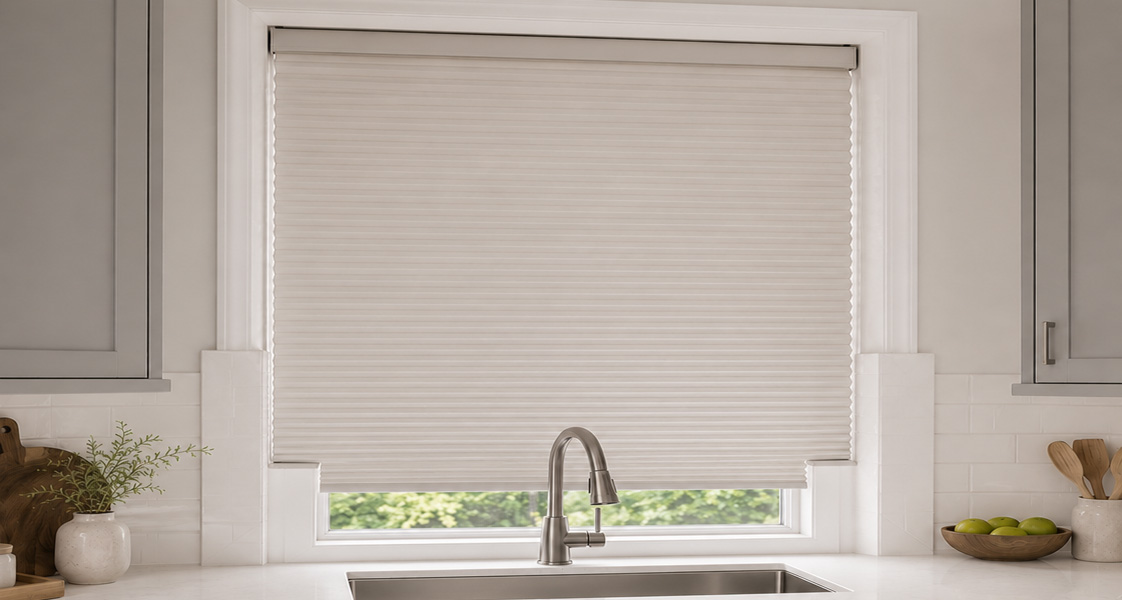
Tile, decorative molding or other trim at the bottom of a window can make an inside-mount blind or shade more difficult to measure. The top of the window opening may be wide enough for a normal shade, while the bottom becomes narrower where the tile or molding projects into the opening.
There are generally two ways to handle this situation. You can order the entire blind or shade to fit the narrowest part of the window, or, on select products, you may be able to order a tile or molding cutout so the lower portion of the treatment is narrower while the upper portion remains wider.
Neither solution is right for every window. Measuring to the narrowest point is simpler and is available on more products, but it can create larger light gaps along the upper portion of the shade. A cutout can provide a tighter overall fit, but it is only available on certain products and may require an additional fee.
This guide explains how to measure both options and how to decide which approach makes the most sense for your window. Explore our collection of custom blinds and window shades
How Do You Measure Blinds When Tile or Molding Narrows the Bottom of the Window?
First, measure the inside width of the window at the top, middle and bottom. If tile or molding projects into the opening, the bottom measurement may be noticeably narrower than the rest of the window.
The simplest option is to use the narrowest width when ordering the shade. This allows the complete treatment to pass between the tile or molding, but the upper portion of the shade will also be made to that narrower width.
On products that offer a tile or molding cutout, you may instead be able to order the upper portion of the treatment to fit the wider opening while having only the lower portion narrowed to clear the obstruction. Please contact us to see if your product offers this option.
| Option | How It Works | Advantage | Tradeoff |
|---|---|---|---|
| Use the Narrowest Measurement | The entire blind or shade is ordered to fit the narrowest part of the opening | Simple and available on most products | Creates larger side gaps where the window is wider |
| Tile or Molding Cutout | The upper treatment remains wider while the lower section is narrowed around the obstruction | Tighter fit through most of the window | Only available on select products and may have an additional fee |
Learn more about how to properly measure for window blinds and shades
Why Tile or Molding Changes the Measurement
Inside-mount blinds and shades need enough clearance to move freely within the window opening. When tile, molding or trim extends into the opening near the bottom, the treatment can no longer use the full width available at the top.
This situation is especially common in kitchens and bathrooms where tile surrounds a window, but it can also occur with decorative wood molding, stone, backsplash material or other architectural trim.
Example
Imagine that the inside width of the window measures 36 inches at the top and middle, but decorative tile reduces the opening to 34 1/2 inches near the bottom. A standard shade made for the 36-inch opening could hit the tile as it lowers.
If the shade does not have a cutout option, you would typically need to order based on the narrower 34 1/2-inch measurement, following the measuring instructions for the specific product.
Step 1: Measure the Window at the Top, Middle and Bottom
Use a steel measuring tape and measure the inside width of the window opening in at least three places: near the top, through the middle and at the narrowest area near the bottom.
Record all three measurements rather than assuming the window is the same width throughout.
| Measurement Location | Example Width |
|---|---|
| Top | 36 inches |
| Middle | 36 inches |
| Bottom at Tile | 34 1/2 inches |
The difference between these measurements tells you how much the tile or molding projects into the opening.
Option 1: Order the Entire Blind or Shade to the Narrowest Width
The simplest way to deal with tile or molding at the bottom of a window is to size the entire blind or shade so it fits through the narrowest part of the opening.
Using the example above, if the window is 36 inches wide at the top but only 34 1/2 inches wide at the tile, the treatment would need to be sized according to the narrower opening, subject to the measuring and factory-deduction instructions for the specific product.
Advantages of Using the Narrowest Measurement
- Simple measuring process.
- Available with most inside-mount blinds and shades.
- No special cutout fabrication is required.
- Usually avoids an additional customization fee.
- Ensures the treatment can clear the tile or molding.
The Tradeoff: Larger Light Gaps
The disadvantage is that the entire shade becomes narrower even though only the bottom of the window requires the additional clearance.
If the opening is 36 inches wide at the top but the shade must be sized to approximately 34 1/2 inches because of the tile, the difference will create additional space along the sides of the shade through the wider portion of the window.
This can make the headrail look less tightly fitted to the opening and may increase visible light gaps, particularly with room-darkening or blackout shades.
Option 2: Order a Tile or Molding Cutout
Some custom blinds and shades can be manufactured with a special cutout designed to clear tile, molding or another obstruction near the bottom of the window.
With this type of configuration, the upper portion of the treatment can remain wider and fit more closely to the main window opening, while only the lower section is narrowed where it needs to pass the tile or molding.
How a Tile Cutout Works
The treatment is manufactured so the section that meets the obstruction is narrower than the portion above it. This allows the shade to travel through the restricted lower area without forcing the entire treatment to be made to the smaller width.
Advantages of a Tile or Molding Cutout
- Allows a tighter fit through the wider portion of the window.
- Can reduce unnecessary side light gaps near the top and middle of the shade.
- Helps the headrail fit more closely to the full window opening.
- Can create a more custom, built-in appearance.
Limitations of a Cutout
- Cutouts are not available on every blind or shade.
- Availability can vary by manufacturer and product.
- There may be an additional fabrication fee.
- Additional measurements are required.
- Minimum and maximum cutout dimensions may apply.
If you are interested in a tile or molding cutout, verify that the specific treatment you are considering offers the option before taking your final measurements.
How to Measure for a Tile or Molding Cutout
A cutout requires more information than a standard inside-mount measurement because the manufacturer needs to know both the normal width of the shade and where the obstruction begins.
Measure the Main Window Width
Measure the inside width of the window above the tile or molding according to the instructions for the particular product.
Measure the Narrow Width
Measure the width between the inside edges of the tile, molding or other obstruction at the narrowest point.
Measure Where the Cutout Begins
Measure the vertical distance from the bottom of the window opening to the top of the tile or molding. This tells the manufacturer how high the narrower portion of the treatment needs to extend.
Measure Both Sides if Necessary
If the tile or molding projects into the opening by different amounts on the left and right sides, measure each side independently rather than assuming they are symmetrical.
Exact cutout measuring requirements vary by product, so use the instructions for the specific blind or shade you are ordering before submitting the final dimensions.
Tile Cutout Measuring Example
Suppose the window measures 36 inches wide through most of the opening, but tile extends into the bottom 8 inches and reduces the available width to 34 1/2 inches.
| Measurement | Example |
|---|---|
| Main Window Width | 36 inches |
| Width Between Tile | 34 1/2 inches |
| Height of Tile From Bottom | 8 inches |
| Difference in Width | 1 1/2 inches total |
Instead of making the entire treatment narrow enough for the 34 1/2-inch opening, a compatible product could potentially be manufactured so the upper portion fits the wider opening while the bottom section is narrowed to clear the tile.
This example is for illustration only. The exact measurements you submit and the amount of any factory deductions depend on the product and manufacturer.
How Much Do Tile and Molding Affect Light Gaps?
The biggest performance difference between the two measuring approaches is usually the amount of space along the sides of the treatment.
When the complete shade is sized to the narrowest opening, the shade is also narrower through the top and middle of the window where the tile is not present. This creates larger side gaps than you would normally have with a more closely fitted inside mount.
Why This Matters for Blackout Shades
A blackout fabric can prevent light from passing directly through the material, but it cannot stop light from entering through gaps along the sides.
If room darkening is an important priority, a tile cutout may be worth considering on a compatible product because it can allow the upper portion of the shade to fit more closely to the window opening.
Even with a cutout, however, no standard inside-mounted treatment should be expected to eliminate every trace of edge light.
How Tile Affects the Fit of the Headrail
Another reason to consider a cutout is the appearance of the headrail at the top of the window.
If you size the complete treatment to the narrowest dimension at the bottom, the headrail also has to be narrow enough to match that treatment. This can leave a noticeably larger gap between the ends of the headrail and the sides of the window opening.
With an available cutout configuration, the upper portion and headrail may be able to fit more closely to the wider portion of the opening while only the lower section is modified to clear the tile.
This difference can be particularly noticeable on windows where the tile projects substantially into the opening.
Explore more: How to Measure between Cabinets for Blinds
Should You Use the Narrowest Measurement or Order a Cutout?
| Your Priority | Option to Consider | Why |
|---|---|---|
| Simplest Order | Narrowest Measurement | Requires no special fabrication |
| Lowest Cost | Narrowest Measurement | Avoids a potential cutout fee |
| Tighter Overall Fit | Tile or Molding Cutout | Keeps the upper portion of the treatment wider |
| Reduced Side Light Gaps | Tile or Molding Cutout | Can reduce unnecessary gaps above the obstruction |
| Better Headrail Fit | Tile or Molding Cutout | May allow the headrail to fit more closely to the main opening |
| Product Does Not Offer Cutouts | Narrowest Measurement | The entire treatment must clear the obstruction |
If the difference between the main opening and the narrow area is very small, ordering to the narrowest width may be perfectly reasonable. If the tile projects significantly into the opening and privacy, blackout performance or a tight finished appearance is important, a cutout may provide a better result when the product offers one.
Another Option: Consider an Outside Mount
If the tile or molding makes an inside mount especially difficult, an outside-mounted blind or shade may provide another solution.
An outside mount is installed over and around the window opening rather than inside it. Because the treatment does not need to pass between the tile or molding, the obstruction may no longer affect the shade width.
An Outside Mount May Be Worth Considering When
- The tile significantly narrows the inside opening.
- The product you want does not offer a cutout.
- You want greater overlap for room darkening.
- The larger inside-mount side gaps would be objectionable.
- There is sufficient wall or trim surface around the window for mounting.
An outside mount creates a different appearance, so compare the finished look and available mounting surface before deciding.
Which Blinds and Shades Can Have Tile Cutouts?
Tile and molding cutout availability varies by product and manufacturer. Some custom shades can be specially fabricated around lower window obstructions, while other products must remain the same width from top to bottom. Typical products include faux wood blinds, wood blinds, mini blinds or cellular shades, although others may also have the option.
The feasibility of a cutout can depend on the treatment's construction, bottom rail, operating system and internal components.
Before assuming a cutout is available, check the options for the exact blind or shade you want to order or contact Blinds Chalet for assistance.
Common Measuring Mistakes With Tile or Molding
Measuring Only at the Top
If you measure only the wider upper portion of the opening, the shade may be too wide to travel past the tile or molding at the bottom.
Assuming the Window Is Symmetrical
Tile and trim are not always installed evenly. Measure both sides and the full width rather than assuming the projection is identical.
Ignoring the Light-Gap Tradeoff
A treatment ordered to the narrowest width may fit correctly but leave larger gaps through the rest of the opening. Consider whether privacy or room darkening makes those gaps important.
Assuming Every Product Offers a Cutout
A tile or molding cutout is a specialty fabrication option and is only available on certain products.
Making Your Own Factory Deductions
Follow the measuring instructions for the specific treatment. Do not automatically subtract additional width unless the product instructions tell you to do so, because manufacturers may make their own required deductions for inside mounts.
Ordering Before Confirming the Cutout
If you need a specialty cutout, verify availability, measurements and any additional fee before placing the order.
Tile and Molding Measuring Checklist
- Measure the width at the top: Record the normal inside opening width.
- Measure the width at the middle: Check for changes in the window opening.
- Measure at the tile or molding: Record the narrowest available width.
- Measure both sides: Determine whether the obstruction projects equally from the left and right.
- Measure the obstruction height: If considering a cutout, determine how far upward the tile or molding extends.
- Compare the widths: Determine how much narrower the bottom opening is.
- Decide whether larger side gaps are acceptable: This helps determine whether simply using the narrowest width makes sense.
- Check cutout availability: Verify that the specific blind or shade offers a tile or molding cutout.
- Consider the additional cost: Specialty cutouts may require an additional fabrication fee.
- Consider outside mount: This may be a better alternative when inside-mount clearance is too restrictive.
- Follow product-specific instructions: Factory deductions and cutout requirements vary by treatment.
Not Sure Which Measurement to Use? We Can Help
If tile or molding changes the width of your window and you are unsure whether to order using the narrowest measurement or request a special cutout, contact us before placing your order.
Measure the opening at the top, middle and bottom and note how high the tile or molding extends into the window. If possible, also take a photo showing the entire opening and the obstruction.
Our window treatment team can help you determine whether the product you are considering can accommodate a cutout and explain the measuring information needed for the order.
This can be especially useful when the difference between the upper and lower widths is significant or when blackout performance, privacy or a tight headrail fit is important.
Expert Guidance from Blinds Chalet
Blinds Chalet has helped homeowners measure and order custom window treatments since 2006. Windows with tile or molding at the bottom are a good example of why measuring only the top of an opening is not enough.
When we help customers with these windows, the first decision is usually whether they are comfortable making the entire treatment narrow enough to clear the obstruction. That is the simplest solution, but it can create noticeably larger light gaps and a looser-looking headrail fit through the wider portion of the opening.
When the selected product offers a tile or molding cutout, that can provide a more tailored solution because only the section that actually encounters the obstruction needs to be narrower. The rest of the treatment can remain closer to the width of the main window opening.
Cutout availability, required dimensions and fees vary by product and manufacturer, so we recommend confirming the option before placing the order. If you are unsure, provide us with the top, middle and bottom widths along with the height of the obstruction and we can help you work through the available options.
Explore more:
How to Measure for Window Treatments
How to Measure for Window Blinds for French Doors
How to Measure for Blinds in Corner Windows
How to Measure Bay Windows for Window Treatments
How to Measure Sliding Doors for Window Blinds
How to Measure for RV Windshield Shades for Blinds
Measuring Blinds Around Tile and Molding FAQs
How do I measure blinds when tile narrows the bottom of the window?
Measure the inside width at the top, middle and bottom of the window. If you are ordering a standard treatment without a cutout, you generally need to account for the narrowest part of the opening so the blind or shade can clear the tile. Follow the measuring instructions for the specific product before submitting your order.
What is a tile cutout on a window shade?
A tile cutout is a specialty fabrication option available on some custom blinds and shades. The lower portion of the treatment is made narrower to clear tile, molding or another obstruction while the upper portion remains wider to fit the main window opening more closely.
Is it better to use the narrowest measurement or order a tile cutout?
Using the narrowest measurement is simpler and works with more products, but it makes the entire treatment narrower and can create larger side gaps. A tile cutout can provide a tighter overall fit when available, although it may require additional measurements and an extra fabrication fee.
Will using the narrowest window measurement create larger light gaps?
Yes. If only the bottom of the window is narrow but the entire shade is ordered to that smaller width, there will be additional space along the sides through the wider upper portion of the opening. This can make light gaps more noticeable.
Does a tile cutout reduce light gaps?
A tile cutout can reduce unnecessary side gaps through the upper portion of the window because that part of the treatment can remain wider. Some operating clearance will still be required, and the exact fit depends on the product and installation.
Do all blinds and shades offer tile cutouts?
No. Tile and molding cutouts are specialty options available only on certain products and from certain manufacturers. Availability can also depend on the dimensions, control system and construction of the treatment.
Does a tile cutout cost extra?
A tile or molding cutout may require an additional fabrication fee. The cost and availability depend on the specific blind or shade, so confirm the option before placing your order.
What measurements are needed for a tile cutout?
Typical measurements include the main window width, the narrower width between the tile or molding, and the height from the bottom of the opening to where the obstruction ends. Some products may also require separate left- and right-side measurements.
Can I outside mount a shade instead of using a tile cutout?
Yes. An outside mount may avoid the tile or molding obstruction entirely because the treatment is installed over the window opening rather than inside it. This can be a good alternative when a cutout is unavailable or when larger inside-mount light gaps would be undesirable.
Can Blinds Chalet help me measure a window with tile or molding?
Yes. Measure the width at the top, middle and bottom of the opening and note how high the tile or molding extends. Blinds Chalet can help you determine whether using the narrowest measurement, ordering an available cutout or choosing an outside mount is the better approach for the product you are considering.