







Measuring blinds or shades for two windows that meet in a corner requires a little more planning than measuring a standard window. If both treatments are made to extend all the way into the same corner, the headrails, rollers or shade fabric can interfere with each other.
The solution commonly used in the window covering industry is called a butt-and-bypass installation. One blind or shade extends into the corner while the second treatment stops short and meets, or "butts," against it.
You can calculate the required corner clearance yourself, or you can simply provide Blinds Chalet with the full measurements for each side and tell us which treatment you want to butt and which you want to bypass. Our window treatment team can help you work through the corner configuration before you order.
This guide explains both methods so you can choose whichever approach you are most comfortable using.
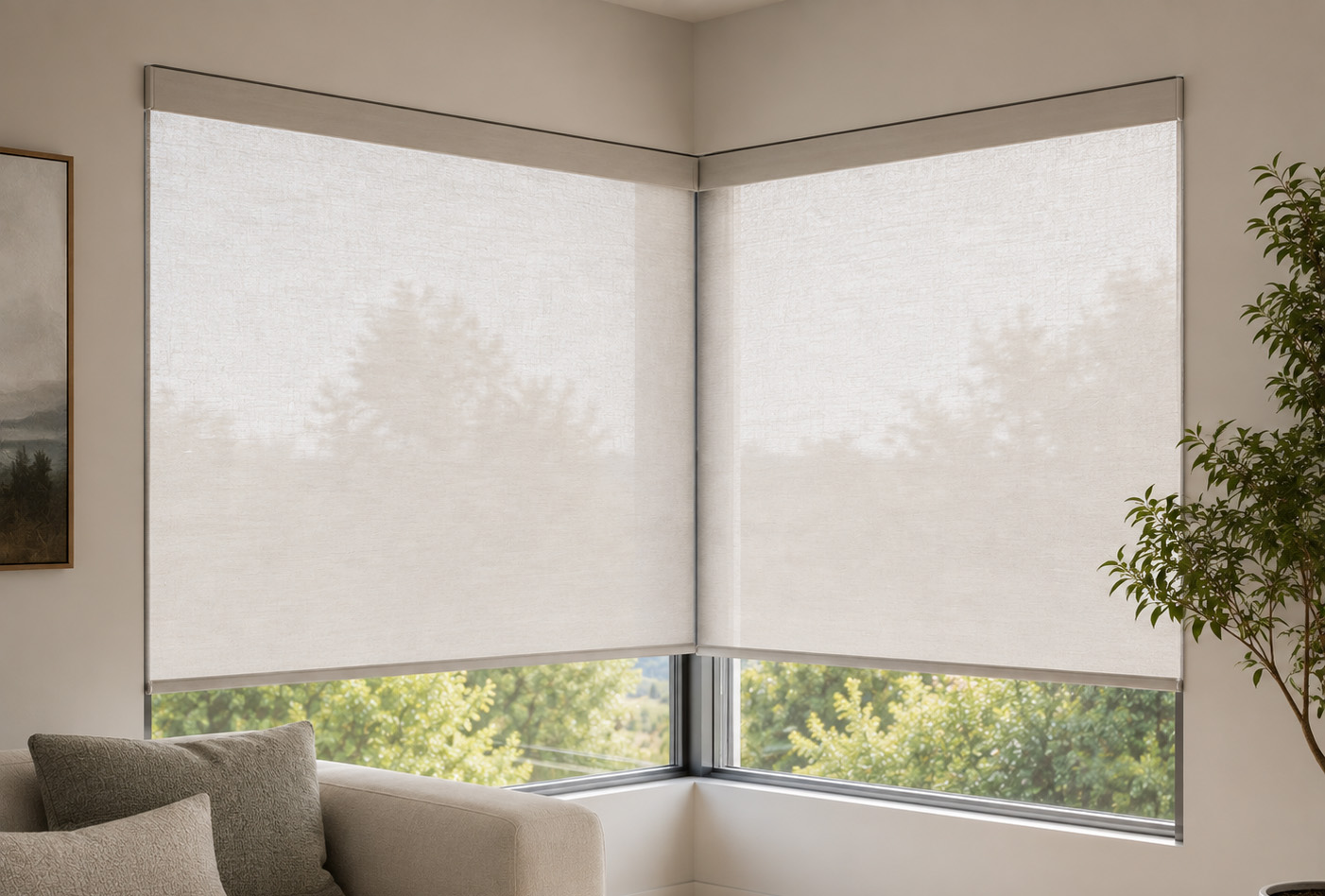
How Do You Measure Blinds for Corner Windows?
Start by measuring each window separately from the inside corner to the outside point where you want that blind or shade to end. Next, decide which treatment will extend into the corner, called the bypass, and which treatment will stop alongside it, called the butt.
If you are calculating the finished measurements yourself, the butt treatment generally needs to be shortened to account for the depth or projection of the bypass treatment. If you would rather have us help calculate that clearance, give us the full corner-to-edge measurements without making your own deduction.
| Measurement | What to Measure | Important Detail |
|---|---|---|
| Bypass Side | Inside corner to the outside edge of desired coverage | This treatment extends into the corner |
| Butt Side | Inside corner to the outside edge of desired coverage | This treatment stops alongside the bypass treatment |
| Projection | Distance the treatment projects away from the mounting surface | Important when molding, spacers or hardware move the treatment away from the wall |
| DIY Butt Deduction | Account for the space occupied by the bypass treatment | Exact clearance varies by product and hardware |
What Is a Butt-and-Bypass Corner Blind Installation?
"Butt and bypass" is the window covering industry term for arranging two separate blinds or shades where two windows meet at a corner.
What Is the Bypass Blind or Shade?
The bypass treatment is the blind or shade that extends farther into the corner. It creates the continuous line through the corner that the other treatment must clear.
What Is the Butt Blind or Shade?
The butt treatment approaches the corner from the other direction and stops short enough to meet the side of the bypass treatment without the two units colliding.
The result is two independently operating blinds or shades that visually meet at the corner while still having enough clearance to raise, lower or operate properly.
Which Blind Should Be the Butt and Which Should Be the Bypass?
Either window can usually be designated as the butt or bypass side, depending on the product and installation. Before ordering, think about which direction will create the cleanest appearance and easiest operation.
In many installations, it makes sense for the treatment on the more prominent window to continue into the corner as the bypass treatment. The other treatment then butts against it.
Things to Consider When Choosing Butt vs. Bypass
- Which window is more visible from the room.
- Which direction provides the cleanest visual line through the corner.
- Where the lift, tilt, chain or other controls will be located.
- Whether furniture or other objects affect access to the treatment.
- The depth of each blind or shade.
- Whether one treatment has a cassette, fascia or deeper headrail.
When possible, placing controls toward the outside ends of the two windows rather than directly next to each other in the corner can also make the treatments easier to operate.
How to Measure Corner Window Blinds Step by Step
Step 1: Decide Where Each Treatment Will End
Before taking measurements, determine how much of each window you want the blind or shade to cover. Look at the mounting surface, trim and surrounding wall and decide where the outside edge of each treatment should end.
Step 2: Measure the Bypass Window
Measure from the inside corner along the mounting surface to the outside point where you want the bypass blind or shade to end.
Record the full measurement. Do not automatically subtract anything from this measurement simply because the window is in a corner.
Step 3: Measure the Butt Window
Measure from the same inside corner along the second mounting surface to the outside point where you want the butt blind or shade to end.
Again, record the full corner-to-edge measurement before making any deduction.
Step 4: Determine Whether You Need a Projection Measurement
If both treatments mount directly to a flat wall or molding, the mounting surface itself may provide the reference point you need. If raised trim, spacer brackets or another obstruction moves the blind or shade away from the wall, you should also determine the treatment's projection.
Step 5: Decide Whether You Will Calculate the Deduction Yourself
If you know the depth and projection of the treatment you are ordering, you can calculate the approximate clearance needed for the butt unit. If you prefer, you can stop after recording the full measurements and let Blinds Chalet help you determine the proper corner configuration.
What Is Projection When Measuring Corner Window Blinds?
Projection is the distance the blind or shade sits away from the mounting surface. It becomes especially important when molding, trim or other obstructions require the mounting brackets to be spaced away from the wall.
For example, raised window molding may require spacer brackets behind the blind. Those spacers move the treatment farther into the room, which changes where the two treatments intersect at the corner.
Measure Projection When
- The shade must clear raised window molding.
- Spacer brackets or shims will be used.
- The blind or shade mounts above projecting trim.
- A cassette, valance or headrail sits significantly away from the wall.
- Another architectural obstruction affects the mounting position.
When both corner treatments use projection measurements, the mounting positions should be evaluated together so the correct corner clearance can be calculated.
How to Calculate Butt-and-Bypass Measurements Yourself
If you are comfortable calculating the corner clearance yourself, start with the full measurement of each window from the inside corner to the outside edge of desired coverage.
The bypass treatment generally uses the full corner-to-edge measurement. The butt treatment must then stop short enough to clear the depth or projection of the treatment extending into the corner.
| Treatment | Basic Calculation |
|---|---|
| Bypass Treatment | Full inside-corner-to-outside-edge measurement |
| Butt Treatment | Full inside-corner-to-outside-edge measurement minus the required corner clearance |
Basic formula: Butt treatment measurement = full butt-side measurement - required corner clearance.
Corner Measurement Example
Suppose your bypass-side window measures 72 inches from the inside corner to the outside edge of the desired coverage. The butt-side window measures 60 inches from the corner to its desired outside edge.
If the particular bypass treatment requires approximately 3 inches of clearance at the corner, the approximate finished butt-side measurement would be 57 inches.
| Measurement | Example |
|---|---|
| Full Bypass Measurement | 72 inches |
| Full Butt Measurement | 60 inches |
| Required Corner Clearance | 3 inches |
| Approximate Finished Butt Measurement | 57 inches |
Important: The 3-inch clearance in this example is only an example. Do not assume that every blind or shade requires a 3-inch deduction. The correct amount depends on the depth and construction of the specific product you are ordering.
Why the Corner Deduction Varies by Blind or Shade
There is not one universal corner deduction that works for every type of window treatment. The amount of space required at the corner depends on the physical dimensions of the product.
A shallow cellular shade may require a different amount of clearance than a 2-inch faux wood blind. A roller shade with an open roll can have different dimensions than the same type of shade with a cassette or fascia.
Product Details That Can Change the Corner Clearance
- Headrail depth.
- Roller tube and bracket projection.
- Cassette or fascia depth.
- Valance projection.
- Slat size.
- Shade fabric position.
- Spacer brackets.
- Raised molding.
- Control hardware.
For this reason, determine the actual specifications of the blinds or shades you plan to order before making your own final corner deduction.
Don't Want to Calculate the Corner Deduction? We Can Help
You do not have to figure out the butt-and-bypass calculation by yourself. If you are unsure how much to deduct, take the full measurements and let the Blinds Chalet window treatment team help you work through the setup.
Measure each side from the inside corner to the outside point where you want that treatment to end. Do not make your own corner deduction if you want us to help calculate it.
Give Us These Measurements
- The full measurement from the corner to the desired outside edge of the left window treatment.
- The full measurement from the corner to the desired outside edge of the right window treatment.
- Which treatment you want to be the butt.
- Which treatment you want to be the bypass.
- The type of blind or shade you plan to order.
- Whether there is raised molding, trim or another obstruction.
- The projection measurement when applicable.
With this information, we can help you understand how the treatments should be configured and walk you through the ordering measurements.
Do not make both your own deduction and a manufacturer deduction. If Blinds Chalet or the manufacturer will be determining the corner clearance, provide the requested full measurements rather than shortening the treatment a second time.
How to Measure Roller Shades for Corner Windows
Roller shades are a popular choice for corner windows because their simple design works well in contemporary spaces, but you need to consider more than just the width of the fabric.
The roller tube, brackets, cassette or fascia may extend beyond or project farther than the shade fabric. The hardware dimensions are therefore important when calculating how two roller shades will meet at the corner.
Open Roll Roller Shades
With an open roll, pay attention to the roller tube, brackets and the direction the fabric leaves the roller. These components determine how close the two units can be positioned without interfering with one another.
Roller Shades With a Cassette or Fascia
A cassette or fascia can increase the depth and overall dimensions of the shade hardware. Use the dimensions of the complete system rather than assuming the fabric measurement alone determines the required corner clearance.
You can browse our custom roller shades to compare available styles and hardware options.
How to Measure Cellular Shades for Corner Windows
Cellular or Honeycomb shades generally have a relatively compact profile, which can make them a good option for corner windows. The same butt-and-bypass principle still applies.
Measure both sides from the corner to the desired outside edge and determine which treatment will extend into the corner. Then account for the depth of the bypass treatment when determining where the butt treatment needs to stop.
If the shades are mounted away from the wall because of molding or spacer brackets, include that projection when evaluating the corner.
How to Measure Wood and Faux Wood Blinds for Corner Windows
Horizontal blinds typically have deeper headrails than many fabric shades, so corner clearance deserves particular attention.
The slats also project from the headrail when tilted. Make sure the two treatments have enough clearance not only when closed but also while the slats are being tilted.
Two-inch and larger slats can require more space at the corner than a shallow shade, which is another reason not to use one standard deduction for every product.
Browse our window blinds to compare blind styles and options.
Inside Mount vs. Outside Mount Corner Window Blinds
Corner windows can use inside or outside mounted blinds and shades depending on the window construction and the specific product.
Inside Mount Corner Blinds
With an inside mount, each treatment is installed within its respective window opening. You still need to determine whether the headrails, fabric or operating hardware will interfere where the two openings meet. When ordering inside mount the factory will take proper deductions for the blinds or shades to fit within the size you specify.
Outside Mount Corner Blinds
Outside mounts attach to the wall, molding or another surface surrounding the window. Measure along the actual mounting surface from the corner to the point where you want each treatment to end. When ordering outside mount the blind or shade comes the size you specify.
If the treatment must be projected away from the surface to clear molding or trim, measure that projection as well.
Will There Be a Gap Between Corner Window Blinds?
A properly planned butt-and-bypass installation allows the treatments to meet closely at the corner, but some clearance is necessary for the blinds or shades to operate without interfering with each other.
The amount of visible gap depends on the product, headrail depth, fabric position and mounting configuration. Roller shades may also have fabric that is narrower than the overall hardware width, which can affect the appearance of the corner.
If blackout or maximum privacy is your primary goal, discuss the expected corner gap before ordering so you understand how the selected treatment will perform.
Where Should the Controls Go on Corner Window Blinds?
When control locations can be selected, it is generally helpful to position them toward the outside ends of the corner-window installation rather than clustering both controls near the inside corner.
This can make the treatments easier to reach and helps reduce congestion where the two blinds or shades meet.
Available control locations vary by product, so check the options for the exact treatment you are ordering.
How Valances and Valance Returns Work on Corner Window Blinds
If your corner window blinds include a decorative valance, the valance also needs to be planned for the butt-and-bypass junction. A standard valance may include returns on the ends, but those returns can interfere where the two blinds meet in the corner.
Let Us Know You Are Ordering for a Corner Window
When placing your order, let Blinds Chalet know that the blinds are being installed on a corner window and identify which treatment will be the butt and which will be the bypass. This allows us to account for the way the valances need to meet at the junction.
Valance Returns at the Corner May Need to Be Removed
At the inside corner where the two treatments meet, the standard valance returns should generally be removed so they do not overlap or interfere with each other.
The outside ends of the valances can still use returns where appropriate, but the ends that meet at the corner junction need to be configured differently.
Mitered Valances Create a Cleaner Corner
For a more finished appearance, the valances can be mitered so the two pieces meet neatly at the corner rather than ending with standard square returns.
This creates a more continuous, built-in look across the two corner windows and helps the valance follow the same butt-and-bypass layout as the blinds themselves.
Important: Be sure to tell us before the order is placed that the treatments are for a corner-window installation. We can then help make sure the inside valance returns are removed and the valances are configured to meet properly at the corner.
Common Mistakes When Measuring Blinds for Corner Windows
Making the Same Deduction on Both Treatments
A butt-and-bypass configuration is intentionally asymmetrical. One treatment extends into the corner while the other stops short. Automatically subtracting the same amount from both sides can create a larger and unnecessary corner gap.
Using a Generic Deduction for Every Product
The required clearance depends on the actual blind or shade. Do not assume a deduction used for one cellular shade, roller shade or wood blind will work for another.
Measuring the Glass Instead of the Mounting Surface
For many outside-mounted applications, you need to measure along the surface where the treatment will actually be installed, from the inside corner to the desired outside edge.
Ignoring Projection
Raised molding, spacer brackets and other obstructions can move the treatment farther away from the wall and change where the two units intersect.
Forgetting the Headrail or Cassette
The fabric itself may fit perfectly while the headrails or cassettes collide. Consider the dimensions of the complete treatment.
Deducting Twice
If you make your own corner deduction and then order a product where the manufacturer also makes an appropriate butt-and-bypass deduction, the resulting treatment may be too narrow. Know whether you are providing full measurements or finished calculated measurements before placing the order.
Not Identifying Butt and Bypass
Simply providing two widths does not communicate how you want the treatments to meet. Clearly identify which side should butt and which should bypass.
Corner Window Measuring Checklist
- Choose your blinds or shades: Product depth affects the required corner clearance.
- Determine the mounting surface: Decide whether the treatments will mount inside the openings or on the wall, trim or molding.
- Measure the first side: Measure from the inside corner to the outside edge of desired coverage.
- Measure the second side: Repeat the same measurement for the other window.
- Choose the bypass treatment: Decide which blind or shade should extend into the corner.
- Choose the butt treatment: Identify which treatment should stop alongside the bypass unit.
- Measure projection if necessary: Account for molding, spacers and other obstructions.
- Check hardware depth: Review headrail, roller, cassette and bracket dimensions.
- Choose your measurement method: Either calculate the required butt deduction yourself or provide the full measurements and let us help.
- Avoid double deductions: Do not make an additional deduction if Blinds Chalet or the manufacturer will be calculating it for you.
- Review control locations: Position controls away from the inside corner when the product allows.
- Verify the measurements before ordering: Recheck both corner-to-edge dimensions and the butt-and-bypass orientation.
Expert Guidance from Blinds Chalet
Blinds Chalet has helped homeowners measure and order custom window treatments since 2006. Corner windows are one of the applications where understanding the actual construction of the blind or shade is just as important as measuring the window itself.
The key is recognizing that the two treatments cannot occupy the same space in the corner. A butt-and-bypass configuration solves that problem by allowing one treatment to continue into the corner while the other stops alongside it.
If you are comfortable with the product specifications, you can calculate the corner clearance yourself. If you are not, there is no reason to guess. Measure each window from the inside corner to the outside point where you want the treatment to end, tell us which unit you want to butt and which you want to bypass, and provide any applicable projection measurement. Our team can help you work through the ordering configuration.
Exact deductions, hardware clearances and control requirements vary by product and manufacturer, so always use the measuring specifications for the particular blind or shade you are ordering rather than applying a universal corner deduction.
Explore more:
How to Measure for Blinds & Shades
How to Measure for Blinds & Shades for French Doors
How to Measure Blinds or Shades with Tile or Molding
How to Measure Window Treatments for Bay Windows
How to Measure Sliding Doors for Window Blinds
How to Measure for Top Angled Windows
How to Measure for Window Treatments Between Cabinets
How to Measure for RV Windshield Shades for Blinds
Corner Window Blinds and Shades FAQs
How do you measure blinds for corner windows?
Measure each window from the inside corner to the outside point where you want that blind or shade to end. Then determine which treatment will extend into the corner as the bypass and which treatment will stop alongside it as the butt. You can calculate the required corner clearance yourself or provide the full measurements and ask Blinds Chalet for help with the configuration.
What does butt and bypass mean for corner window blinds?
Butt and bypass describes how two separate blinds or shades meet at a corner. The bypass treatment extends farther into the corner, while the butt treatment stops short and meets the side of the bypass treatment so the two units do not interfere with each other.
Which corner blind should be the butt and which should be the bypass?
Either side may be able to serve as the butt or bypass depending on the product and installation. Consider which window is more prominent, the location of the controls, product depth and which direction creates the cleanest appearance through the corner.
Do I need to make a deduction when measuring corner window blinds?
The butt treatment generally needs enough clearance to stop alongside the bypass treatment. You can calculate that clearance yourself using the dimensions of the specific product, or you can provide Blinds Chalet with the full corner-to-edge measurements and let us help you determine the appropriate configuration.
What is the formula for measuring butt-and-bypass blinds?
A basic approach is to use the full corner-to-edge measurement for the bypass treatment and subtract the required corner clearance from the full measurement of the butt treatment. The exact clearance depends on the headrail, roller, cassette, brackets and mounting projection of the specific product.
Can Blinds Chalet help calculate my corner window measurements?
Yes. Measure each side from the inside corner to the outside point where you want the treatment to end and tell us which treatment you want to be the butt and which you want to be the bypass. Also provide information about raised molding or projection when applicable, and our window treatment team can help you work through the ordering configuration.
What is projection when measuring corner window shades?
Projection is the distance the blind or shade sits away from the mounting surface. Raised molding, spacer brackets, cassettes and other obstructions can increase projection and change the amount of clearance needed where the two treatments meet.
Can roller shades be used on corner windows?
Yes. Roller shades can work well on corner windows, but the roller tube, brackets, cassette or fascia and the position of the fabric should be considered when determining the corner clearance. The hardware dimensions can be different from the width or position of the shade fabric itself.
Can cellular shades be installed on corner windows?
Yes. Cellular shades can be used on many corner windows and their relatively compact profile can make them a good choice. The two shades still need to be configured so one bypasses the corner and the other butts alongside it with sufficient operating clearance.
Will there be a gap between blinds on a corner window?
Some operating clearance is normally required where corner blinds or shades meet. The visible gap depends on the product, headrail depth, mounting position and fabric construction. A properly planned butt-and-bypass installation is designed to keep the treatments as close as practical while still allowing them to operate independently.
Should I deduct the corner clearance myself if the manufacturer makes deductions?
No. If Blinds Chalet or the manufacturer will calculate the appropriate corner deduction for the product, provide the requested full measurements and do not make an additional deduction yourself. Deducting twice can result in an unnecessarily large gap between the treatments.
headrails, rollers or shade fabric can interfere with each other.
The solution commonly used in the window covering industry is called a butt-and-bypass installation. One blind or shade extends into the corner while the second treatment stops short and meets, or "butts," against it.
You can calculate the required corner clearance yourself, or you can simply provide Blinds Chalet with the full measurements for each side and tell us which treatment you want to butt and which you want to bypass. Our window treatment team can help you work through the corner configuration before you order.
This guide explains both methods so you can choose whichever approach you are most comfortable using.
How Do You Measure Blinds for Corner Windows?
Start by measuring each window separately from the inside corner to the outside point where you want that blind or shade to end. Next, decide which treatment will extend into the corner, called the bypass, and which treatment will stop alongside it, called the butt.
If you are calculating the finished measurements yourself, the butt treatment generally needs to be shortened to account for the depth or projection of the bypass treatment. If you would rather have us help calculate that clearance, give us the full corner-to-edge measurements without making your own deduction.
| Measurement | What to Measure | Important Detail |
|---|---|---|
| Bypass Side | Inside corner to the outside edge of desired coverage | This treatment extends into the corner |
| Butt Side | Inside corner to the outside edge of desired coverage | This treatment stops alongside the bypass treatment |
| Projection | Distance the treatment projects away from the mounting surface | Important when molding, spacers or hardware move the treatment away from the wall |
| DIY Butt Deduction | Account for the space occupied by the bypass treatment | Exact clearance varies by product and hardware |
What Is a Butt-and-Bypass Corner Blind Installation?
"Butt and bypass" is the window covering industry term for arranging two separate blinds or shades where two windows meet at a corner.
What Is the Bypass Blind or Shade?
The bypass treatment is the blind or shade that extends farther into the corner. It creates the continuous line through the corner that the other treatment must clear.
What Is the Butt Blind or Shade?
The butt treatment approaches the corner from the other direction and stops short enough to meet the side of the bypass treatment without the two units colliding.
The result is two independently operating blinds or shades that visually meet at the corner while still having enough clearance to raise, lower or operate properly.
Which Blind Should Be the Butt and Which Should Be the Bypass?
Either window can usually be designated as the butt or bypass side, depending on the product and installation. Before ordering, think about which direction will create the cleanest appearance and easiest operation.
In many installations, it makes sense for the treatment on the more prominent window to continue into the corner as the bypass treatment. The other treatment then butts against it.
Things to Consider When Choosing Butt vs. Bypass
- Which window is more visible from the room.
- Which direction provides the cleanest visual line through the corner.
- Where the lift, tilt, chain or other controls will be located.
- Whether furniture or other objects affect access to the treatment.
- The depth of each blind or shade.
- Whether one treatment has a cassette, fascia or deeper headrail.
When possible, placing controls toward the outside ends of the two windows rather than directly next to each other in the corner can also make the treatments easier to operate.
How to Measure Corner Window Blinds Step by Step
Step 1: Decide Where Each Treatment Will End
Before taking measurements, determine how much of each window you want the blind or shade to cover. Look at the mounting surface, trim and surrounding wall and decide where the outside edge of each treatment should end.
Step 2: Measure the Bypass Window
Measure from the inside corner along the mounting surface to the outside point where you want the bypass blind or shade to end.
Record the full measurement. Do not automatically subtract anything from this measurement simply because the window is in a corner.
Step 3: Measure the Butt Window
Measure from the same inside corner along the second mounting surface to the outside point where you want the butt blind or shade to end.
Again, record the full corner-to-edge measurement before making any deduction.
Step 4: Determine Whether You Need a Projection Measurement
If both treatments mount directly to a flat wall or molding, the mounting surface itself may provide the reference point you need. If raised trim, spacer brackets or another obstruction moves the blind or shade away from the wall, you should also determine the treatment's projection.
Step 5: Decide Whether You Will Calculate the Deduction Yourself
If you know the depth and projection of the treatment you are ordering, you can calculate the approximate clearance needed for the butt unit. If you prefer, you can stop after recording the full measurements and let Blinds Chalet help you determine the proper corner configuration.
What Is Projection When Measuring Corner Window Blinds?
Projection is the distance the blind or shade sits away from the mounting surface. It becomes especially important when molding, trim or other obstructions require the mounting brackets to be spaced away from the wall.
For example, raised window molding may require spacer brackets behind the blind. Those spacers move the treatment farther into the room, which changes where the two treatments intersect at the corner.
Measure Projection When
- The shade must clear raised window molding.
- Spacer brackets or shims will be used.
- The blind or shade mounts above projecting trim.
- A cassette, valance or headrail sits significantly away from the wall.
- Another architectural obstruction affects the mounting position.
When both corner treatments use projection measurements, the mounting positions should be evaluated together so the correct corner clearance can be calculated.
How to Calculate Butt-and-Bypass Measurements Yourself
If you are comfortable calculating the corner clearance yourself, start with the full measurement of each window from the inside corner to the outside edge of desired coverage.
The bypass treatment generally uses the full corner-to-edge measurement. The butt treatment must then stop short enough to clear the depth or projection of the treatment extending into the corner.
| Treatment | Basic Calculation |
|---|---|
| Bypass Treatment | Full inside-corner-to-outside-edge measurement |
| Butt Treatment | Full inside-corner-to-outside-edge measurement minus the required corner clearance |
Basic formula: Butt treatment measurement = full butt-side measurement - required corner clearance.
Corner Measurement Example
Suppose your bypass-side window measures 72 inches from the inside corner to the outside edge of the desired coverage. The butt-side window measures 60 inches from the corner to its desired outside edge.
If the particular bypass treatment requires approximately 3 inches of clearance at the corner, the approximate finished butt-side measurement would be 57 inches.
| Measurement | Example |
|---|---|
| Full Bypass Measurement | 72 inches |
| Full Butt Measurement | 60 inches |
| Required Corner Clearance | 3 inches |
| Approximate Finished Butt Measurement | 57 inches |
Important: The 3-inch clearance in this example is only an example. Do not assume that every blind or shade requires a 3-inch deduction. The correct amount depends on the depth and construction of the specific product you are ordering.
Why the Corner Deduction Varies by Blind or Shade
There is not one universal corner deduction that works for every type of window treatment. The amount of space required at the corner depends on the physical dimensions of the product.
A shallow cellular shade may require a different amount of clearance than a 2-inch faux wood blind. A roller shade with an open roll can have different dimensions than the same type of shade with a cassette or fascia. Learn more about How to Measure Blinds for Shallow Mount Windows
Product Details That Can Change the Corner Clearance
- Headrail depth.
- Roller tube and bracket projection.
- Cassette or fascia depth.
- Valance projection.
- Slat size.
- Shade fabric position.
- Spacer brackets.
- Raised molding.
- Control hardware.
For this reason, determine the actual specifications of the blinds or shades you plan to order before making your own final corner deduction.
Don't Want to Calculate the Corner Deduction? We Can Help
You do not have to figure out the butt-and-bypass calculation by yourself. If you are unsure how much to deduct, take the full measurements and let the Blinds Chalet window treatment team help you work through the setup.
Measure each side from the inside corner to the outside point where you want that treatment to end. Do not make your own corner deduction if you want us to help calculate it.
Give Us These Measurements
- The full measurement from the corner to the desired outside edge of the left window treatment.
- The full measurement from the corner to the desired outside edge of the right window treatment.
- Which treatment you want to be the butt.
- Which treatment you want to be the bypass.
- The type of blind or shade you plan to order.
- Whether there is raised molding, trim or another obstruction.
- The projection measurement when applicable.
With this information, we can help you understand how the treatments should be configured and walk you through the ordering measurements.
Do not make both your own deduction and a manufacturer deduction. If Blinds Chalet or the manufacturer will be determining the corner clearance, provide the requested full measurements rather than shortening the treatment a second time.
How to Measure Roller Shades for Corner Windows
Roller shades are a popular choice for corner windows because their simple design works well in contemporary spaces, but you need to consider more than just the width of the fabric.
The roller tube, brackets, cassette or fascia may extend beyond or project farther than the shade fabric. The hardware dimensions are therefore important when calculating how two roller shades will meet at the corner.
Open Roll Roller Shades
With an open roll, pay attention to the roller tube, brackets and the direction the fabric leaves the roller. These components determine how close the two units can be positioned without interfering with one another.
Roller Shades With a Cassette or Fascia
A cassette or fascia can increase the depth and overall dimensions of the shade hardware. Use the dimensions of the complete system rather than assuming the fabric measurement alone determines the required corner clearance.
You can browse our custom roller shades to compare available styles and hardware options.
How to Measure Cellular Shades for Corner Windows
Cellular shades generally have a relatively compact profile, which can make them a good option for corner windows. The same butt-and-bypass principle still applies.
Measure both sides from the corner to the desired outside edge and determine which treatment will extend into the corner. Then account for the depth of the bypass treatment when determining where the butt treatment needs to stop.
If the shades are mounted away from the wall because of molding or spacer brackets, include that projection when evaluating the corner.
How to Measure Wood and Faux Wood Blinds for Corner Windows
Horizontal blinds typically have deeper headrails than many fabric shades, so corner clearance deserves particular attention.
The slats also project from the headrail when tilted. Make sure the two treatments have enough clearance not only when closed but also while the slats are being tilted.
Two-inch and larger slats can require more space at the corner than a shallow shade, which is another reason not to use one standard deduction for every product.
Browse our window blinds to compare blind styles and options.
Inside Mount vs. Outside Mount Corner Window Blinds
Corner windows can use inside- or outside-mounted blinds and shades depending on the window construction and the specific product.
Inside Mount Corner Blinds
With an inside mount, each treatment is installed within its respective window opening. You still need to determine whether the headrails, fabric or operating hardware will interfere where the two openings meet.
Outside Mount Corner Blinds
Outside mounts attach to the wall, molding or another surface surrounding the window. Measure along the actual mounting surface from the corner to the point where you want each treatment to end.
If the treatment must be projected away from the surface to clear molding or trim, measure that projection as well.
Will There Be a Gap Between Corner Window Blinds?
A properly planned butt-and-bypass installation allows the treatments to meet closely at the corner, but some clearance is necessary for the blinds or shades to operate without interfering with each other.
The amount of visible gap depends on the product, headrail depth, fabric position and mounting configuration. Roller shades may also have fabric that is narrower than the overall hardware width, which can affect the appearance of the corner.
If blackout or maximum privacy is your primary goal, discuss the expected corner gap before ordering so you understand how the selected treatment will perform.
Where Should the Controls Go on Corner Window Blinds?
When control locations can be selected, it is generally helpful to position them toward the outside ends of the corner-window installation rather than clustering both controls near the inside corner.
This can make the treatments easier to reach and helps reduce congestion where the two blinds or shades meet.
Available control locations vary by product, so check the options for the exact treatment you are ordering.
Common Mistakes When Measuring Blinds for Corner Windows
Making the Same Deduction on Both Treatments
A butt-and-bypass configuration is intentionally asymmetrical. One treatment extends into the corner while the other stops short. Automatically subtracting the same amount from both sides can create a larger and unnecessary corner gap.
Using a Generic Deduction for Every Product
The required clearance depends on the actual blind or shade. Do not assume a deduction used for one cellular shade, roller shade or wood blind will work for another.
Measuring the Glass Instead of the Mounting Surface
For many outside-mounted applications, you need to measure along the surface where the treatment will actually be installed, from the inside corner to the desired outside edge.
Ignoring Projection
Raised molding, spacer brackets and other obstructions can move the treatment farther away from the wall and change where the two units intersect.
Forgetting the Headrail or Cassette
The fabric itself may fit perfectly while the headrails or cassettes collide. Consider the dimensions of the complete treatment.
Deducting Twice
If you make your own corner deduction and then order a product where the manufacturer also makes an appropriate butt-and-bypass deduction, the resulting treatment may be too narrow. Know whether you are providing full measurements or finished calculated measurements before placing the order.
Not Identifying Butt and Bypass
Simply providing two widths does not communicate how you want the treatments to meet. Clearly identify which side should butt and which should bypass.
Corner Window Measuring Checklist
- Choose your blinds or shades: Product depth affects the required corner clearance.
- Determine the mounting surface: Decide whether the treatments will mount inside the openings or on the wall, trim or molding.
- Measure the first side: Measure from the inside corner to the outside edge of desired coverage.
- Measure the second side: Repeat the same measurement for the other window.
- Choose the bypass treatment: Decide which blind or shade should extend into the corner.
- Choose the butt treatment: Identify which treatment should stop alongside the bypass unit.
- Measure projection if necessary: Account for molding, spacers and other obstructions.
- Check hardware depth: Review headrail, roller, cassette and bracket dimensions.
- Choose your measurement method: Either calculate the required butt deduction yourself or provide the full measurements and let us help.
- Avoid double deductions: Do not make an additional deduction if Blinds Chalet or the manufacturer will be calculating it for you.
- Review control locations: Position controls away from the inside corner when the product allows.
- Verify the measurements before ordering: Recheck both corner-to-edge dimensions and the butt-and-bypass orientation.
Expert Guidance from Blinds Chalet
Blinds Chalet has helped homeowners measure and order custom window treatments since 2006. Corner windows are one of the applications where understanding the actual construction of the blind or shade is just as important as measuring the window itself.
The key is recognizing that the two treatments cannot occupy the same space in the corner. A butt-and-bypass configuration solves that problem by allowing one treatment to continue into the corner while the other stops alongside it.
If you are comfortable with the product specifications, you can calculate the corner clearance yourself. If you are not, there is no reason to guess. Measure each window from the inside corner to the outside point where you want the treatment to end, tell us which unit you want to butt and which you want to bypass, and provide any applicable projection measurement. Our team can help you work through the ordering configuration.
Exact deductions, hardware clearances and control requirements vary by product and manufacturer, so always use the measuring specifications for the particular blind or shade you are ordering rather than applying a universal corner deduction.
Explore more:
How to Measure for Blinds & Shades
How to Measure for Blinds & Shades for French Doors
How to Measure Blinds or Shades with Tile or Molding
How to Measure Window Treatments for Bay Windows
How to Measure for RV Windshield Shades for Blinds
Corner Window Blinds and Shades FAQs
How do you measure blinds for corner windows?
Measure each window from the inside corner to the outside point where you want that blind or shade to end. Then determine which treatment will extend into the corner as the bypass and which treatment will stop alongside it as the butt. You can calculate the required corner clearance yourself or provide the full measurements and ask Blinds Chalet for help with the configuration.
What does butt and bypass mean for corner window blinds?
Butt and bypass describes how two separate blinds or shades meet at a corner. The bypass treatment extends farther into the corner, while the butt treatment stops short and meets the side of the bypass treatment so the two units do not interfere with each other.
Which corner blind should be the butt and which should be the bypass?
Either side may be able to serve as the butt or bypass depending on the product and installation. Consider which window is more prominent, the location of the controls, product depth and which direction creates the cleanest appearance through the corner.
Do I need to make a deduction when measuring corner window blinds?
The butt treatment generally needs enough clearance to stop alongside the bypass treatment. You can calculate that clearance yourself using the dimensions of the specific product, or you can provide Blinds Chalet with the full corner-to-edge measurements and let us help you determine the appropriate configuration.
What is the formula for measuring butt-and-bypass blinds?
A basic approach is to use the full corner-to-edge measurement for the bypass treatment and subtract the required corner clearance from the full measurement of the butt treatment. The exact clearance depends on the headrail, roller, cassette, brackets and mounting projection of the specific product.
Can Blinds Chalet help calculate my corner window measurements?
Yes. Measure each side from the inside corner to the outside point where you want the treatment to end and tell us which treatment you want to be the butt and which you want to be the bypass. Also provide information about raised molding or projection when applicable, and our window treatment team can help you work through the ordering configuration.
What is projection when measuring corner window shades?
Projection is the distance the blind or shade sits away from the mounting surface. Raised molding, spacer brackets, cassettes and other obstructions can increase projection and change the amount of clearance needed where the two treatments meet.
Can roller shades be used on corner windows?
Yes. Roller shades can work well on corner windows, but the roller tube, brackets, cassette or fascia and the position of the fabric should be considered when determining the corner clearance. The hardware dimensions can be different from the width or position of the shade fabric itself.
Can cellular shades be installed on corner windows?
Yes. Cellular shades can be used on many corner windows and their relatively compact profile can make them a good choice. The two shades still need to be configured so one bypasses the corner and the other butts alongside it with sufficient operating clearance.
Will there be a gap between blinds on a corner window?
Some operating clearance is normally required where corner blinds or shades meet. The visible gap depends on the product, headrail depth, mounting position and fabric construction. A properly planned butt-and-bypass installation is designed to keep the treatments as close as practical while still allowing them to operate independently.
Should I deduct the corner clearance myself if the manufacturer makes deductions?
No. If Blinds Chalet or the manufacturer will calculate the appropriate corner deduction for the product, provide the requested full measurements and do not make an additional deduction yourself. Deducting twice can result in an unnecessarily large gap between the treatments.