







Sometimes a blind or shade needs to fit within a fixed space rather than inside a traditional window frame. A common example is a window located between two kitchen cabinets, built-ins, bookcases or other permanent surfaces.
When the finished blind must physically fit between two fixed objects, we recommend treating the installation as an inside mount. Measure the available space between the cabinets and select inside mount when ordering.
This allows the manufacturer to make the appropriate inside-mount deduction so the finished headrail and treatment have enough clearance to fit within the space.
The same principle can apply anywhere a blind or shade must fit between two fixed boundaries. The important question is not whether the treatment is technically inside a window frame, but whether the finished product must fit within a limited opening. For general instructions view our how to measure for blinds and shades page.
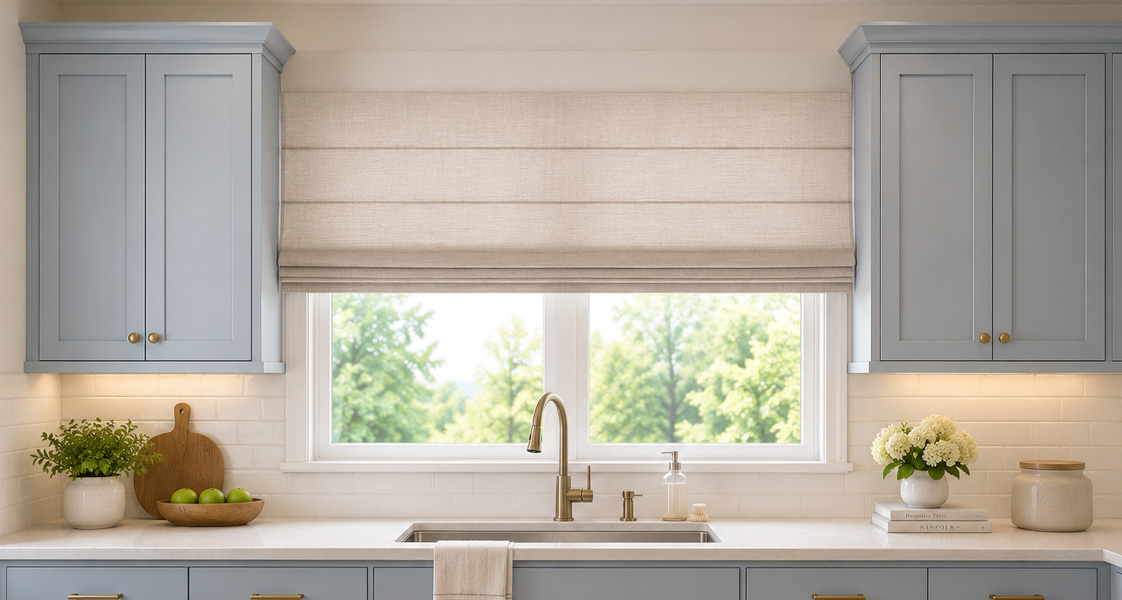
How Do You Measure Blinds Between Two Cabinets?
Measure the exact available width between the two cabinets at the location where the blind or shade will be installed. Then select inside mount when ordering the treatment.
Do not automatically subtract additional width yourself unless the measuring instructions for the specific product tell you to do so. The manufacturer generally makes the appropriate deduction for an inside-mount order.
Also measure the available height and mounting depth so you can confirm that the headrail, brackets and operating components will fit without interfering with the cabinets or surrounding surfaces.
| Measurement | What to Measure | Why It Matters |
|---|---|---|
| Width | Exact available space between the cabinets | Determines the inside-mount order width |
| Height | From the desired top of the treatment to the desired bottom | Determines the overall coverage |
| Mounting Depth | Available depth for the headrail and brackets | Confirms whether the product can fit without projecting too far |
| Obstructions | Cabinet doors, handles, trim and nearby hardware | Prevents interference during operation |
| Mount Type | Select inside mount | Allows the appropriate factory deduction for fit |
Why Blinds Between Cabinets Should Be Ordered as Inside Mount
For measuring purposes, an inside mount means the blind or shade must fit within a specific opening. The opening does not necessarily have to be a traditional window frame.
If two cabinets create the left and right boundaries of the installation, the treatment has to fit between those boundaries just like it would have to fit between the sides of a window opening.
That is why the order should generally be entered as an inside mount.
What Happens With an Inside-Mount Order?
When you provide the measured opening width and select inside mount, the manufacturer can make the product-specific deduction necessary to give the treatment operating clearance.
The exact deduction varies by blind or shade, which is another reason we do not recommend guessing at the deduction yourself.
Why You Should Not Order It as an Outside Mount
An outside-mount blind or shade is generally manufactured closer to the exact width you specify because it is intended to overlap an opening rather than fit inside one.
If you measure 48 inches between two cabinets and order a 48-inch outside-mount treatment, the finished product may be too wide to fit into the available space.
By selecting inside mount, you are telling the manufacturer that the blind must fit within the measured width.
This distinction is one of the most important parts of ordering blinds between cabinets.
Step 1: Determine Exactly Where the Blind Will Be Mounted
Before measuring, decide where the headrail will sit between the cabinets.
The width between the cabinets can sometimes change depending on how far forward or backward you measure. Cabinet face frames, trim and decorative molding can create different dimensions at different depths.
Measure at the exact depth where the headrail and brackets will actually be installed.
Do Not Assume the Opening Is the Same Width Everywhere
Two cabinets may look parallel but still vary slightly. Measure the width at several locations around the proposed mounting area before ordering.
If there is a difference between measurements, follow the inside-mount measuring instructions for the specific product.
Step 2: Measure the Width Between the Cabinets
Using a steel measuring tape, measure horizontally from the inside surface of the left cabinet to the inside surface of the right cabinet.
Take measurements near the top, middle and bottom of the area where the treatment will hang when practical.
Record the measurements accurately rather than rounding to a convenient number.
For general measuring guidance and instructions on recording inside-mount dimensions, see our how to measure window blinds and shades page.
Step 3: Measure the Height
Measure from the point where you want the top of the blind or shade to begin down to the point where you want the treatment to end.
If the window has a sill, countertop, backsplash or other surface below it, make sure the treatment has the appropriate clearance when fully lowered.
For a shade that will extend behind a countertop or other feature, also check that the bottom rail will not contact an obstruction during operation.
Step 4: Check the Mounting Depth
Width is not the only measurement that matters when installing a blind between cabinets. You also need enough depth for the mounting brackets and headrail.
Check the minimum mounting depth required by the specific product and compare it with the space available at the mounting location.
Why Depth Matters Between Cabinets
If the opening is shallow, the headrail may project beyond the cabinet faces. That may be acceptable, but it should be considered before ordering.
A deeper cabinet or decorative face frame can also interfere with bracket placement or make the controls more difficult to reach.
Check Cabinet Doors, Handles and Other Obstructions
Before ordering, open the cabinet doors and drawers surrounding the window and make sure they will not interfere with the blind or shade.
Common Obstructions to Check
- Cabinet doors that swing toward the window.
- Drawer fronts near the bottom of the treatment.
- Cabinet knobs and handles.
- Decorative crown molding or trim.
- Window handles, locks or cranks.
- Backsplash tile or molding.
- Countertops or shelves below the window.
Checking these items before ordering can help prevent a treatment that technically fits the opening but cannot operate correctly.
Example: Measuring a Blind Between Two Kitchen Cabinets
Suppose a kitchen window sits between two wall cabinets and the exact available space between the cabinet sides measures 42 inches.
| Measurement | Example |
|---|---|
| Available Width Between Cabinets | 42 inches |
| Measured Height | 48 inches |
| Mount Type | Inside Mount |
| Customer Width Deduction | None unless specifically required by the product instructions |
| Factory Deduction | Applied according to the selected product's inside-mount specifications |
You would generally enter the measured 42-inch opening width and select inside mount. The manufacturer can then make the appropriate product-specific deduction so the finished treatment fits between the cabinets.
This example is for illustration only. Always follow the measuring instructions for the exact blind or shade being ordered.
Inside Mount vs. Outside Mount When the Blind Is Between Cabinets
| Consideration | Inside Mount | Outside Mount |
|---|---|---|
| Designed to Fit Within a Fixed Space | Yes | No |
| Factory Width Deduction | Generally applied according to product specifications | Generally not intended to create clearance within an opening |
| Best Choice Between Cabinets | Usually yes | Usually no |
| Customer Measures | Available opening between cabinets | Desired finished coverage |
| Risk of Being Too Wide | Reduced when measured and ordered correctly | Higher if exact cabinet opening width is entered |
Simple rule: If the blind or shade has to fit between two fixed surfaces, treat the available space like an inside-mount opening.
Related Article: Inside vs Outside Mount Blinds and Shades
This Measuring Rule Applies to More Than Cabinets
The same principle can apply anywhere a blind or shade needs to fit within a restricted width.
Examples include treatments installed between built-in bookcases, shelving units, columns, wall returns or other permanent architectural features.
If the treatment cannot extend beyond the measured boundaries, it should generally be approached as an inside-mount application so the finished product has the necessary clearance.
What If Tile or Molding Also Narrows the Opening?
Kitchen windows frequently have both cabinets beside the window and backsplash tile, molding or trim that changes the available width near the bottom.
In that situation, you need to account for both restrictions. Measure the available width at the top, middle and bottom and determine whether the treatment needs to clear the narrowest portion of the opening.
Some custom products may also offer a specialty cutout when tile or molding narrows only part of the window. See our guide to measuring blinds and shades around tile or molding for more information.
Common Mistakes When Measuring Blinds Between Cabinets
Ordering the Treatment as Outside Mount
If the treatment needs to fit between two cabinets, selecting outside mount can result in a finished blind that is too wide for the available opening.
Making Your Own Deduction
Unless the product instructions specifically tell you to deduct from the measured width, provide the actual opening measurement and allow the manufacturer to make its normal inside-mount deduction.
Measuring Only One Location
Cabinets and surrounding trim may not be perfectly parallel. Check the available width in more than one location.
Measuring at the Wrong Depth
The distance between the cabinet sides can change depending on where the headrail sits. Measure at the actual intended mounting location.
Ignoring Cabinet Doors
A blind can fit perfectly between the cabinets and still interfere with doors or handles. Open surrounding cabinets before finalizing the mounting position.
Forgetting Mounting Depth
Make sure there is enough depth for the headrail and brackets, especially when cabinet face frames or trim project beyond the wall.
Blinds Between Cabinets Measuring Checklist
- Choose the blind or shade: Review the product's minimum mounting-depth requirements.
- Determine the mounting position: Decide exactly where the headrail will sit between the cabinets.
- Measure the available width: Measure from cabinet to cabinet at the actual mounting depth.
- Measure more than once: Check the width at multiple locations.
- Measure the height: Determine where you want the treatment to begin and end.
- Check the mounting depth: Make sure the brackets and headrail fit.
- Open surrounding cabinet doors: Check for interference.
- Check handles and trim: Make sure hardware does not obstruct operation.
- Select inside mount: Treat the fixed cabinet opening like an inside-mount window opening.
- Do not automatically deduct: Allow the manufacturer to make the appropriate product-specific inside-mount deduction.
- Verify the measurements: Recheck width, height and depth before ordering.
Related Window Measuring Guides
- General Window Blind and Shade Measuring Instructions
- How to Measure Blinds and Shades for French Doors
- How to Measure Blinds for Corner Windows
- How to Measure Blinds and Shades Around Tile or Molding
- How to Measure Vertical Blinds for Sliding Glass Doors
- How to Measure Bay Windows for Blinds and Shades
- How to Measure Two Blinds Side by Side in One Window
- How to Measure Blinds and Shades Below an Arched Window
- How to Measure Blinds for Angled Top Windows
Not Sure How to Measure Between Your Cabinets? We Can Help
If a blind or shade needs to fit between cabinets, built-ins or another restricted opening and you are unsure how to enter the measurements, contact us before ordering.
Measure the exact available width, height and mounting depth and note any nearby cabinet doors, handles, trim or other obstructions. A photo of the complete opening can also be helpful.
Our window treatment team can help you determine whether the product will fit and confirm how the measurements should be entered before you place the order.
Expert Guidance from Blinds Chalet
Blinds Chalet has helped homeowners measure and order custom window treatments since 2006. Windows located between cabinets are a good example of why the mounting environment matters just as much as the dimensions of the glass.
When we help customers with this type of installation, we treat the space between the cabinets as a fixed inside-mount opening. If the blind has to fit between two solid boundaries, the manufacturer needs to know that the product requires clearance within that measured space.
We recommend measuring the actual opening between the cabinets at the depth where the headrail will be installed and selecting inside mount when ordering. Unless the specific product instructions tell you otherwise, do not make an additional width deduction yourself.
We also recommend checking cabinet doors, handles, trim and mounting depth before ordering. A treatment can have the correct width and still create problems if nearby cabinetry interferes with the headrail, controls or movement of the shade.
Measuring Blinds Between Cabinets FAQs
How do I measure blinds between two cabinets?
Measure the exact available width between the cabinets at the location where the blind or shade will be mounted. Also measure the height and available mounting depth. When ordering, select inside mount so the manufacturer can make the appropriate product-specific deduction for clearance.
Should blinds between cabinets be ordered as inside mount or outside mount?
Blinds that must fit between two fixed cabinets should generally be ordered as inside mount. For measuring purposes, the space between the cabinets functions like an inside-mount opening because the finished treatment must fit within a limited width.
Do I subtract from the width when measuring between cabinets?
Usually you should provide the actual measured opening width and select inside mount rather than making your own deduction. The manufacturer typically makes the appropriate inside-mount deduction for the specific product. Follow the measuring instructions for the exact treatment you are ordering.
Why can't I order a blind between cabinets as an outside mount?
An outside-mount treatment is intended to cover or overlap an opening rather than fit within a fixed width. If you enter the exact distance between two cabinets as an outside-mount width, the finished treatment may be too wide to fit between them.
Should I measure the space between cabinets in more than one place?
Yes. Measure at multiple points because the cabinets, wall or trim may not be perfectly parallel. Follow the inside-mount measuring instructions for the specific product when selecting the width to submit.
Does the depth between the cabinets matter?
Yes. The blind or shade needs sufficient mounting depth for its brackets and headrail. Check the minimum mounting-depth requirement for the specific product before ordering.
Can cabinet doors interfere with window blinds?
Yes. Cabinet doors, handles and drawers can interfere with the headrail, controls or movement of the treatment. Open nearby cabinets and check all clearances before choosing the final mounting position.
What if tile or molding also narrows the window between the cabinets?
Measure the available width at the top, middle and bottom and account for the narrowest obstruction according to the product instructions. Some custom shades may offer specialty tile or molding cutouts that allow the lower section to be narrower than the upper treatment.
Does this inside-mount rule apply between bookcases or built-ins too?
Generally yes. If a blind or shade has to fit within a fixed space between bookcases, built-ins, columns or similar permanent surfaces, the opening can usually be approached like an inside-mount application so the treatment has proper clearance.
Can Blinds Chalet help me measure blinds between cabinets?
Yes. Measure the available width, height and mounting depth and note any cabinet doors, handles, trim or other obstructions. Blinds Chalet's window treatment team can help you determine whether the selected product will fit and how the measurements should be entered.
Related Articles
Measuring for French door blinds and shades is slightly different from measuring a standard window because the treatment is mounted directly to the face of the door. You need enough overlap around the glass for privacy and light control while also making sure the blind or shade does not interfere with the door handle, locks, trim or other hardware.
... moreMeasuring for roller shades is straightforward once you understand one important difference: the width you order is not always the same as the width of the shade fabric.
... more- Use a metal tape for accurate measurements
- Measure to the nearest 1/8"
Properly installing window treatments is impossible if the process didn't begin with proper window measurement. Sadly, many novice shoppers fail to recognize the importance of measurements until it's too late. ... more
Measuring for custom drapery panels is simple, just follow these easy steps:... more
To install vertical window blinds, please read completely the instructions below before beginning the installation process.... more
 Because the lift cords that run along the back of roman shades pose a potential chocking hazard to small children, the WCMA/WCSC and CPSC have come up with a temporary solution. This may not work for everyone as it removes the lift cords in the shades. The roman shades must then be raised manually without a cord and then a metal clip inserted to keep them raised....
more
Because the lift cords that run along the back of roman shades pose a potential chocking hazard to small children, the WCMA/WCSC and CPSC have come up with a temporary solution. This may not work for everyone as it removes the lift cords in the shades. The roman shades must then be raised manually without a cord and then a metal clip inserted to keep them raised....
more