







Measuring for French door blinds and shades is slightly different from measuring a standard window because the treatment is mounted directly to the face of the door. You need enough overlap around the glass for privacy and light control while also making sure the blind or shade does not interfere with the door handle, locks, trim or other hardware.
French door window treatments are normally ordered as outside-mount blinds or shades. Rather than fitting inside a recessed window opening, the treatment mounts to the surface of the door and covers the glass from the outside.
The basic process is simple: measure the glass or surrounding molding, add appropriate overlap for coverage and mounting space, then confirm that the finished width will clear the door handle and other hardware.
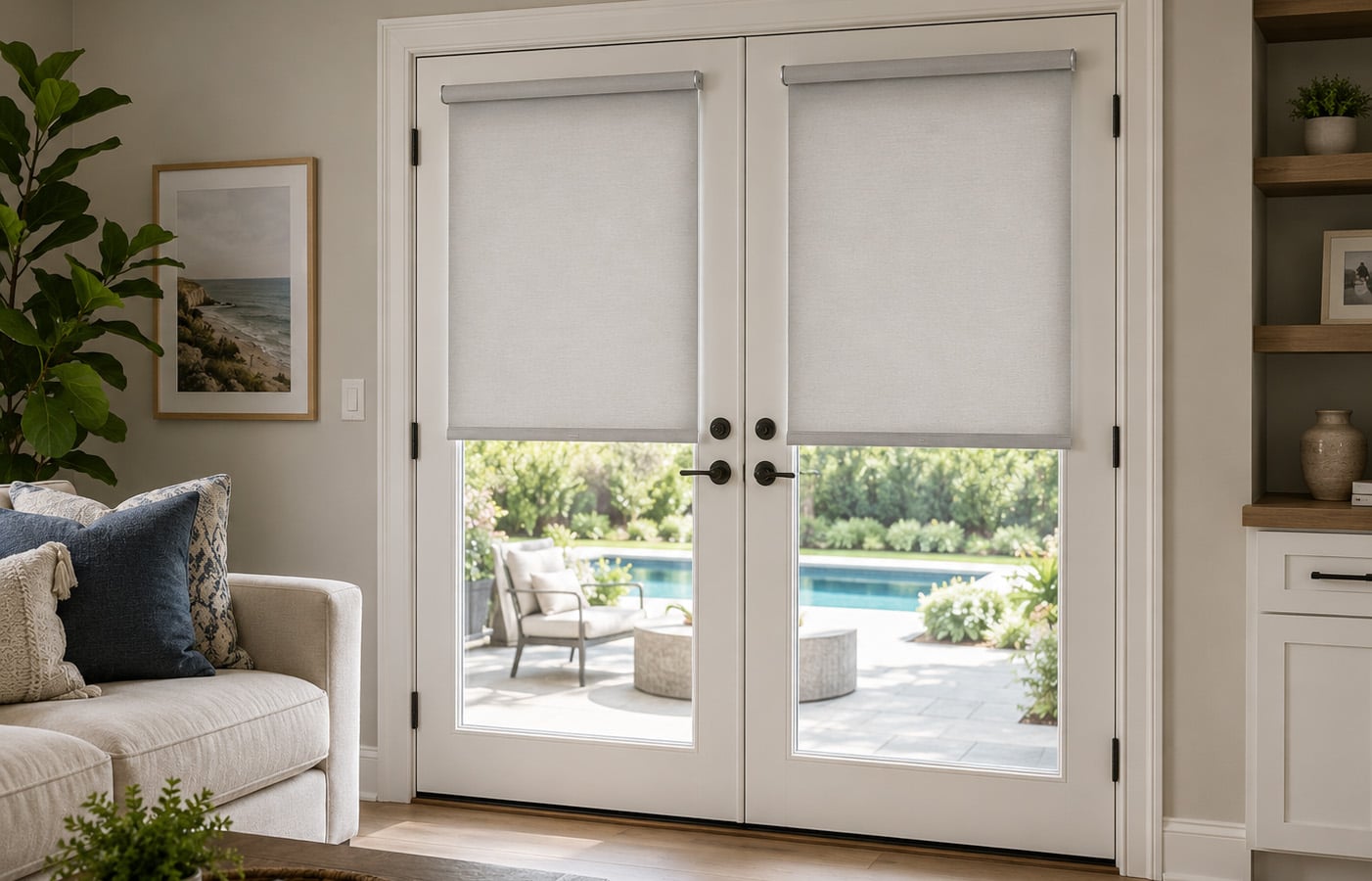
Before You Measure Your French Door
Before taking measurements, look closely at the entire door rather than measuring only the glass. The glass size is your starting point, but the surrounding molding and hardware determine how large the finished blind or shade can be.
Check for the following:
- Raised molding around the glass.
- Lever-style or round door handles.
- Locks or deadbolts near the glass.
- The amount of flat mounting space above the glass.
- The amount of space available on each side of the glass.
- Any trim or molding that projects away from the surface of the door.
You should also decide which type of treatment you plan to order before finalizing your measurements because different blinds and shades have different headrail depths, bracket requirements and available widths.
What You Need to Measure French Door Blinds
- A steel measuring tape.
- A pencil or pen.
- Paper or a phone for recording measurements.
- The measuring instructions for the specific blind or shade you are considering.
Use a steel measuring tape rather than a cloth or flexible tape because it is easier to keep straight and gives you a more accurate measurement across the door.
How to Measure for French Door Blinds and Shades
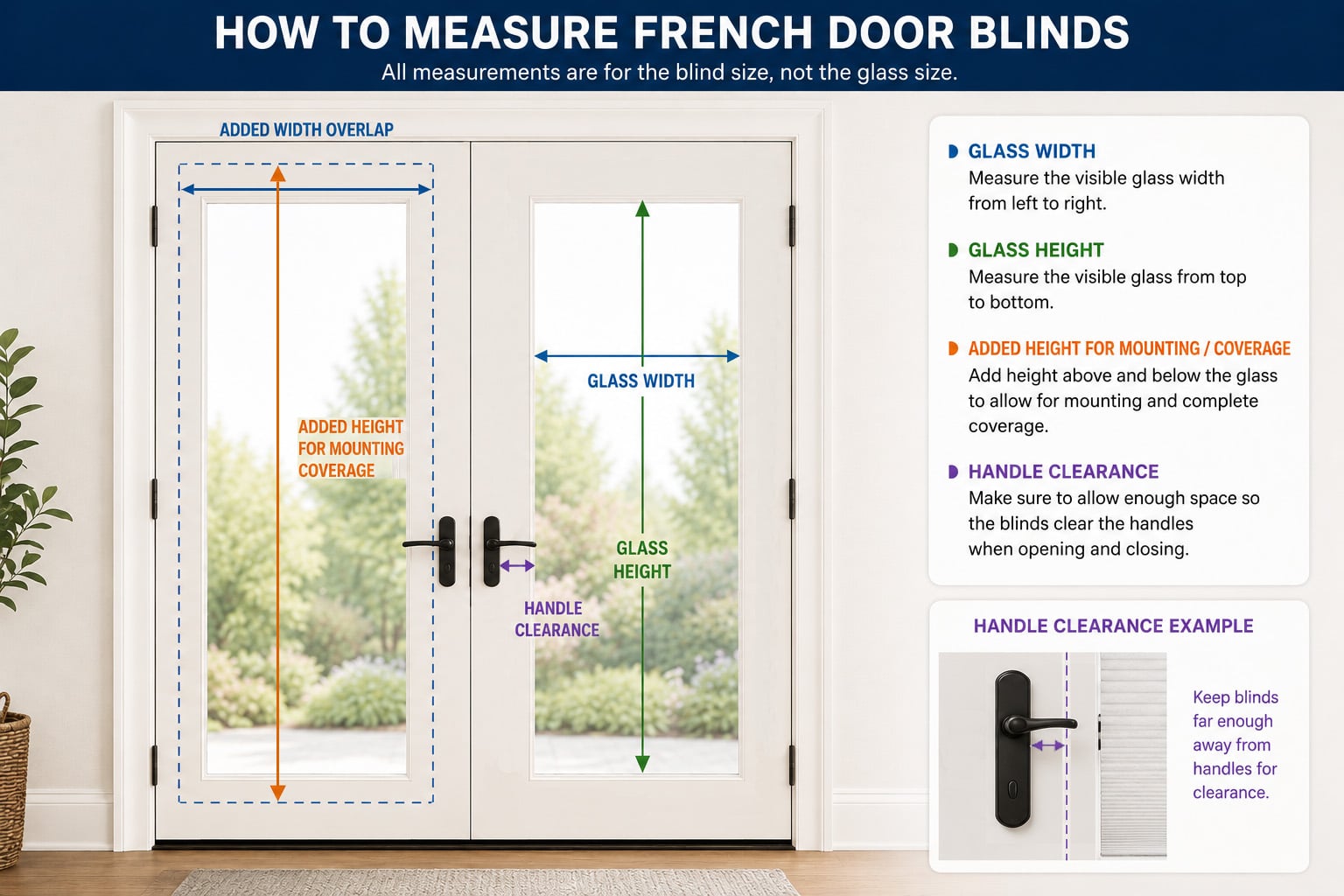
Step 1: Measure the Width of the Glass
Measure the width of the glass from left to right. If the glass is surrounded by raised molding that you want the blind or shade to cover, measure from the outside edge of the molding on one side to the outside edge on the other.
This gives you the starting width for your door-mounted treatment.
Step 2: Add Width for Overlap
For better privacy and light coverage, we recommend adding at least 1 inch to the total width when space allows. This gives the treatment approximately 1/2 inch of additional coverage on each side.
You may be able to add more overlap, but do not make the blind so wide that it interferes with the door handle, lock or other hardware.
Step 3: Measure the Height of the Glass
Measure from the top of the glass to the bottom. If raised molding surrounds the glass and you want the treatment to cover it, measure from the outside edge of the top molding to the outside edge of the bottom molding.
Step 4: Add Height for Mounting and Coverage
We generally recommend adding approximately 3 to 4 inches to the total height of the glass or molding measurement. The additional height provides room for mounting brackets above the glass and gives the blind or shade additional coverage below the glass.
Before adding the full amount, verify that there is enough flat door surface above and below the glass for the brackets and finished treatment.
Step 5: Check the Door Handle
Before placing your order, compare the finished width of the blind or shade with the location of the door handle. The treatment should cover the glass without extending so far toward the handle that the two interfere with each other.
Lever-style handles require particular attention because they often extend horizontally across part of the glass area.
Step 6: Record the Finished Ordering Size
French door blinds and shades are treated as outside mounts. For these door-mount measuring instructions, the width and height you provide are the dimensions used for the ordered treatment, so include the overlap you want in the measurements you submit.
Do not submit only the glass measurement if you intend for the finished treatment to extend beyond the glass.
French Door Measuring Example
Suppose the glass on your French door measures 24 inches wide by 66 inches high.
| Measurement | Example |
|---|---|
| Glass Width | 24 inches |
| Recommended Added Width | At least 1 inch total, if hardware clearance allows |
| Example Order Width | 25 inches |
| Glass Height | 66 inches |
| Recommended Added Height | Approximately 3 to 4 inches total |
| Example Order Height | 69 to 70 inches |
These are example measurements only. Always check the available mounting area and make sure the additional width does not interfere with the door handle or lock.
How to Measure French Doors With Raised Molding
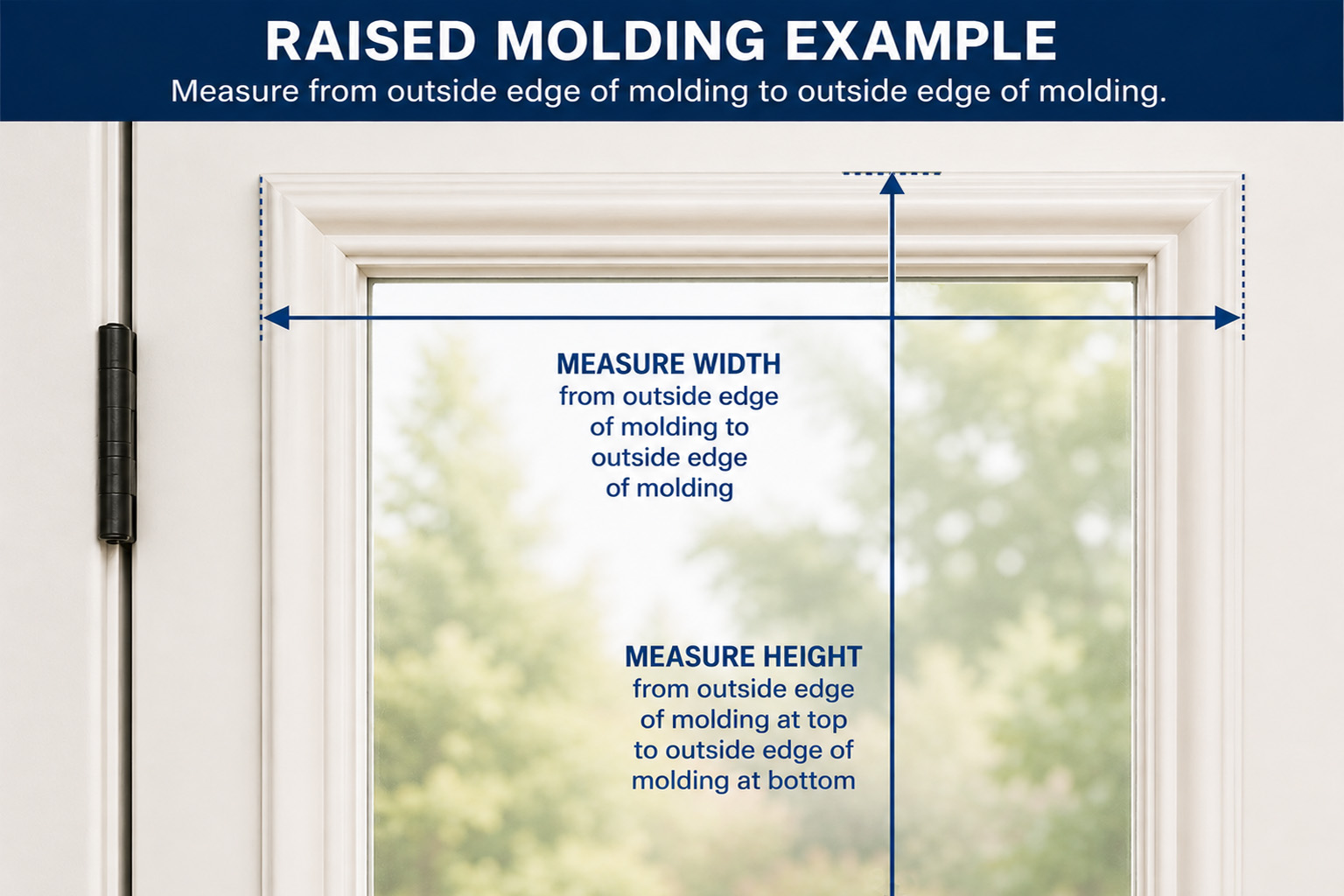
Many French doors have decorative molding surrounding the glass. This molding can project away from the surface of the door and affect both measuring and installation.
If you want the blind or shade to cover the molding, measure from the outside edge of the molding rather than from the edge of the glass.
You may also need spacer brackets to move the blind or shade far enough away from the door for the treatment to clear the raised molding.
Why Spacer Brackets Are Important
Without enough clearance, the blind slats, shade fabric or bottom rail may rub against the molding as the treatment is raised, lowered or tilted. Spacer brackets move the mounting hardware farther away from the door so the treatment can operate freely.
How to Measure Around French Door Handles
Door handles are one of the most common sources of problems when measuring for French door blinds and shades. Before deciding on the final width, measure how much space is available between the glass or molding and the handle.
Lever-Style Door Handles
Lever handles can extend across the path of the blind. Two-inch and 2 1/2-inch horizontal blinds can still work with many lever handles, but the handle may interfere with the slats when you tilt them.
When the blind is closed, the slats can generally fit behind the lever. To tilt the blind open, you may need to move the slats that are directly behind the handle so they can rotate freely.
Roller and Cellular Shades
Roller and cellular shades have a flatter profile than many horizontal blinds, which can make them easier to position around certain door handles. However, the bottom rail and shade fabric still need enough clearance to move without rubbing against the hardware.
Always compare the product depth and finished width with your specific door handle before ordering.
French Door Blinds Are Typically Outside Mounted
French door blinds and shades are normally considered outside-mount treatments because they attach to the surface of the door rather than fitting inside a recessed window opening.
When ordering, select outside mount unless the measuring instructions for the specific product tell you otherwise.
This is important because outside-mount measurements are handled differently from inside-mount measurements. For a door mount, you need to include the width and height necessary to cover the glass and provide the overlap you want.
Where Should the Blind Controls Be Located?
For blinds that have separate lift or tilt controls, we recommend placing the controls on the hinge side of the door whenever the product allows.
This keeps cords, wands and other operating controls farther away from the door handle and reduces the chance that they will be caught when the door opens or closes.
If you are covering a pair of French doors, consider how both doors operate before choosing control locations so the controls remain convenient and out of the way.
Why Hold-Down Brackets Are Important on Door Blinds
A standard window blind remains stationary when the window is opened, but a door-mounted treatment moves every time the door swings. Without anything securing the bottom rail, the blind or shade can swing away from the door.
Hold-down brackets attach near the bottom of the treatment and help keep the bottom rail against the door as it opens and closes.
Benefits of Hold-Down Brackets
- Keep the blind or shade close to the door.
- Reduce swinging when the door moves.
- Help maintain alignment over the glass.
- Make door-mounted treatments feel more secure during everyday use.
Blinds Chalet provides hold-down brackets with applicable door-mounted blinds, so there is generally no need to request them separately.
When Do You Need Spacer Brackets?
Spacer brackets are useful when raised molding or other door features prevent the blind or shade from hanging flat against the door.
The spacers extend the mounting brackets away from the surface, creating room for the treatment to clear projecting molding.
Blinds Chalet provides spacer brackets with applicable Door Blinds when needed for this type of installation.
Which Blinds and Shades Can Be Mounted on French Doors?
Many common window blinds and shades can be used as door-mounted treatments as long as there is enough mounting space and hardware clearance.
| Window Treatment | Measuring Consideration |
|---|---|
| Cellular Shades | Compact profile; check handle and bottom-rail clearance |
| Roller Shades | Check roll projection and fabric clearance around the handle |
| Faux Wood Blinds | Allow room for deeper headrail and tilting slats |
| Wood Blinds | Check headrail depth, slat clearance and weight |
| Aluminum Mini Blinds | Compact profile; hold-down brackets help prevent movement |
| Roman Shades | Allow room for fabric stack and handle clearance |
You can browse custom window blinds and shades to compare styles that may work for your French doors.
Common French Door Measuring Mistakes
Measuring Only the Glass
If you submit only the exact glass dimensions, the finished treatment may not provide enough overlap for privacy, light control or mounting space.
Adding Too Much Width
Additional overlap is helpful, but making the treatment too wide can cause it to interfere with the door handle, lock or surrounding trim.
Ignoring Raised Molding
Raised molding can interfere with the blind or shade even when the width and height are correct. Determine whether you will mount over the molding and whether spacer brackets are needed.
Forgetting the Door Handle Projection
Do not look only at the handle's location from left to right. Also consider how far it projects away from the door and whether the blind, shade or bottom rail can pass behind it.
Selecting Inside Mount
French door treatments are generally ordered as outside mounts because they attach directly to the face of the door.
Forgetting About Hold-Down Brackets
A treatment can measure perfectly but still swing every time the door moves. Plan for hold-down brackets when the product supports them.
French Door Measuring Checklist
- Measure the glass width.
- Measure the glass height.
- If raised molding will be covered, measure to the outside edges of the molding instead.
- Add at least 1 inch to the total width when sufficient space is available.
- Add approximately 3 to 4 inches to the total height for mounting and coverage.
- Confirm the added width will not interfere with the door handle or locks.
- Check how far the handle projects from the surface of the door.
- Make sure there is enough flat mounting space above the glass.
- Choose outside mount when ordering.
- Place controls toward the hinge side when possible.
- Use hold-down brackets to help secure the bottom rail.
- Use spacer brackets if raised molding requires additional clearance.
- Review the measuring instructions for the exact blind or shade before placing your order.
Expert Guidance from Blinds Chalet
Blinds Chalet has helped homeowners measure and order custom window treatments since 2006. With French doors, the most important part of measuring is not simply getting the size of the glass correct. You also need to account for the mounting area, molding, door handle and the fact that the entire treatment moves every time the door opens.
We recommend starting with the glass or outside edge of the molding, adding enough overlap for privacy and coverage, and then checking the finished dimensions against the door hardware before ordering.
Pay particular attention to lever-style handles and raised molding because these are two of the most common obstacles on French door installations. Hold-down brackets can help keep the treatment against the door, while spacer brackets can provide clearance over raised trim.
Because mounting requirements, hardware dimensions and available options vary by product, always review the measuring instructions for the exact blind or shade you plan to purchase before submitting your measurements.
Explore more:
How to Measure for Blinds & Shades
How to Choose Door Blinds and Shades
How to Measure for Shallow Mount Window Blinds
How to Measure Corner Windows for Blinds
How to Measure Patio Doors for Vertical Blinds
How to Measure Blinds or Shades with Tile or Molding
How to Measure Window Treatments for Bay Windows
How to Measure for RV Windshield Shades for Blinds
How to Measure for Roller Shades
How to Measure for Shutters
How to Measure for Window Blinds in Top Angled Windows
Best Blinds and Shades for Windows on French Doors
How to Measure when Mounting Window Treatments Between Cabinets
Guide to Specialty Window Treatments
French Door Measuring FAQs
How do I measure for blinds on a French door?
Measure the width and height of the glass or the outside edges of raised molding if you plan to cover it. Add at least 1 inch to the total width and approximately 3 to 4 inches to the height when space allows, then make sure the finished dimensions will not interfere with the handle, locks or other door hardware.
Are French door blinds inside mount or outside mount?
French door blinds and shades are generally outside mounted because they attach directly to the surface of the door rather than fitting inside a recessed window opening.
How much wider should French door blinds be than the glass?
Blinds Chalet generally recommends adding at least 1 inch to the total glass width when sufficient space is available. This provides additional coverage while still allowing room around the door handle and locks.
How much height should I add when measuring for French door blinds?
Approximately 3 to 4 inches of total additional height is generally recommended to provide mounting space above the glass and additional coverage below it, provided the door has enough flat mounting surface.
How do I measure a French door with raised molding around the glass?
If you want the treatment to cover the molding, measure from the outside edge of the molding on one side to the outside edge on the other and do the same for the height. Spacer brackets may be needed to provide clearance over raised molding.
How do I keep French door blinds from hitting the handle?
Before ordering, compare the finished width and depth of the treatment with the position and projection of the door handle. Do not add so much width that the blind overlaps the handle area, and choose a treatment profile that provides adequate clearance.
What are hold-down brackets for French door blinds?
Hold-down brackets attach near the bottom of the door and connect to the bottom rail of compatible blinds or shades. They help keep the treatment close to the door instead of allowing it to swing when the door opens and closes.
What are spacer brackets used for on French doors?
Spacer brackets move the blind or shade farther away from the surface of the door. They are useful when raised molding around the glass would otherwise interfere with the treatment.
Which side should the controls be on for French door blinds?
When the product allows you to choose control locations, placing the lift and tilt controls toward the hinge side of the door can help keep them away from the handle and reduce the chance that they will become caught when the door opens or closes.