







Measuring for roller shades is straightforward once you understand one important difference: the width you order is not always the same as the width of the shade fabric.
Roller shades need space for the roller tube, brackets, end caps and operating mechanism. The ordered width refers to the overall width of the roller shade, bracket-to-bracket width, tip-to-tip width or cassette width. The fabric itself is narrower.
This difference is especially important for inside-mounted roller shades because it creates normal light gaps along the sides of the fabric. The exact fabric deduction varies by product, lift system and top treatment, so always review the specifications for the exact roller shade you are ordering.
This guide explains how to measure for both inside and outside mount roller shades, how bracket-to-bracket and fabric measurements differ, and how to account for side light gaps.
Ready to shop? Browse our custom roller shades.
How Do You Measure for Roller Shades?
First decide whether the roller shade will be installed as an inside mount or an outside mount.
For an inside mount, measure the actual window opening and order according to the product's inside-mount instructions. The manufacturer normally makes the required deductions so the shade fits within the opening.
For an outside mount, measure the total area you want the roller shade to cover. The width you enter generally represents the finished overall shade width or bracket-to-bracket measurement, not the fabric width. Because the fabric is narrower than the hardware, add enough overlap so the fabric itself covers the window opening.
| Measurement | Inside Mount | Outside Mount |
|---|---|---|
| Where Shade Is Installed | Inside the window opening | On trim, wall or surface outside the opening |
| Width You Measure | Inside width of the opening | Total finished width you want the shade hardware to span |
| Factory Deduction | Usually made by manufacturer | Normally little or no width deduction from the ordered overall width |
| Fabric Width | Narrower than the ordered/opening width | Narrower than the overall ordered width |
| Side Light Gaps | Normal and more visible | Can be reduced by adding overlap beyond the window opening |
| Best For | Clean recessed appearance | Greater light and privacy coverage |
Understanding Roller Shade Width: Fabric Width vs. Tip-to-Tip Width
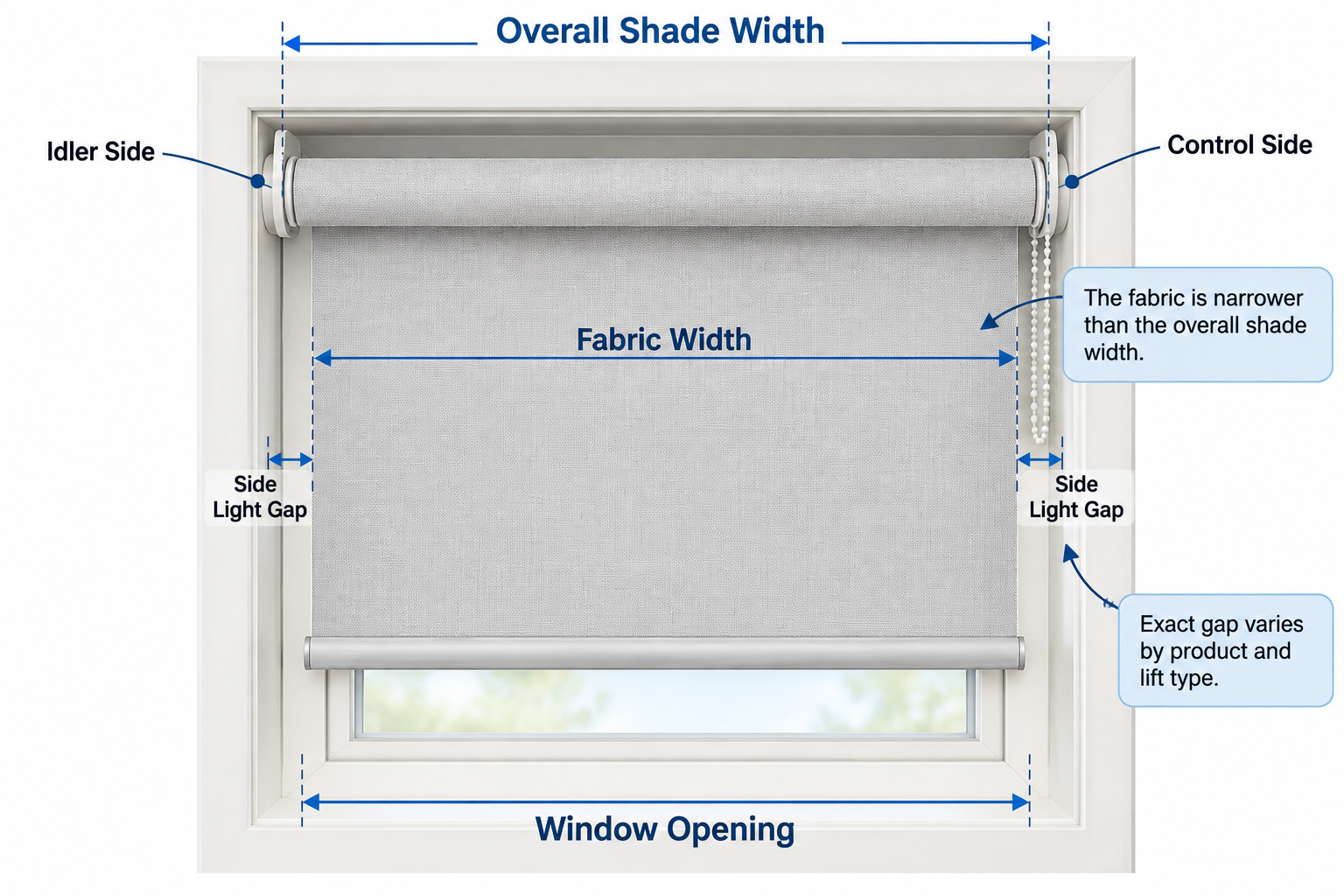
One of the most common roller shade measuring mistakes is assuming that the width entered when ordering will be the width of the fabric.
It is not.
A roller shade has operating hardware on both sides of the fabric. Depending on the shade, this can include a clutch, cordless mechanism, motor, idler pin, brackets, end caps or cassette.
Because of that hardware, the fabric must be narrower than the total width of the completed roller shade.
Tip-to-Tip or Bracket-to-Bracket Width
The terms tip-to-tip and bracket-to-bracket describe the overall width required by the complete roller shade system rather than the fabric alone.
On an open-roll shade, this generally represents the span of the roller assembly from one mounting side to the other. Manufacturer terminology can vary, so some products may instead refer to overall shade width, finished width or pin-to-pin width.
For cassette roller shades, the ordered width may correspond to the overall cassette or headrail width instead.
Fabric Width
The fabric hangs between the operating components, so it is narrower than the overall shade.
The difference between the overall shade width and fabric width is what creates the normal side gaps associated with roller shades.
How Large Are the Side Gaps on Roller Shades?
There is no single fabric-gap measurement that applies to every roller shade.
The amount of fabric deduction depends on several factors, including:
- The specific roller shade product.
- Cordless, continuous-loop or motorized operation.
- The type and size of clutch or motor.
- Whether the shade has an open roll, cassette, fascia or valance.
- Inside versus outside mount.
- The manufacturer and hardware system.
As an example of why product-specific specifications matter, some current roller shade systems list inside-mount light gaps of approximately 9/16 inch per side for certain cordless configurations and up to approximately 3/4 inch per side for some cord-loop or motorized configurations. Other products can differ.
Always check the specifications for the exact roller shade and lift system you are ordering. The product page should be used to determine the expected fabric width or side-gap allowance.
Is the Light Gap Larger on the Control Side?
It can be.
Some roller shade systems require more room on the control side because the clutch, chain mechanism, cordless assembly or motor takes up more space than the idler side.
Other systems distribute the deduction more evenly.
This is another reason we do not recommend assuming that every roller shade has the same amount of gap on each side.
When light control is important, check the individual product specifications for the selected lift system before ordering.
How to Measure for Inside Mount Roller Shades
An inside-mounted roller shade is installed within the window opening. This creates a clean, built-in appearance but leaves some space between the fabric and the sides of the window.
Step 1: Check the Mounting Depth
Before measuring width, make sure the window has enough depth for the roller shade and mounting hardware.
Roller shades with larger cassettes, motors or fascia systems can require more depth than a basic open-roll shade.
Check both the minimum mounting depth and the flush-mount depth listed for the product if you want the shade fully recessed into the opening.
Step 2: Measure the Inside Width
Measure the width of the window opening at the top, middle and bottom.
For most inside-mounted shades, we recommend using the narrowest width but with roller shades use the measurement at the top of the window frame. This helps ensure the finished shade can fit within an opening that may not be perfectly square.
Do not make your own deductions for inside mount. With our custom inside-mount roller shades, the manufacturer makes the necessary deduction from the measurement you provide.
Pro Tip: With roller shades the most critical measurement is the top of the window frame. The tube and mechanism is the widest part of the roller shade and very little deduction is taken so use this measurement for your width
Step 3: Measure the Height
Measure the height of the opening at the left, center and right.
Follow the exact product instructions for which height measurement to enter. In many cases, the longest height is used so the shade reaches the bottom of the opening.
Pro Tip: With roller shades extra fabric is not an issue so you may want to add a few extra inches just to be safe.
Step 4: Check for Obstructions
Look for window cranks, locks, handles, screens, sensors or trim that could interfere with the roller, fabric or bottom rail.
A window can have enough nominal mounting depth but still have an obstruction that prevents the shade from operating correctly.
Inside Mount Roller Shades Will Have Side Light Gaps
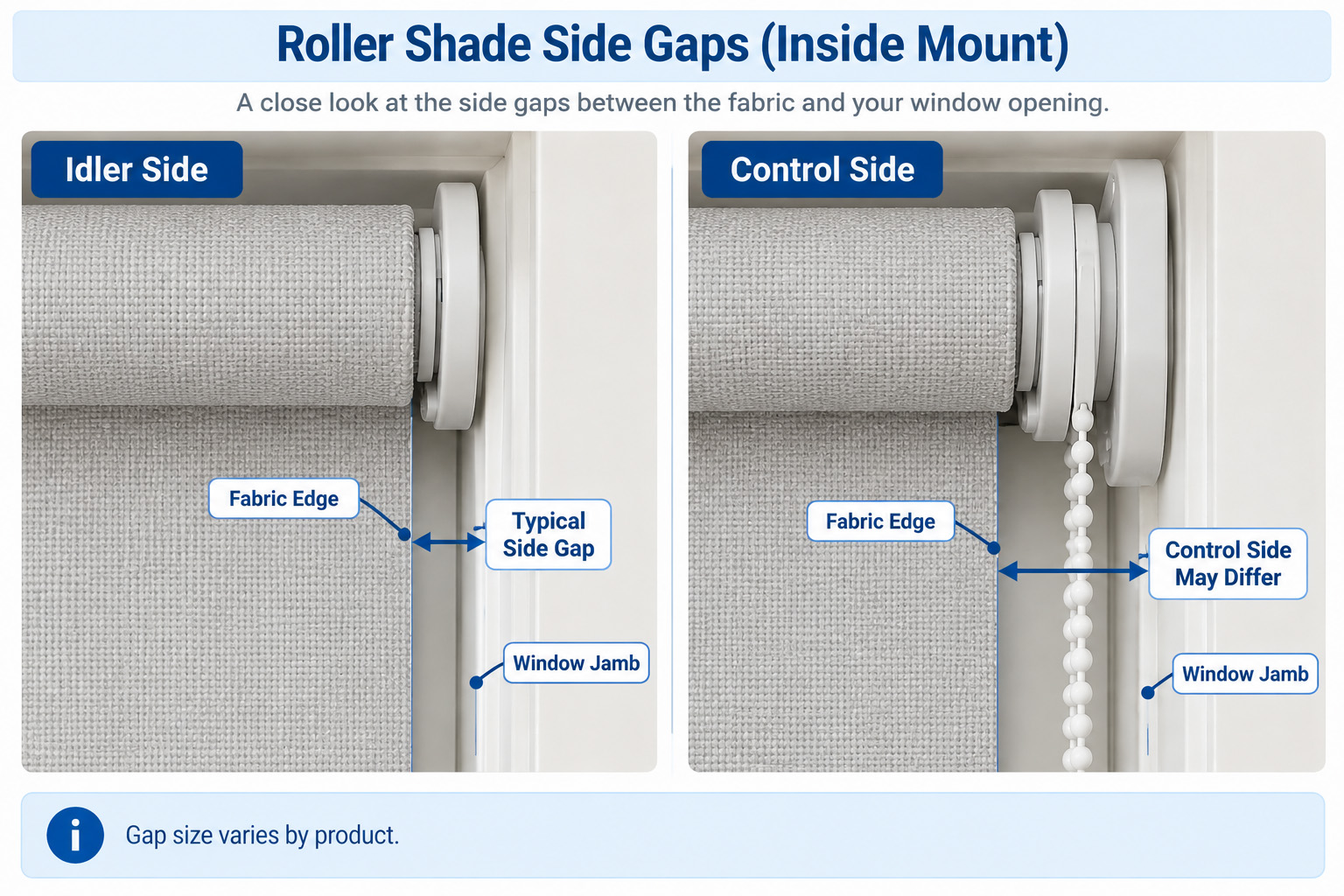
Side gaps are a normal characteristic of inside-mounted roller shades.
The fabric cannot extend all the way to both edges of the window opening because the operating hardware must fit between the fabric and the mounting surface.
This is particularly important when ordering a blackout roller shade. A blackout fabric blocks light through the material, but light can still enter around the edges of an inside-mounted shade.
If minimizing light gaps is more important than achieving a recessed appearance, consider an outside mount.
For a deeper comparison, see our Inside Mount vs. Outside Mount Blinds and Shades guide.
How to Measure for Outside Mount Roller Shades
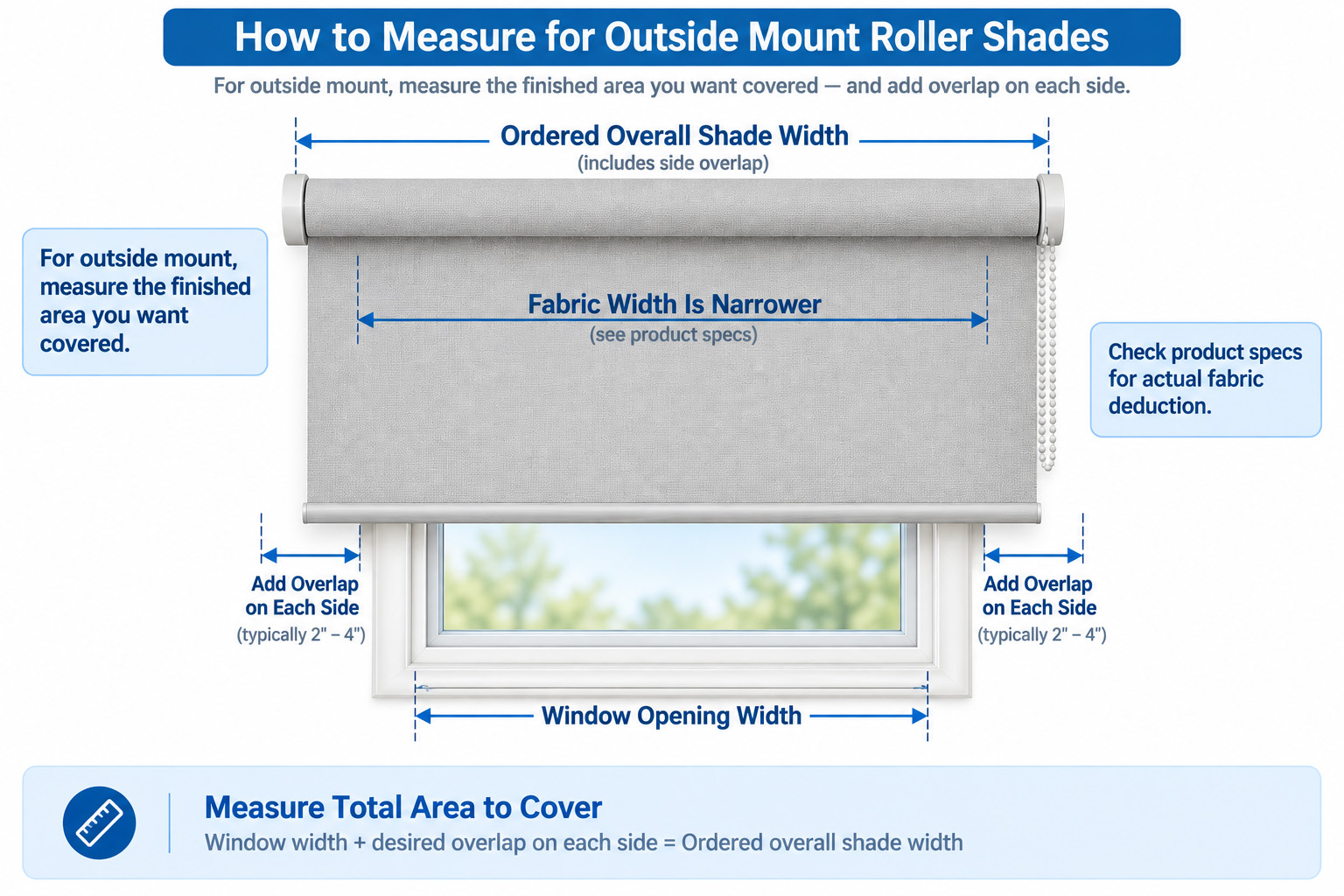
An outside-mounted roller shade is installed on the wall, trim or another mounting surface outside the window opening.
Outside mounting gives you more control over how much the shade overlaps the opening and can significantly reduce visible side light.
Step 1: Decide How Much Area You Want to Cover
Do not simply measure the glass or window opening.
Decide how far you want the shade to extend beyond the opening on the left, right, top and bottom.
Adding side overlap helps the fabric cover the window opening even though the fabric itself is narrower than the complete roller shade.
Step 2: Measure the Overall Width
The width entered for an outside-mounted roller shade represents the overall finished shade width or bracket-to-bracket width and not the width of the fabric.
For example, if you order a 40-inch outside-mount roller shade, that does not mean the fabric will be 40 inches wide. The fabric will be narrower because part of the 40 inches is occupied by the operating hardware.
This is why you need to account for the product's fabric deduction when deciding how wide to order an outside-mounted shade.
Step 3: Add Enough Overlap
If the goal is greater privacy or room darkening, make the shade wider than the window opening so the narrower fabric still overlaps the opening on both sides.
The amount of additional width needed depends on the exact product, lift system and how much coverage you want.
Check the product specifications for the fabric deduction before determining the final ordered width.
Pro Tip: You can calculated the width of the finished fabric based on the deductions the manufacturer will take. This is based on the lift style and whether you choose open roller or add a cassette or valance you check the appropriate options.
Step 4: Measure the Height
Measure from the point where the roller shade will be mounted to where you want the shade to end.
Remember that an outside-mounted shade can be mounted above the window opening, which can provide additional coverage at the top and may make the window appear taller.
Pro Tip: Add a few extra inches to the height just to be safe. The additional fabric will just be on the tube when the shades are fully lowered where you want them.
Outside Mount Example: Why Fabric Width Matters
Suppose your window opening is 36 inches wide and you want the roller shade fabric to overlap the opening by approximately 2 inches on each side.
Your target fabric coverage would therefore be approximately 40 inches.
But if the selected roller shade has hardware that makes the fabric approximately 1 1/4 inches narrower than the overall ordered width, ordering the shade at exactly 40 inches would result in fabric that is narrower than your intended coverage.
You would need to account for that product's specific fabric deduction when determining the final ordered width.
This is why outside-mount roller shades should be measured based on both the overall shade width and the resulting fabric width.
Lift System Can Change the Fabric Gap
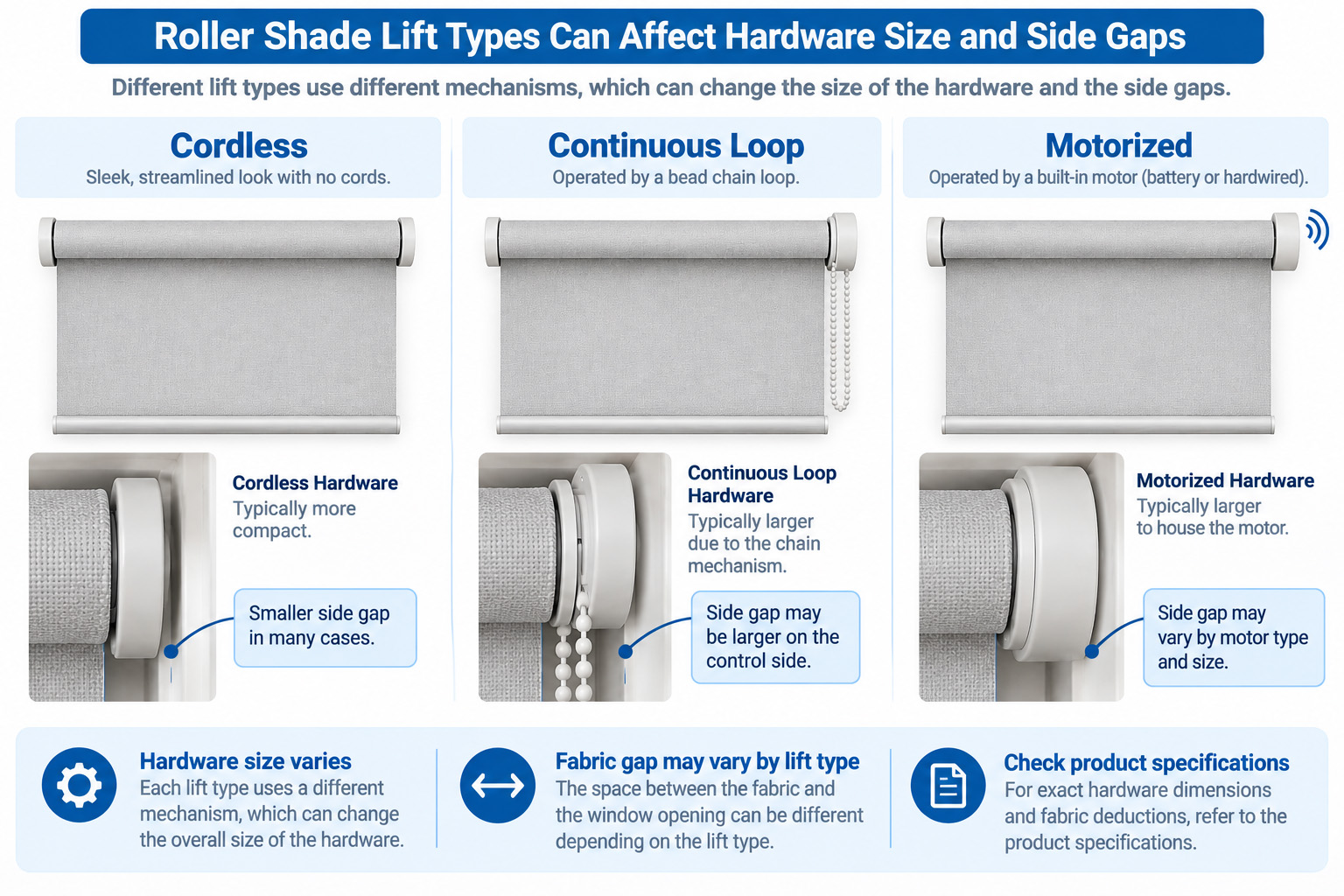
The selected operating system can change the relationship between the ordered width and the fabric width.
| Lift Type | Why Width Can Differ | What to Check |
|---|---|---|
| Cordless | Cordless operating components occupy space at the ends of the roller | Product-specific fabric deduction and minimum width |
| Continuous Loop / Clutch | The clutch and idler require clearance beside the fabric | Control-side and opposite-side gaps |
| Motorized | The motor and idler assembly may require additional space | Fabric width, motor side and minimum product width |
| Cassette System | Cassette end caps and internal hardware affect overall width | Cassette width versus fabric width |
Do not use the fabric deduction from one lift option to measure for another. Always check the specifications for the exact lift system being ordered.
How Do Cassettes and Valances Affect Roller Shade Measurements?
A cassette or fascia can change how the overall width is defined.
With an open-roll roller shade, the relevant measurement may be described as bracket-to-bracket or tip-to-tip width.
With a cassette shade, the ordered width may instead correspond to the overall cassette width. The fabric still needs clearance inside that cassette and will therefore be narrower than the cassette itself.
Cassettes can also affect the amount of side light gap, so review the specifications for the exact top treatment you choose.
How Should You Measure Blackout Roller Shades?
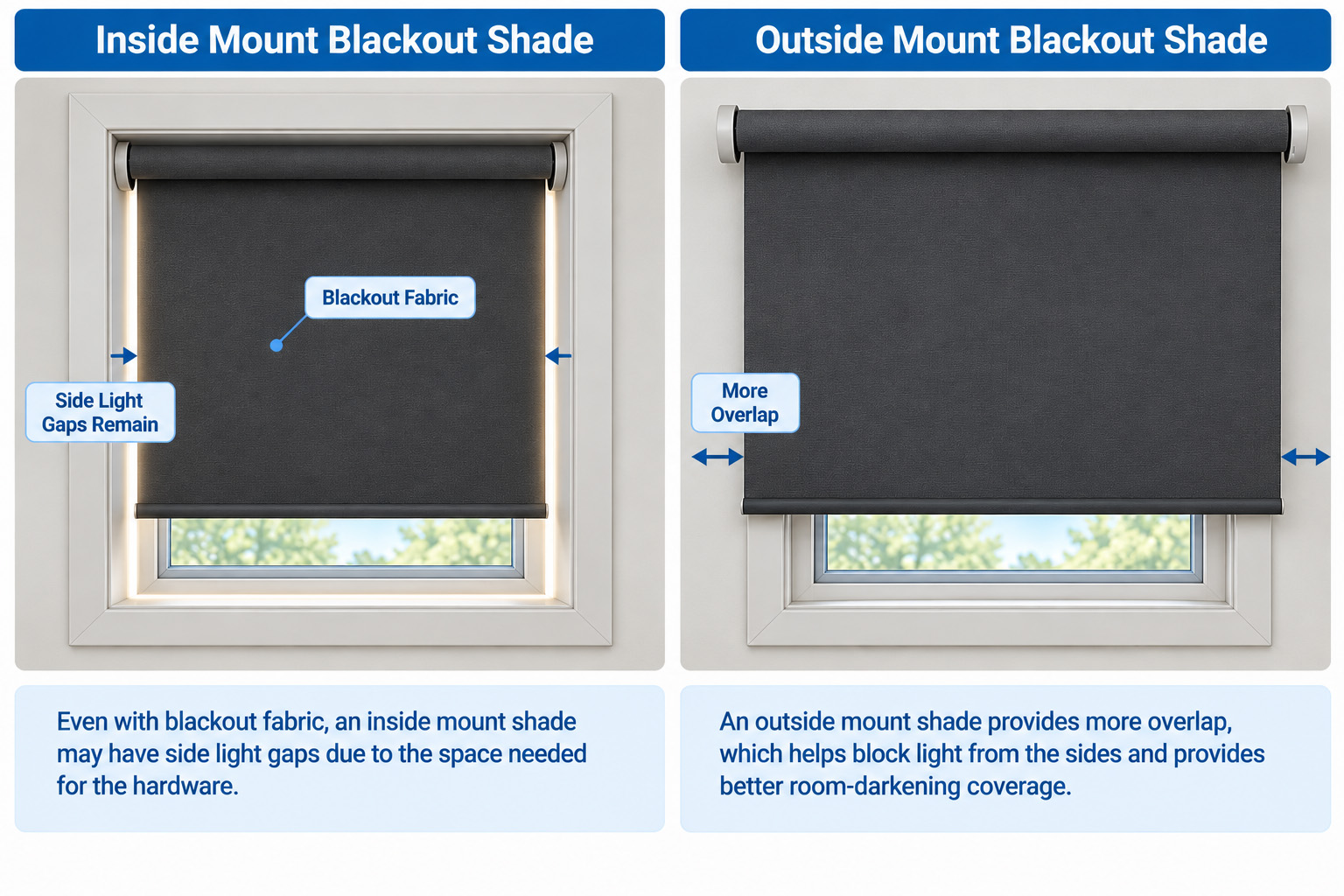
If room darkening is your main priority, do not focus only on the blackout fabric.
An inside-mounted blackout roller shade will still have side gaps because the fabric must be narrower than the complete roller assembly.
An outside mount generally provides greater flexibility because you can extend the shade beyond the window opening on all sides.
For maximum room darkening, consider:
- Outside mounting with additional side overlap.
- Mounting above the opening to reduce light at the top.
- Extending the shade below the opening where practical.
- Checking the exact fabric deduction for the selected lift system.
- Considering side channels or other light-control accessories when available.
See our Inside Mount vs. Outside Mount Blackout Shades guide for more detail.
Common Roller Shade Measuring Mistakes
- Assuming ordered width equals fabric width: Roller shade fabric is narrower than the complete shade.
- Using one standard deduction for every product: Fabric deductions vary by manufacturer, lift type and top treatment.
- Making your own inside-mount deduction: Manufacturers typically make the required deduction for an inside mount unless the product instructions specifically say otherwise.
- Ordering an outside mount exactly the width of the window: This can leave the fabric narrower than the window opening.
- Ignoring the lift system: Cordless, clutch and motorized systems can have different side clearances.
- Ignoring mounting depth: The roller or cassette needs adequate room inside the window opening.
- Expecting an inside-mounted blackout shade to eliminate all light: Side gaps are normal on roller shades.
Inside or Outside Mount: Which Should You Choose?
| Priority | Inside Mount | Outside Mount |
|---|---|---|
| Clean built-in appearance | Best choice | More visible |
| Keep decorative trim visible | Best choice | May cover trim |
| Reduce side light gaps | More limited | Usually better |
| Blackout performance | Good, but side gaps remain | Usually better with adequate overlap |
| Shallow window | May not work | Often better |
| Uneven opening | Requires careful measurement | More forgiving |
Always Check the Exact Roller Shade Specifications
Roller shades are not standardized enough for one universal fabric deduction.
Two shades that look very similar may have different hardware, clutch sizes, motors, cassettes or cordless mechanisms and therefore different fabric widths.
Before ordering, check the individual product page for:
- Inside-mount deduction.
- Overall or bracket-to-bracket width.
- Fabric width deduction.
- Control-side gap.
- Idler-side gap.
- Minimum mounting depth.
- Flush-mount depth.
- Minimum and maximum shade dimensions.
If you are unsure how the listed deduction applies to your window, contact Blinds Chalet before placing the order.
Expert Measuring Guidance from Blinds Chalet
Blinds Chalet has helped homeowners measure and order custom roller shades since 2006. One of the most important things we explain to customers is that roller shade fabric is narrower than the complete roller assembly.
That difference is normal and necessary because the shade needs room for the clutch, motor, cordless mechanism, idler and mounting hardware.
For an inside mount, measure the window according to the product instructions and allow the manufacturer to make the required deductions. For an outside mount, think about how much actual fabric coverage you want and then account for the difference between fabric width and the overall ordered width.
Because those deductions vary among products and operating systems, we recommend checking the specifications for the exact shade and lift type before ordering rather than relying on a universal roller shade deduction.
Content developed by: Blinds Chalet's window treatment team
Last updated: September 2026
Related Guides
- Shop Custom Roller Shades
- Inside Mount vs. Outside Mount Blinds and Shades
- Inside Mount vs. Outside Mount Blackout Shades
- How to Measure for Blinds and Shades
Roller Shade Measuring FAQs
Is roller shade fabric the same width as the ordered width?
Usually not. The ordered width generally represents the overall finished shade, bracket-to-bracket, tip-to-tip or cassette width. The fabric is narrower because space is needed for the operating mechanism, idler, brackets and end caps.
What does tip-to-tip mean on a roller shade?
Tip-to-tip refers to the overall width of the roller shade assembly from one end of the operating hardware to the other. Depending on the manufacturer, similar measurements may be described as bracket-to-bracket, overall shade width or finished width.
What is bracket-to-bracket width on a roller shade?
Bracket-to-bracket width is the total span required by the complete roller shade mounting system. It includes the operating hardware and is therefore wider than the shade fabric itself.
How much narrower is roller shade fabric than the ordered width?
The difference varies by product, operating system and top treatment. Cordless, continuous-loop and motorized roller shades can all have different fabric deductions. Always check the specifications for the exact roller shade and lift system being ordered.
Why do roller shades have side gaps?
Roller shade fabric must be narrower than the complete roller assembly so there is room for the operating mechanism, idler and mounting hardware. This creates normal gaps between the fabric and the sides of the window opening on inside-mounted shades.
Does the lift type change the roller shade light gap?
Yes. Cordless, continuous-loop and motorized operating systems use different hardware and can have different fabric deductions and side gaps. Check the product specifications for the exact lift type selected.
Should I deduct anything when measuring an inside mount roller shade?
Usually no. Measure the window opening according to the product instructions and enter the requested dimensions. The manufacturer typically makes the necessary inside-mount deductions unless the measuring instructions specifically tell you otherwise.
How should I measure an outside mount roller shade?
Measure the total area you want to cover, including any desired overlap beyond the window opening. Remember that the ordered width normally represents the overall shade or bracket-to-bracket width, while the fabric itself will be narrower. Account for the product-specific fabric deduction when determining how much overlap you need.
Is outside mount better for blackout roller shades?
Outside mounting can provide better room-darkening performance because the fabric can overlap the window opening instead of sitting within it. Inside-mounted blackout roller shades still have normal side gaps even though the fabric itself blocks light.
Do cassette roller shades have different fabric deductions?
They can. Cassette end caps and internal hardware affect the relationship between the cassette width and the fabric width. Check the specifications for the selected cassette and lift system before ordering.