









)
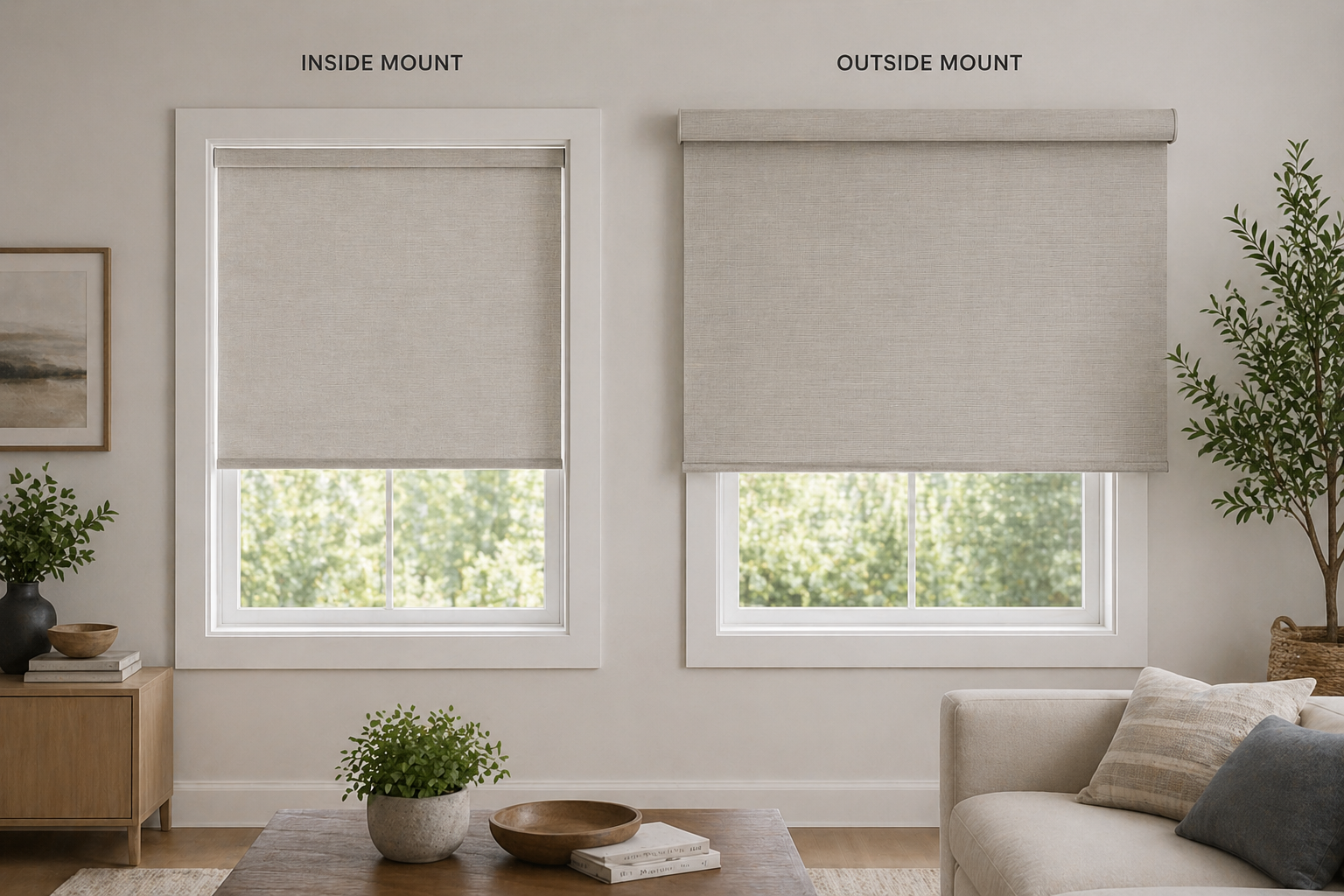
When choosing window blinds or shades, one of the most important decisions is whether to use an inside mount or outside mount. This choice affects how your window treatments look, how they function, and how much light they block.
Understanding the differences between inside and outside mounts will help you choose the best option for your windows and your space.
Browse our full selection of custom made window blinds and custom made window shades, or learn how to measure in our How to Measure for Blinds guide.
Watch: Inside Mount vs. Outside Mount Explained
What Is an Inside Mount?
Inside mount blinds or shades are installed within the window frame. This creates a clean, built-in appearance that sits flush within the window opening.
- Installed inside the window frame
- Creates a streamlined, finished look
- Requires precise measurements
Pros of Inside Mount
Clean, built-in appearance: Inside mount blinds and shades sit within the window opening, creating a streamlined look that feels integrated with the window rather than added on top of it. This is often a good choice when you want a clean, modern appearance.
Keeps decorative trim visible: Because the window treatment stays inside the frame, an inside mount allows attractive molding, woodwork, or decorative trim to remain visible instead of being covered.
Works well with layered window treatments: Inside-mounted blinds or shades can be paired easily with curtains, drapery, or another outside-mounted treatment. This gives you more flexibility to combine privacy, light control, and decorative elements.
Can preserve wall space around the window: Since the blind or shade fits inside the opening, it does not extend onto the surrounding wall or trim. This can be useful when windows are close together or when there is limited mounting space around the frame.
Cons of Inside Mount
May allow more light around the edges: Inside-mounted window treatments usually require small operating clearances between the product and the sides of the window opening. Those gaps can allow some light to enter, even when blackout fabric is used.
Requires sufficient mounting depth: Not every window has enough depth for an inside mount. The required depth varies by product, so it is important to check the minimum mounting depth before ordering.
Requires more precise measurements: Because the product must fit within the window opening, accurate width and height measurements are especially important. Uneven or out-of-square windows can make an inside mount more challenging.
Window hardware may cause interference: Handles, cranks, locks, or other hardware inside the window opening can interfere with the operation of an inside-mounted blind or shade. These obstructions should be considered when measuring.
What Is an Outside Mount?
Outside mount blinds or shades are installed outside the window frame, either on the wall or above the trim. This allows the window covering to fully cover the opening.
- Installed outside the window frame
- Covers the entire window opening
- Can be mounted on wall or trim
Pros of Outside Mount
Provides greater window coverage: Outside-mounted blinds and shades can extend beyond the edges of the window opening, which can help reduce light gaps and provide additional privacy.
Often better for room darkening: Because the window treatment can overlap the window opening, an outside mount is often the better choice when minimizing incoming light is a priority. This can be especially useful in bedrooms, nurseries, and media rooms.
Works well with shallow or uneven windows: An outside mount does not depend on having enough depth inside the window frame. It can also be more forgiving when the opening is uneven or not perfectly square.
Can make a window appear larger: Mounting the window treatment above and wider than the actual opening can create the visual impression of a taller or wider window.
Can hide unattractive trim or window frames: If the existing trim is damaged, dated, or simply not something you want to emphasize, an outside-mounted treatment can cover part or all of it.
Cons of Outside Mount
Creates a more prominent appearance: Because the blind or shade sits on the wall or trim rather than inside the window opening, it becomes a more visible part of the room.
May cover decorative trim: An outside mount can partially or completely cover window casing or molding, which may not be desirable if the trim is an important design feature.
Requires additional mounting space: You need enough flat wall or trim around the window to securely install the mounting brackets and accommodate the full width of the window treatment.
Usually requires a larger window covering: Since the product extends beyond the opening, outside-mounted blinds and shades are often ordered wider and sometimes taller than an inside-mounted version. This can slightly increase the overall cost depending on the product.
Inside Mount vs Outside Mount: Key Differences
| Feature | Inside Mount | Outside Mount |
|---|---|---|
| Appearance | Clean, recessed look that fits within the window opening | More prominent look because the treatment sits on the wall or trim |
| Window Trim | Keeps decorative trim and molding visible | May partially or completely cover the trim |
| Light Gaps | Small gaps around the edges are more common | Can overlap the window opening to reduce edge light |
| Blackout Performance | Good, but some light may enter around the edges | Typically better for reducing light gaps and improving room darkening |
| Mounting Depth | Requires sufficient depth inside the window frame | Does not require a deep window opening |
| Measuring | Requires more precise measurements to fit inside the opening | Generally more forgiving because the treatment covers the opening |
| Uneven or Out-of-Square Windows | Can be more difficult because the product must fit within the opening | Often a better choice because it does not need to fit inside the frame |
| Shallow Window Frames | May not be possible if there is not enough mounting depth | Often the better option for shallow windows |
| Window Size Appearance | Maintains the natural size and proportions of the window | Can make a small window appear larger by mounting above and wider than the opening |
| Layered Window Treatments | Works well as an inner layer beneath curtains or drapery | Can be used as an outer layer or when additional coverage is needed |
| Window Handles or Cranks | Hardware inside the opening may interfere with operation | Often provides more clearance around projecting hardware |
| Privacy | Provides good privacy but may leave small side gaps depending on the product | Can provide greater coverage around the window opening |
| Best For | Clean appearance, visible trim, deep window frames and layered treatments | Blackout, shallow windows, uneven openings and maximum coverage |
Quick rule of thumb: Choose an inside mount when you want a clean, built-in appearance and your window has enough mounting depth. Choose an outside mount when reducing light gaps, increasing coverage, or working around a shallow or uneven window is more important.
Which Mount Option Is Best?
The best choice depends on your goals and your window type:
- Choose inside mount for a clean, modern look and when your window frame has enough depth
- Choose outside mount for better light blocking, privacy, or if your window frame is shallow or uneven
When to Use Inside vs Outside Mount
| Situation | Best Option |
|---|---|
| Deep window frame | Inside mount |
| Need blackout or minimal light gaps | Outside mount |
| Show off window trim | Inside mount |
| Shallow window frame | Outside mount |
Measuring for Inside vs Outside Mount
Measuring correctly is essential for both mount types:
- Inside mount requires precise width and height measurements inside the frame
- Outside mount requires measuring the area you want to cover, including extra width for better coverage
Learn more:
How to Measure for Blinds
How to Measure for Shallow Mount Blinds and Shades
Roller Shade Measuring Instructions
How Much Mounting Depth Do You Need for an Inside Mount?
The amount of mounting depth required for an inside mount depends on the specific blind or shade. Some window treatments need only enough depth to securely attach the mounting brackets, while larger headrails, roller systems, and fully recessed installations may require considerably more space.
Before ordering an inside mount, always check the minimum mounting depth listed for the specific product. Also look for a separate flush-mount depth if you want the entire headrail or roller mechanism to sit completely within the window opening.
A window may technically have enough depth for an inside mount even when the product does not sit completely flush. In that situation, part of the headrail or shade may project beyond the face of the window opening.
Also consider anything inside the window opening that could interfere with the blind or shade, including:
- Window cranks
- Handles and locks
- Security sensors
- Screens
- Tile or backsplash
- Protruding trim or hardware
If the window is too shallow or has hardware that interferes with the treatment, an outside mount is often the easier and more practical choice.
Inside Mount vs Outside Mount for Blackout and Light Gaps
If reducing incoming light is one of your main goals, mount type can make a noticeable difference. Inside-mounted blinds and shades must fit within the window opening, which normally requires small operating clearances along the sides. Those clearances can allow some light to enter around the edges, even when the fabric itself is blackout.
An outside-mounted shade can extend beyond the width and height of the window opening, helping cover those gaps. For bedrooms, nurseries, media rooms, and other spaces where maximum room darkening is important, an outside mount will often provide better overall coverage.
Blackout fabric does not automatically mean a completely dark room. Blackout refers to the fabric's ability to prevent light from passing through the material. Light can still enter around the top, bottom, and sides of the window treatment.
For customers who want the greatest possible light control, consider an outside mount with additional overlap beyond the window opening. Certain products may also be available with side channels or other light-blocking options that can further reduce edge light.
An inside mount can still provide excellent room darkening when a clean, recessed appearance is more important than eliminating every trace of light.
Inside Mount vs Outside Mount by Window Treatment
Both mounting styles are available for many blinds and shades, but the best choice can vary depending on the product. Here are some general guidelines for common window treatments.
Roller Shades
Inside mount: Provides a clean, streamlined appearance with the roller mechanism positioned within the window opening. However, the shade fabric is typically narrower than the total bracket-to-bracket width, which can create visible gaps along the sides.
Outside mount: Allows the shade fabric to extend beyond the window opening and can provide better light coverage. An outside mount is often worth considering for blackout roller shades or whenever reducing side light is a priority.
Cellular Shades
Inside mount: Cellular shades are well suited to inside mounting because their compact headrails and fabric stack can create a clean, built-in appearance. This is a popular option when the window has sufficient mounting depth.
Outside mount: Provides additional coverage around the edges of the window and may improve room darkening. It can also be useful when the window opening is too shallow for the cellular shade you want.
Wood and Faux Wood Blinds
Inside mount: Often provides the most traditional built-in appearance for horizontal blinds. The window opening must be deep enough to accommodate the headrail and allow the slats to tilt and operate without interference.
Outside mount: Works well for shallow windows, uneven openings, or when you want to cover unattractive trim. Outside mounting can also provide greater privacy coverage around the edges of the window.
Roman Shades
Inside mount: Creates a tailored appearance that showcases decorative window trim. It can be an attractive choice when the window frame is deep enough and relatively square.
Outside mount: Can make the window appear taller or wider and may provide better coverage around the edges. Outside mounting can also hide unattractive trim or create a more dramatic decorative look.
Solar Shades
Inside mount: Gives solar shades a clean appearance while maintaining the architectural lines of the window. Keep in mind that side gaps are common because the fabric must be narrower than the complete operating system.
Outside mount: Provides additional coverage and may reduce glare entering around the sides of the shade. However, solar shades are designed to manage glare and UV exposure rather than provide complete blackout.
Vertical Blinds
Inside mount: May work when there is enough depth inside a large window or door opening to accommodate the headrail and vertical vanes.
Outside mount: Is very common for sliding patio doors and wide openings. Mounting above the opening gives the vanes room to operate and can allow the treatment to extend beyond the door for greater coverage.
Panel Track Shades
Inside mount: Can provide a clean look on large recessed openings when sufficient depth is available for the track system.
Outside mount: Is often preferred for sliding doors and wide openings because the track can be installed above the opening and extended beyond it, allowing the panels to stack more completely away from the active door area.
Special Window Situations to Consider
Uneven or Out-of-Square Windows
An inside mount requires the blind or shade to fit within the actual window opening, so an opening that is noticeably narrower at the top, middle, or bottom can create installation or operating problems.
When measuring for an inside mount, take multiple width and height measurements according to the instructions for the specific product. If the window is significantly out of square, an outside mount may be more forgiving because the treatment does not have to fit precisely within the opening.
Shallow Window Frames
Shallow windows are one of the most common reasons to choose an outside mount. If there is not enough depth to securely install the brackets, or if the headrail would interfere with the glass or window hardware, an inside mount may not be practical.
Always compare your available depth with the product's minimum mounting-depth requirement before ordering. Learn more about flush mount vs protruding blinds and shades on an inside mount.
Window Cranks, Handles, and Locks
Window hardware can interfere with the operation of an inside-mounted blind or shade. Cranks and handles that project into the window opening may prevent the treatment from lowering completely or may rub against the fabric, slats, or bottom rail.
Measure how far the hardware projects into the opening and compare that measurement with the position of the window treatment. If there is not enough clearance, an outside mount can move the blind or shade farther away from the obstruction.
Decorative Window Trim
If your window has attractive wood casing, molding, or decorative trim that you want to keep visible, an inside mount is usually the better design choice. The treatment remains within the opening and allows the surrounding trim to remain part of the room's appearance.
An outside mount may be preferable when the trim is damaged, uneven, outdated, or something you would rather conceal. It can also create the appearance of a larger window when the treatment is mounted above and wider than the existing trim.
Inside vs Outside Mount for Blinds vs Shades
Both blinds and shades can be installed as inside or outside mounts. However, outside mount is often preferred for blackout shades, while inside mount is commonly used for blinds where appearance is a priority.
| Mount Type | Advantages | Disadvantages |
|---|---|---|
| Inside Mount |
|
|
| Outside Mount |
|
|
Explore Window Treatment Options
Final Thoughts
Choosing between inside mount and outside mount blinds or shades depends on your window, your design preferences, and how much light control you need. Inside mount offers a clean, built-in look, while outside mount provides better coverage and light blocking.
Inside vs Outside Mount FAQs
Is inside mount or outside mount better?
Neither mounting style is automatically better. An inside mount is usually preferred when you want a clean, recessed appearance and the window has enough mounting depth. An outside mount is often better when you want greater coverage, reduced light gaps, or need to work around a shallow or uneven window opening.
Do inside mount blinds let in more light?
They can. Inside-mounted blinds and shades normally require small clearances around the edges so they can operate properly. Those gaps may allow some light to enter around the sides, especially with roller and blackout shades.
Are outside mount shades better for blackout?
Outside mounting is often better for room darkening because the shade can extend beyond the edges of the window opening. This helps reduce the amount of light that enters around the sides and top of the treatment.
Do outside mount blinds make windows look bigger?
They can. Mounting the treatment above the window and extending it wider than the opening can create the visual impression of a taller and wider window.
Can you inside mount blinds on a shallow window?
Possibly. Some blinds and shades require very little mounting depth, while others need considerably more space. Check the minimum mounting depth for the specific product before ordering. A partial inside mount may also be possible even when there is not enough depth for a completely flush installation.
Which mount is better if my window is not square?
An outside mount is generally more forgiving because the treatment does not need to fit precisely within an uneven opening. Inside-mounted products require more accurate measurements and may not operate properly if the window is significantly out of square.
Can I mount blinds directly on the window trim?
Many outside-mounted blinds and shades can be installed on suitable window trim. The trim should be flat, secure, and large enough to properly support the mounting brackets. Always follow the installation requirements for the specific product.
What if my window has a crank or handle?
Measure how far the crank, handle, or lock projects into the window opening before choosing an inside mount. If the hardware would interfere with the blind or shade, an outside mount may provide the necessary clearance.
Can all blinds and shades be installed as inside or outside mount?
Many products offer both options, but not every mounting style works with every window or product configuration. Available mounting depth, window hardware, product dimensions, and installation requirements should all be checked before ordering.
Can I use an inside mount with curtains or drapes?
Yes. An inside-mounted blind or shade works very well with curtains or drapery because the window treatment sits within the opening while the decorative fabric can be mounted outside the frame.
How far should outside mount blinds extend past the window?
The amount of overlap depends on the product and your goals for privacy and light control. Extending the treatment beyond the window opening can help reduce light gaps, but you should follow the measuring recommendations for the specific blind or shade you are ordering.