







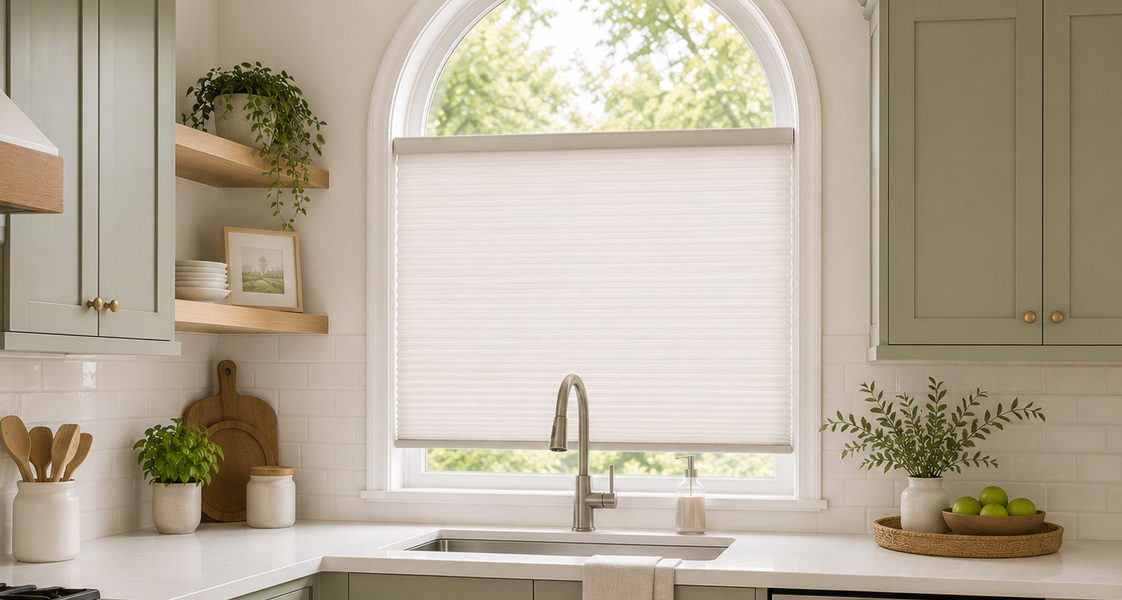
Arched windows are beautiful architectural features, and you do not necessarily have to cover the arch itself to add privacy and light control to the rectangular portion of the window below it. One popular solution is to mount a blind or shade horizontally at the point where the arch begins, leaving the curved portion above completely open.
You can also use two separate treatments: a standard window blind or shade for the rectangular portion of the window and a separate arch window treatment above it. This allows you to control privacy and light through the lower portion while deciding independently whether the arch should remain uncovered or have its own specialty treatment.
The most important part of measuring is identifying exactly where the straight sides of the window end and the curved arch begins. That point becomes the top of the lower blind or shade and determines both your width measurement and your mounting location.
This guide explains how to measure the rectangular portion below an arch, how side-mount brackets may affect the width you order, and what to consider if you plan to add a separate treatment to the arch. Explore our best window treatments for arch windows.
How Do You Measure a Blind or Shade Below an Arched Window?
First locate the point on both sides of the window where the vertical sides stop and the curved arch begins. Measure horizontally between those two points to determine the width available for the blind or shade.
Next, measure vertically from that same arch-start line down to the bottom of the window opening. That gives you the height of the rectangular area you want to cover.
The exact width you should order depends on the type of blind or shade and how its brackets attach. Some treatments installed directly below an open arch require side-mount or L-bracket hardware and may need additional clearance. Other products use bracket systems that allow you to provide the exact opening measurement without making the same deduction.
| Measurement | Where to Measure | Why It Matters |
|---|---|---|
| Arch Start Width | From one side of the opening to the other where the curve begins | Determines the available width for the lower treatment |
| Lower Window Height | From the arch-start line to the bottom of the opening | Determines the height of the lower blind or shade |
| Mounting Clearance | Available space at each side where the treatment will mount | Determines whether side-mount or L-bracket hardware will fit |
| Window Depth | Depth of the opening at the mounting location | Helps determine whether the selected product and brackets can be installed |
Step 1: Find Where the Arch Begins
The first measurement is not the highest point of the arch. Instead, locate the two points where the straight vertical sides of the window transition into the curved top.
Imagine drawing a horizontal line from one side of the window to the other at those points. That line represents the top edge of the rectangular window treatment.
Why This Measurement Is Important
If the shade is mounted too high, its headrail or brackets can extend into the curved portion of the window where there may not be enough flat mounting surface. If it is mounted too low, you may unnecessarily leave part of the rectangular glass uncovered.
The goal is generally to position the blind or shade as close as practical to the point where the arch begins while still providing enough mounting surface for the specific hardware.
Step 2: Measure the Width Where the Arch Begins
Measure horizontally across the window at the exact point where the arch begins. Measure from the inside surface on the left to the inside surface on the right.
Take the measurement carefully with a steel tape measure and record the exact width before making any product-specific deduction.
Check the Width More Than Once
Even if the window looks perfectly symmetrical, measure the opening at the arch-start line and again slightly below it. Architectural window openings are not always perfectly square or uniform.
If the measurements differ, use the measuring requirements for the exact blind or shade you are ordering to determine which dimension should be submitted.
Step 3: Measure the Height of the Rectangular Portion
Measure vertically from the horizontal line where the arch begins down to the bottom of the window opening.
Take the height measurement on the left, center and right portions of the opening when possible. This helps identify whether the sill or lower portion of the window is uneven.
The product-specific measuring instructions will tell you whether to submit the shortest, longest or exact height measurement for the treatment you select.
How Is a Blind or Shade Mounted Below an Open Arch?
Unlike a typical inside-mounted shade that can attach to a horizontal surface above the headrail, a treatment installed directly where an open arch begins may not have a flat surface immediately above it.
For some products, this requires side-mount or L-bracket installation. The brackets attach to the vertical sides of the window opening and support the headrail from each end.
Why the Bracket Type Matters
Side-mount brackets occupy some of the available width. That means the blind or shade itself may need additional clearance so both the treatment and the brackets fit between the sides of the opening.
Blinds Chalet's existing measuring instructions for applicable shades installed below an open arch specify measuring the exact opening width and allowing approximately 1/4 inch of total clearance for the L-bracket installation. However, this should not be treated as a universal deduction for every product because mounting hardware varies.
Always verify the side-mount requirements for the exact treatment before making your final deduction.
Measuring Horizontal Blinds Below an Arch
Mini blinds and larger horizontal blinds can use different mounting hardware than fabric shades. Because of this, the width calculation may not be the same as it is for a shade that requires L brackets.
Blinds Chalet's existing instructions specify that mini blinds and 2-inch horizontal blinds installed in this application should be measured using the exact opening width without taking the same 1/4-inch L-bracket deduction described for applicable shades.
This is an important example of why you should select the product before making a final measurement adjustment. Two treatments installed in exactly the same window may require different ordering dimensions because their bracket systems are different.
Measuring Cellular Shades Below an Arched Window
Cellular shades are a popular option for the rectangular portion of an arched window because their compact headrail can work well below the curved section and the shade provides privacy, light control and insulation through the lower portion of the glass.
Depending on the cellular shade and mounting configuration, side-mount or L brackets may be required when there is no horizontal mounting surface directly above the headrail.
Measure the exact width where the arch begins first. Then verify the side-mount bracket requirements for the specific cellular shade before determining the final order width.
You can compare available cellular shades before finalizing your measurements.
Can Every Blind or Shade Be Mounted Below an Open Arch?
No. The limiting factor is often not the shape of the window but the mounting hardware used by the specific treatment.
If there is no horizontal mounting surface above the treatment, the product must have a compatible method for mounting from the sides of the opening. Some bracket systems are not designed for this installation.
For example, Blinds Chalet's existing instructions note that some woven wood shades and soft sheer horizontal products are not suitable for this type of installation because their brackets do not work with the required L-bracket configuration.
Check Before Ordering
If you want a particular shade style for the lower portion of an arched window, confirm that the product supports side mounting before placing the order. Do not assume that every treatment available as a standard inside mount can also be suspended below an open arch.
Quick Q&A: Can you Mount Window Blinds on the Sides of Windows?
Using a Palladian Shelf for Larger Arched Windows
For larger arched windows, a Palladian shelf can provide a practical mounting surface between the rectangular lower portion of the window and the arch above. The shelf spans across the opening at the point where the arch begins, creating a flat horizontal surface for mounting a blind or shade below it.
This can be especially helpful when the window is too wide for a side-mounted treatment or when the selected blind or shade requires a top-mount bracket rather than an L-bracket or side-mount installation.
The arch above the shelf can be left open or covered with a separate arch window treatment. When measuring, account for the thickness and placement of the Palladian shelf because it becomes the mounting reference for the lower blind or shade.
If you are considering a Palladian shelf for a large arch, contact Blinds Chalet before ordering so we can help confirm the mounting method and measurements for the specific treatment you want to use.
Option 1: Leave the Arched Portion Open
Leaving the arch uncovered is often the simplest approach and allows the architectural shape of the window to remain visible.
The blind or shade covers only the rectangular portion below the arch. When lowered, it provides privacy and light control through the lower portion while daylight continues to enter through the arch above.
Advantages of Leaving the Arch Open
- Preserves the architectural appearance of the arched window.
- Allows additional natural light into the room.
- Requires only one standard rectangular blind or shade.
- Can be less expensive than adding a separate specialty arch treatment.
- Allows independent control of the lower portion of the window.
Things to Consider
An uncovered arch will continue to admit light even when the lower shade is closed. It can also allow visibility through the upper glass depending on the height and location of the window.
If blackout, glare control or complete privacy is important, leaving the arch open may not provide the performance you need.
Option 2: Add a Separate Window Treatment to the Arch
Another option is to use two treatments: a rectangular blind or shade below the arch and a separate specialty window treatment made specifically for the arched portion above it.
This allows the two portions of the window to be measured and treated independently.
Advantages of a Separate Arch Treatment
- Provides additional light control through the upper glass.
- Can improve privacy compared with leaving the arch uncovered.
- Allows the architectural shape to remain visible while still covering the glass.
- The lower blind or shade can continue to operate independently.
Coordinate the Two Treatments
If both sections will be covered, consider how the colors, materials and headrails will look together. The lower treatment does not necessarily need to be identical to the arch covering, but coordinating colors and materials usually creates a more intentional finished appearance.
Leave the Arch Open or Cover It Separately?
| Consideration | Leave Arch Open | Separate Arch Treatment |
|---|---|---|
| Natural Light | Maximum light through upper arch | Depends on arch treatment |
| Architectural Appearance | Arch remains completely exposed | Arch shape remains but glass is treated |
| Privacy | Limited through upper glass | Can provide greater privacy |
| Room Darkening | Upper arch continues to admit light | Can improve overall light control |
| Cost | Generally simpler | Requires an additional specialty treatment |
| Measuring | Measure rectangular portion only | Rectangular and arch sections must be measured separately |
What About Light Gaps Below the Arch?
Because the lower blind or shade stops at the point where the arch begins, some light may be visible around the headrail depending on the mounting system and window construction.
The arch itself will also remain a significant source of incoming light if it is left uncovered.
For Bedrooms and Blackout Applications
If you need a very dark room, covering only the rectangular portion of the window may not be sufficient. Even a blackout shade below the arch cannot prevent sunlight from passing through uncovered glass above it.
In that situation, consider a separate arch treatment or another window covering solution that addresses the entire opening.
Does Leaving the Arch Open Affect Privacy?
It can. The lower blind or shade can provide excellent privacy through the rectangular portion, but the upper arch remains uncovered.
Whether that matters depends on the height of the window, the angle from which someone could view it and what is outside the home.
A high arch may create little practical privacy concern, while an arch near eye level or facing a neighboring property may warrant a separate treatment.
Example: Measuring a Shade Below an Arched Window
Suppose an arched window is 48 inches wide at the point where the curved top begins. The rectangular section from that point to the bottom sill measures 60 inches high.
| Measurement | Example |
|---|---|
| Width Where Arch Begins | 48 inches |
| Height Below Arch | 60 inches |
| Applicable L-Bracket Clearance Example | Approximately 1/4 inch total where required by the product |
| Example Shade Width With Applicable Clearance | 47 3/4 inches |
This example illustrates the measuring concept only. Do not automatically deduct 1/4 inch from every blind or shade. The appropriate width depends on the mounting brackets and measuring requirements of the specific product.
Common Mistakes When Measuring Below an Arched Window
Measuring at the Widest Part of the Arch
The measurement that matters for the lower treatment is generally the width where the straight sides meet the curve, not the width or height at another point within the arch.
Assuming There Is a Top Mounting Surface
At the point where the arch begins, there may be no horizontal surface above the blind. Confirm that the treatment supports side mounting before ordering.
Using the Same Deduction for Every Product
Bracket systems vary. A deduction appropriate for an L-bracket-mounted shade may not be appropriate for a horizontal blind with a different mounting system.
Forgetting That the Arch Will Still Admit Light
A blackout shade below an uncovered arch will darken only the rectangular portion of the window. The uncovered arch can continue to admit substantial daylight.
Assuming Every Shade Can Be Side Mounted
Some products require mounting hardware that cannot be adapted to the sides of the window opening. Confirm compatibility before ordering.
Not Measuring the Window at Several Points
Arched openings are not always perfectly symmetrical. Verify the width near the arch-start line and measure the rectangular height in several locations before finalizing the order.
Arched Window Measuring Checklist
- Locate where the arch begins: Find the point on each side where the straight vertical edge transitions into the curve.
- Measure the width at that point: Measure horizontally from inside edge to inside edge.
- Measure the lower height: Measure from the arch-start line to the bottom of the opening.
- Measure in multiple locations: Check for variations in width and height.
- Choose the lower treatment: Determine which blind or shade you want to use.
- Confirm side-mount capability: Verify that the product can be installed without a horizontal mounting surface above it.
- Check bracket clearance: Determine whether the product requires an L-bracket or other side-mount deduction.
- Do not assume one deduction fits every product: Follow the measuring instructions for the exact treatment.
- Decide whether the arch will remain open: Consider privacy, glare and room-darkening needs.
- If covering the arch, treat it separately: Measure the specialty arch treatment according to its own instructions.
- Confirm before ordering: If you are unsure about the mounting hardware or measurement, contact Blinds Chalet before placing the order.
Not Sure Whether Your Shade Can Mount Below the Arch? We Can Help
Arched windows vary considerably, and the most important question is often not the measurement itself but whether the mounting hardware for the treatment you want can be installed at the point where the arch begins.
If you are uncertain, measure the width where the arch starts, measure the height of the rectangular portion below it and take a photo showing the entire window and the area where you want the headrail to mount.
Our window treatment team can help you determine whether the product supports the required mounting method and walk you through the appropriate measurements before you order.
This is particularly helpful if you are deciding between leaving the arch open and using a separate arch treatment, or if the window has unusual trim, limited mounting depth or an irregular transition between the rectangular and curved portions.
Expert Guidance from Blinds Chalet
Blinds Chalet has helped homeowners measure and order custom window treatments since 2006. When covering only the rectangular portion below an arched window, one of the most important details is identifying the exact line where the arch begins and understanding how the selected treatment will be mounted there.
A standard blind or shade normally has a horizontal mounting surface above it. Below an open arch, that surface may not exist, which is why the product's bracket system becomes so important. Some shades can use side-mount or L brackets, while other treatments use different hardware or may not be suitable for this application at all.
We recommend choosing the product before making your final width deduction. Measure the opening accurately first, then use the specific mounting requirements for the treatment you plan to order. If you are unsure whether a blind or shade can be side mounted, contact us before ordering rather than trying to adapt incompatible hardware during installation.
You should also decide whether leaving the arch uncovered meets your privacy and light-control needs. Keeping the arch open preserves the architectural feature and natural light, while a separate arch treatment can provide additional privacy and room darkening when needed.
Explore more:
How to Measure for Blinds & Shades
How to Measure Corner Windows for Blinds
How to Measure Patio Doors for Vertical Blinds
How to Measure Blinds or Shades with Tile or Molding
How to Measure Window Treatments for Bay Windows
How to Measure for RV Windshield Shades for Blinds
How to Measure for Roller Shades
How to Measure for Shallow Mount Blinds or Shades
How to Measure Window Treatments Between Cabinets
How to Measure for Shutters
Guide to Specialty Window Treatments
Shop Blinds and Shades for the Lower Window
Measuring Blinds Below Arched Windows FAQs
How do I measure a blind or shade below an arched window?
Locate the points where the straight sides of the window transition into the curved arch. Measure horizontally between those points for the width, then measure vertically from that line to the bottom of the window opening for the height. Verify the mounting requirements of the specific blind or shade before making any width deduction.
Can I leave the top of an arched window uncovered?
Yes. A blind or shade can cover only the rectangular portion below the arch while leaving the curved upper section open. This preserves the architectural appearance and allows additional natural light through the upper glass.
Can I put a separate shade in the arched portion of the window?
Yes. The rectangular lower section and arched upper section can be treated separately. A standard blind or shade can cover the lower portion while a compatible specialty arch treatment covers the curved glass above.
Where should the headrail go below an arched window?
The headrail is generally positioned at or just below the horizontal line where the straight sides of the window transition into the curved arch, provided there is enough mounting area and the product supports the required bracket configuration.
Do shades below an arch need special brackets?
Some do. When there is no horizontal mounting surface above the shade, a compatible product may require side-mount or L brackets that attach to the vertical sides of the window opening. Bracket requirements vary by product.
Should I subtract 1/4 inch when measuring a shade below an arch?
Some Blinds Chalet shades that use L brackets in this application require approximately 1/4 inch of total clearance, but this is not a universal deduction. Other blinds use different mounting systems and may require the exact opening width. Follow the instructions for the specific product you are ordering.
How do I measure mini blinds below an arched window?
Blinds Chalet's measuring guidance for applicable mini blinds and 2-inch horizontal blinds calls for providing the exact opening width rather than using the same L-bracket deduction required by certain shades. Always confirm the instructions for the exact blind before ordering.
Can cellular shades be installed below an arched window?
Many cellular shades can work well below an arch when the specific product supports the necessary side-mount hardware. Measure the opening where the arch begins and verify the bracket and width requirements before placing the order.
Can every window shade be installed below an open arch?
No. Some products use mounting brackets that require a horizontal mounting surface and cannot be adapted to a side-mount installation. Confirm that the selected blind or shade supports the required mounting method before ordering.
Will a blackout shade below an arch make the room completely dark?
No. A blackout shade can block light through the rectangular portion it covers, but an uncovered arch will continue to admit light. If maximum room darkening is important, consider adding a separate treatment to the arched portion as well.
Can Blinds Chalet help me measure an arched window?
Yes. Measure the width where the arch begins and the height of the rectangular section below it. A photo of the entire window and proposed mounting area can also be helpful. Blinds Chalet can help you determine whether the product you are considering supports the required mounting method and which measurements to use.