







Large windows can sometimes be too wide or heavy for one horizontal blind, or you may want the flexibility to operate different sections of the window independently. One solution is to install two separate blinds side by side within the same window opening. Another option on select products is to use two or more blind sections beneath one shared headrail.
This guide focuses primarily on measuring two completely separate blinds in one inside-mount window opening. The basic process is to measure the entire opening first, decide where the two blinds should meet, divide the full width between the two blinds and order both treatments as inside mounts.
If you prefer one continuous headrail, see our 2-on-1 headrail measuring and ordering instructions or explore multiple blinds on one headrail.
Using two blinds can be particularly useful for large window blinds because each section is lighter and easier to operate than one oversized blind. You can also browse our horizontal blinds or review our guide to the best blinds for large windows before deciding which configuration is right for your opening.
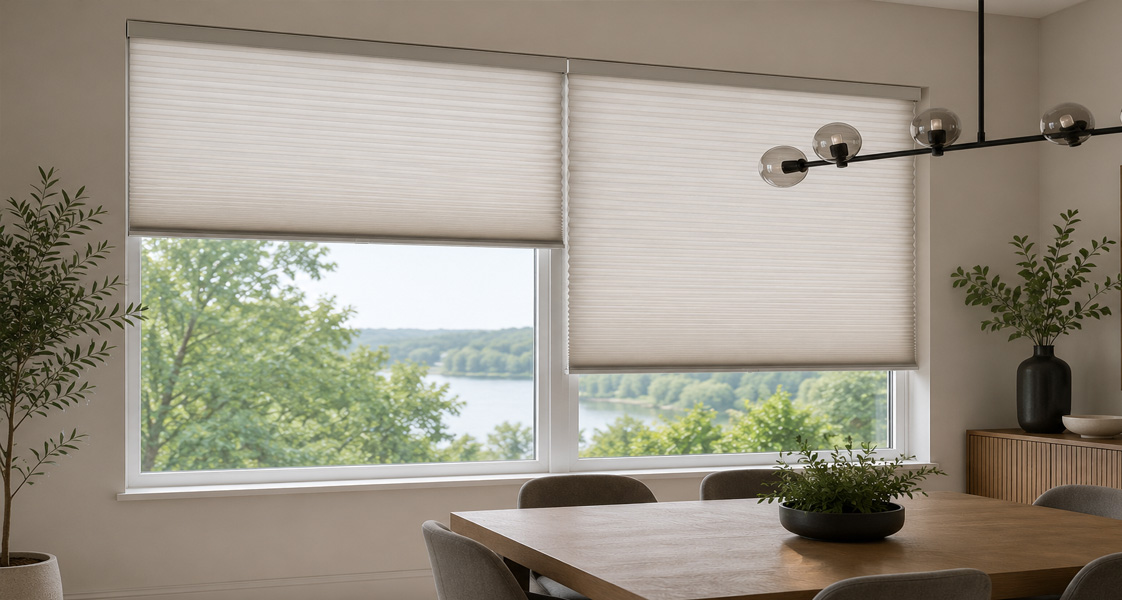
How Do You Measure Two Blinds for One Window?
Measure the full inside width of the window opening first. Then decide where you want the two blinds to meet and divide the total width between the left and right treatments.
If the window is evenly divided, each blind will usually receive approximately half of the total measured width. For example, if the inside opening measures 72 inches wide, you could use 36 inches as the measured width for each blind.
Both blinds should be ordered as inside mount. Unless the measuring instructions for the specific product tell you otherwise, do not make your own additional factory deduction. The manufacturer will make the appropriate inside-mount deductions for each blind.
| Measurement | What to Do | Example |
|---|---|---|
| Full Window Width | Measure the complete inside opening | 72 inches |
| Left Blind Width | Assign part of the total width to the left blind | 36 inches |
| Right Blind Width | Assign the remaining width to the right blind | 36 inches |
| Combined Width | Both measured widths should equal the full measured opening | 72 inches |
| Height | Use the appropriate inside-mount height measurement for both blinds | 60 inches |
| Mount Type | Order both treatments as inside mount | Inside Mount |
Why Use Two Blinds in One Large Window?
One large horizontal blind can become increasingly heavy as the width and height increase. Dividing a large opening between two blinds reduces the amount of weight you need to lift at one time and lets each section operate independently.
Advantages of Two Separate Blinds
- Each blind is lighter and easier to raise and lower.
- You can operate each side independently.
- You can leave one side open while keeping the other closed.
- Two smaller blinds may fit within product size limitations when one oversized blind does not.
- One blind can generally be repaired or replaced without replacing the other.
- A shared valance may be available on some products to create a more unified appearance.
For more information about treatments designed for oversized openings, see our large window blinds options.
Step 1: Measure the Full Inside Width of the Window
Start by measuring the entire inside width of the window opening from the left inside edge to the right inside edge. Do not begin by independently measuring two halves of the window.
Measure the width at the top, middle and bottom of the opening according to the measuring instructions for the horizontal blind you plan to order. Window openings are not always perfectly square, so taking several measurements can reveal small variations.
For complete general instructions, see our how to measure window blinds guide.
Why Measure the Whole Window First?
Measuring the complete opening first gives you one reliable total width to work from. You can then divide that measurement between the two treatments and verify that the two measured sections add back up to the complete opening.
If you measure each half independently without first establishing the full width, small measuring differences can create an unnecessary center gap or make the combined measurements too large.
Step 2: Decide Where the Two Blinds Should Meet
In many windows, the simplest approach is to divide the opening exactly in half. However, the two blinds do not have to be the same width.
If the window has a vertical mullion or frame division, it is usually best to position the meeting point between the blinds directly in front of that architectural division whenever possible.
Why Align the Center Gap With a Window Mullion?
Two separate blinds will normally have a small amount of clearance where the headrails and slats meet. Positioning that junction over an existing mullion helps hide the gap and can make the finished installation look more intentional.
It can also reduce the visual effect of light entering between the blinds because the solid window frame is positioned behind the center junction.
Step 3: Divide the Total Width Between the Two Blinds
Once you have measured the complete opening and selected the center point, divide the total width between the left and right blinds.
Equal Split Example
If the window opening measures 72 inches wide and you want an equal split, use 36 inches as the measured width for the left blind and 36 inches for the right blind.
The two measured widths add back up to the original 72-inch opening.
Unequal Split Example
Suppose the opening measures 80 inches wide, but the vertical mullion is located 38 inches from the left side. In that situation, using 38 inches for the left blind and 42 inches for the right blind would align the junction with the window rather than forcing two 40-inch blinds.
| Full Opening | Left Blind | Right Blind | Combined Width |
|---|---|---|---|
| 72 inches | 36 inches | 36 inches | 72 inches |
| 80 inches | 40 inches | 40 inches | 80 inches |
| 80 inches with offset mullion | 38 inches | 42 inches | 80 inches |
Step 4: Order Both Blinds as Inside Mount
When two separate blinds are being installed side by side within the same continuous window opening, order both treatments as inside mount.
Enter the portion of the opening assigned to each blind as that blind's measured width. The manufacturer can then make the normal inside-mount deductions required for the particular product.
Do Not Automatically Make Your Own Factory Deduction
Unless the measuring instructions for the specific blind tell you otherwise, provide the actual measured portion of the window rather than subtracting additional width yourself.
Making your own deduction and then having the manufacturer make its normal inside-mount deduction can result in larger side gaps or a larger center gap than necessary.
Step 5: Measure the Height for Both Blinds
Measure the inside height of the full window according to the instructions for the product you are ordering. Take measurements on the left, center and right because the sill or top of the opening may not be perfectly level.
In most installations, both blinds should use the same measured height so the headrails and bottom rails align when the treatments are lowered.
Follow the product-specific instructions for determining which height measurement to submit.
Will There Be a Gap Between the Two Blinds?
Yes. There will generally be a small amount of space where two independent blinds meet. Each treatment has its own headrail, end caps and operating clearance, so the two blinds cannot occupy exactly the same space.
The actual center gap varies by product construction, headrail design, slat size and factory deductions.
How to Make the Center Gap Less Noticeable
- Align the junction with a vertical window mullion whenever possible.
- Install the two headrails as close together as the brackets and product allow.
- Use the same blind style, slat size and color on both sides.
- Keep both headrails at the same mounting height.
- Consider a continuous valance when the product offers one.
If blackout or maximum room darkening is important, remember that two separate blinds can allow additional light through the center junction compared with one continuous treatment.
Can Two Separate Blinds Use One Valance?
Some horizontal blinds can use a common valance that spans across both separate headrails. This can make the installation look more like one unified window treatment even though there are two independent blinds underneath.
The individual blinds still retain their own headrails and operate separately, but the continuous valance helps conceal the hardware and center junction.
Why Consider a Shared Valance?
- Creates a more continuous appearance across the large window.
- Helps conceal the two separate headrails.
- Can make the installation look more like one custom treatment.
- Still allows each blind to operate independently.
Valance availability and maximum valance widths vary by product, so check the options for the exact blind before ordering.
Where Should the Controls Be Located?
Control placement is worth considering when you install two blinds next to each other.
When the product allows you to select control locations, positioning the controls toward the outside ends of the window can help keep the center junction cleaner and make each treatment easier to operate.
For example, controls for the left blind can be placed toward the left side and controls for the right blind toward the right side when the product configuration allows it.
Available control locations vary by blind and operating system.
Two Separate Blinds vs. Two Blinds on One Headrail
Two separate blinds are not the only way to divide a large window into independently operated sections. Some horizontal blinds are also available with two blind sections mounted beneath one continuous headrail, commonly called a 2-on-1 headrail.
Both configurations can reduce the amount of weight you need to raise at one time and allow the left and right sections to operate independently, but they are constructed, measured and ordered differently.
| Feature | Two Separate Blinds | 2-on-1 Headrail |
|---|---|---|
| Headrail | Each blind has its own separate headrail | Both blind sections share one continuous headrail |
| Operation | Each blind operates independently | Each blind section generally operates independently |
| Measuring | Divide the full window width between two separate inside-mount blinds | Follow the product's specific 2-on-1 headrail measuring instructions |
| Center Junction | Two separate headrails meet near the center | One continuous headrail spans the opening |
| Appearance | A common valance may help create a unified appearance | Continuous headrail provides a more integrated appearance |
| Installation | Each blind is mounted separately | One larger headrail is mounted across the opening |
| Product Availability | Possible with many horizontal blinds | Available only on products offering multiple blinds on one headrail |
| Replacement | One complete blind can generally be replaced separately | Blind sections are part of the same headrail system |
If you are deciding between these configurations, see our detailed comparison of 2-on-1 headrail vs. two separate blinds.
What If You Want Two Blinds on One Headrail?
If you want the appearance of one continuous headrail but still want to operate each side of a large window independently, a 2-on-1 headrail may be a better option than ordering two completely separate blinds.
With this configuration, two blind sections are manufactured beneath one shared headrail. The center division can often be positioned to align with a vertical window mullion, helping the treatment coordinate with the architecture of the window.
Do Not Measure a 2-on-1 Headrail the Same Way as Two Separate Blinds
The instructions on this page for dividing the opening into two separate inside-mount blinds apply when you are ordering two independent blinds with two independent headrails.
If you are ordering a 2-on-1 headrail, follow the measuring and ordering instructions specifically for that option. See how to measure and order a 2-on-1 headrail before submitting your measurements.
When a 2-on-1 Headrail Is Worth Considering
- You want one continuous headrail across the large window.
- You want the two blind sections to operate independently.
- You want the center split positioned over a window mullion.
- One oversized blind would be too heavy or exceed the product's size limitations.
- You prefer a more unified appearance than two separate headrails.
You can also review our multiple blinds on one headrail options to learn more about available configurations.
What Are Multiple Blinds on One Headrail?
Depending on the product, large windows may be covered with more than two independently operated blind sections under one common headrail. These configurations are useful when an opening is especially wide or when the window itself is divided into several individual sections.
The advantage is that the headrail can create one continuous visual line across the opening while the individual blind sections below can be raised and lowered separately.
Multiple Blind Sections Can Be Useful When
- A very wide window is divided by multiple vertical mullions.
- One large blind would be too heavy to operate comfortably.
- The required width exceeds the limits of one standard blind.
- You want independent control over several sections of the window.
- You want one continuous headrail rather than several separate headrails.
See our multiple blinds on one headrail page for more information about available configurations.
Should You Use One Large Blind or Two Smaller Blinds?
The best choice depends on the size of the opening, product limitations, weight, appearance and how you want to operate the window treatment.
| Consideration | One Large Blind | Two Separate Blinds |
|---|---|---|
| Appearance | One continuous treatment | Small center junction |
| Weight | Heavier | Weight divided between two treatments |
| Independent Control | No | Yes |
| Large Window Size Limits | May exceed product limitations | Can allow treatment of larger openings |
| Center Light Gap | No center junction | Small gap between treatments |
| Flexibility | Entire blind operates together | Either side can be operated independently |
For a broader comparison of window treatment options for oversized openings, see our guide to the best blinds for large windows.
Example: Measuring Two Blinds for a 96-Inch-Wide Window
Suppose your window opening measures 96 inches wide by 60 inches high and has a mullion exactly in the center.
You could divide the opening into two 48-inch measured sections and order both blinds as inside mounts.
| Measurement | Example |
|---|---|
| Full Inside Width | 96 inches |
| Left Blind Measured Width | 48 inches |
| Right Blind Measured Width | 48 inches |
| Combined Measured Width | 96 inches |
| Measured Height | 60 inches |
| Mount Type | Inside mount for both blinds |
The finished blind widths may be slightly narrower because the manufacturer can make the appropriate inside-mount deductions for each product.
What If the Window Is Not Divided Exactly in Half?
You do not have to split a large window exactly in half. If the window has an off-center mullion or one section of glass is wider than the other, divide the blind measurements according to the actual architecture of the window.
For example, an 84-inch opening might have a mullion 40 inches from the left side. In that situation, a 40-inch left measurement and 44-inch right measurement may make more sense than ordering two 42-inch blinds.
The most important rule is that the two measured widths should add up to the complete opening width and the center junction should be positioned where you want the blinds to meet.
What If There Is a Wide Mullion Between the Windows?
A wide center mullion can make a two-blind installation especially effective because it provides a natural location for the center gap.
Measure the complete opening first, then identify the center point where you want the two headrails to meet. If the mullion is wide enough, the operating gap between the blinds can sit directly in front of it and become much less noticeable.
Do not automatically subtract the width of the mullion from the overall measurements unless the blinds are actually being mounted inside two completely separate recessed openings. The correct measuring method depends on whether you have one continuous opening or two distinct window openings.
Common Mistakes When Measuring Two Blinds in One Window
Measuring Each Half Separately Before Measuring the Full Opening
Always establish the full opening width first. Two independently measured halves can accidentally produce measurements that do not add up correctly.
Making Your Own Inside-Mount Deduction
Unless the product instructions specifically require it, do not subtract additional width before ordering. Manufacturers commonly make the necessary inside-mount deductions.
Forgetting About the Center Gap
Two separate blinds will normally have a small space between them. Align that junction with a mullion whenever possible.
Forcing an Equal Split When the Window Is Not Equal
If the window has an off-center mullion, use measurements that align the blind junction with the actual window structure rather than automatically dividing the width in half.
Ordering a 2-on-1 Headrail Using Two-Separate-Blind Measurements
A 2-on-1 headrail is a different product configuration and should be measured and ordered using the instructions for that option. Do not assume the ordering process is identical simply because the finished window also has two blind sections.
Ordering One Blind as Inside Mount and the Other as Outside Mount
For two blinds installed side by side within one continuous window opening, both should generally use the same inside-mount configuration so the headrails align correctly.
Using Different Heights
Two blinds installed next to each other generally look best when their headrails and bottom rails align. Measure the entire opening carefully before assigning different heights.
Ignoring Product Size Limitations
Even after dividing the opening, verify that each individual blind falls within the minimum and maximum width and height limitations of the selected product.
Two-Blind Measuring Checklist
- Choose the horizontal blind: Confirm that the product can be manufactured in the required individual sizes.
- Measure the full inside width: Measure the complete opening before dividing it.
- Measure at the top, middle and bottom: Check whether the opening is square.
- Locate the center mullion: If one exists, use it as the preferred meeting point.
- Decide whether the split should be equal: Do not force a 50/50 split if the window structure suggests otherwise.
- Assign the left blind width: Measure from the left edge of the opening to the desired center junction.
- Assign the right blind width: Use the remaining width from the center junction to the right edge.
- Confirm the widths add up: Left measured width plus right measured width should equal the complete measured opening.
- Measure the height: Use the appropriate inside-mount height measurement for both blinds.
- Order both as inside mount: Allow the manufacturer to make normal product-specific deductions.
- Consider control placement: Position controls toward the outside edges when available and practical.
- Consider a shared valance: A continuous valance may create a more unified appearance.
- Compare 2-on-1 headrail: Decide whether two independent headrails or one shared headrail better fits your needs.
- Verify everything before ordering: Check the total width, individual widths, height and center position one more time.
Related Large Window and Measuring Guides
- How to Measure Window Blinds
- How to Measure and Order a 2-on-1 Headrail
- 2-on-1 Headrail vs. Two Separate Blinds
- Multiple Blinds on One Headrail
- Large Window Blinds
- Best Blinds for Large Windows
- How to Measure Blinds and Shades for French Doors
- How to Measure Vertical Blinds for Sliding and Patio Doors
Not Sure How to Divide Your Large Window? We Can Help
If you are uncertain where the two blinds should meet, whether you should use two separate blinds or a 2-on-1 headrail, or how to handle an off-center mullion, you do not have to guess.
Measure the complete inside width and height of the window and note the location of any vertical mullions or frame divisions. Our window treatment team can help you determine how to divide the opening and walk you through the appropriate ordering configuration before you place your order.
This can be especially helpful when the opening is not divided evenly, when you are close to the maximum product size, or when you are deciding between two separate blinds and multiple blinds on one headrail.
Expert Guidance from Blinds Chalet
Blinds Chalet has helped homeowners measure and order custom window treatments since 2006. For large windows, using two separate horizontal blinds is often a practical way to reduce the weight of each treatment while providing more flexibility in how the window is used.
When we help customers measure this type of installation, we recommend starting with the complete window opening rather than measuring two halves independently. Once the total width is confirmed, choose the point where the blinds should meet and divide that measured width between the two treatments.
If the window has a vertical mullion, we generally prefer to align the center junction with it. This helps hide the small gap between the blinds and makes the finished installation look more intentional.
Both separate blinds should normally be ordered as inside mounts, and you should follow the measuring instructions for the specific product rather than making an extra factory deduction yourself.
If you prefer one continuous headrail, a 2-on-1 or other multiple-headrail blind configuration may provide a cleaner appearance while still allowing independent operation. Because these configurations are measured and ordered differently from two separate blinds, review the appropriate instructions before placing the order.
Product size limitations, factory deductions, valance options and control configurations vary by blind. If you are unsure which setup is best, contact us before ordering and we can help you work through the measurements.
Explore Blinds for Large Windows
- Shop Horizontal Blinds
- Shop Large Window Blinds
- Multiple Blinds on One Headrail
- Best Blinds for Large Windows
- General Window Blind Measuring Instructions
Measuring Two Blinds in One Window FAQs
How do I measure two blinds for one window?
Measure the complete inside width of the window opening first. Then choose where the two blinds should meet and divide the total width between the left and right treatments. The two measured widths should add up to the full opening width, and both blinds should generally be ordered as inside mounts.
Should I divide the window width exactly in half?
You can divide the width in half when the window is symmetrical, but you do not have to. If the window has an off-center mullion or frame division, it is often better to divide the measurements so the junction between the blinds aligns with that feature.
Should two blinds in one window be ordered as inside mount?
Yes. When two separate blinds are being installed side by side within one continuous window opening, both treatments should generally be ordered as inside mounts so the appropriate product-specific factory deductions can be applied.
Do I subtract anything from each blind when splitting a window in half?
Usually you should not make an additional factory deduction yourself unless the measuring instructions for the specific product tell you to do so. Measure and divide the actual opening, then allow the manufacturer to make the normal inside-mount deductions.
Will there be a gap between two blinds mounted side by side?
Yes. Two separate blinds normally have a small gap where their headrails and slats meet because each treatment requires operating clearance. Aligning the junction with a vertical window mullion can help make the gap less noticeable.
Can two blinds in one window have different widths?
Yes. The blinds do not have to be equal widths. If the window has an off-center mullion or uneven sections, the opening can be divided accordingly as long as the two measured widths together equal the full measured width of the opening.
Can two separate blinds use one valance?
Some horizontal blind products can use a common valance that spans across both separate headrails. This can create a more unified appearance while allowing each blind to operate independently. Availability varies by product and maximum width.
Is a 2-on-1 headrail the same as two separate blinds?
No. Two separate blinds each have their own independent headrail. With a 2-on-1 headrail, two blind sections share one continuous headrail while generally operating independently. The two configurations are also measured and ordered differently.
How do I measure for two blinds on one headrail?
A 2-on-1 headrail should be measured and ordered according to the instructions for the specific multiple-blind headrail option rather than using the same process as two completely separate inside-mount blinds. Blinds Chalet provides separate instructions for measuring and ordering a 2-on-1 headrail.
Which is better for a large window, a 2-on-1 headrail or two separate blinds?
Both can work well. A 2-on-1 headrail provides a more continuous appearance because the blind sections share one headrail, while two separate blinds provide completely independent headrails and can be easier to handle or replace individually. Product availability, window size, weight and desired appearance should all be considered.
What are multiple blinds on one headrail?
Multiple blinds on one headrail use one continuous headrail with two or more independently operated blind sections beneath it. This can be useful for very wide windows or openings divided by several vertical mullions.
Why would I use two blinds instead of one large blind?
Two separate blinds divide the weight of a large treatment and allow each section to operate independently. They can also make it possible to cover an opening that exceeds the maximum width available for one blind.
Where should two blinds meet in a large window?
When possible, position the junction between the two blinds over a vertical window mullion or frame division. This helps conceal the center gap and creates a more natural visual break between the treatments.
Can Blinds Chalet help me divide the measurements for two blinds?
Yes. Measure the complete inside width and height of the window and note the location of any mullions or frame divisions. Blinds Chalet's window treatment team can help you determine where to divide the opening and whether two separate blinds or a multiple-blind headrail configuration is the better choice.