







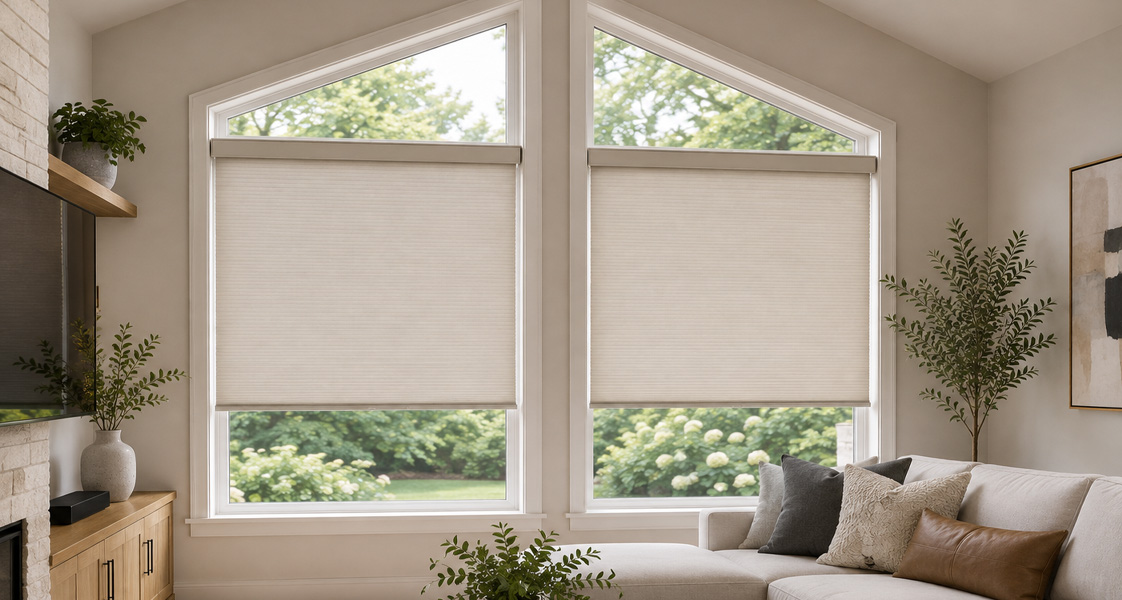
Angled top windows, sometimes called triangular or sloped-top windows, can be difficult to cover with a standard rectangular blind or shade because the top of the opening is not level. One practical solution is to mount a standard blind or shade at the point where the angle begins and leave the triangular portion above uncovered.
A second option is to use two separate treatments: a standard rectangular blind or shade for the lower portion of the window and a separate specialty triangular window treatment above it.
The most important part of measuring is identifying the exact horizontal line where the angled section begins. That line becomes the top of the lower blind or shade and determines the width and height of the rectangular portion you are ordering.
This guide explains how to measure both configurations, what to consider before leaving the angled section open, and when a separate triangular window treatment may be the better choice.
How Do You Measure Blinds for an Angled Top Window?
First, locate the point on both sides of the window where the straight vertical sides end and the angled top begins. Imagine a horizontal line connecting those two points. That line represents the top of the rectangular blind or shade.
Measure horizontally across the opening at that line to determine the available width. Then measure vertically from that line down to the bottom of the window opening to determine the height of the lower treatment.
You can leave the angled glass above uncovered or cover it separately with a specialty triangular treatment.
| Measurement | Where to Measure | Why It Matters |
|---|---|---|
| Width Where Angle Begins | Measure horizontally across the opening where the sloped top starts | Determines the width of the lower rectangular treatment |
| Lower Window Height | Measure from the angle-start line to the bottom of the opening | Determines the height of the lower blind or shade |
| Mounting Depth | Measure the depth of the opening where the headrail will sit | Helps determine whether the selected product can be inside mounted |
| Angled Section | Measure separately if adding a triangular treatment | Specialty treatments require their own dimensions |
Using a Palladian Shelf for Larger Arched Windows
For larger arched windows, a Palladian shelf can provide a practical mounting surface between the rectangular lower portion of the window and the arch above. The shelf spans across the opening at the point where the arch begins, creating a flat horizontal surface for mounting a standard blind or shade below it.
This can be especially helpful when the window is too wide for a side-mounted treatment or when the blind or shade you want to use requires a top-mount bracket rather than an L-bracket or other side-mount installation.
The arched portion above the shelf can be left open to preserve the architectural shape and allow more natural light, or it can be covered with a separate specialty arch window treatment for additional privacy and light control.
When measuring, account for the thickness and exact placement of the Palladian shelf because it becomes the mounting reference for the lower blind or shade. The shelf must also be securely mounted and properly sized for the width of the opening and the treatment it will support.
For more information about how this type of setup works, see our guide to Palladian window coverings and shelf options.
Step 1: Find Where the Angled Top Begins
The most important measurement is not the highest point of the window. Instead, locate the points where the straight vertical sides transition into the sloped or angled top.
Imagine drawing a level horizontal line between those two points. The lower blind or shade will typically mount at or just below that line.
Why This Line Matters
A standard rectangular blind or shade needs a level mounting position. If you try to mount the headrail higher into the angled portion, there may not be enough flat mounting surface to support the brackets.
Mounting the treatment where the angle begins allows you to use a standard rectangular product while preserving the architectural shape above it.
Step 2: Measure the Width Where the Angle Begins
Measure horizontally from the inside left edge of the opening to the inside right edge at the exact point where the angled section begins.
Record the exact opening width first before making any product-specific deduction.
Measure More Than Once
Even if the window looks symmetrical, measure the width at the angle-start line and again slightly below it. Angled and specialty windows are not always perfectly square.
Follow the measuring instructions for the specific blind or shade to determine which width should be submitted.
For general inside- and outside-mount measuring guidance, see our how to measure window blinds and shades page.
Step 3: Measure the Height of the Rectangular Portion
Measure vertically from the horizontal line where the angle begins down to the bottom of the window opening.
Take height measurements on the left, center and right when possible. This helps identify variations in the sill or lower opening.
Use the product-specific measuring instructions to determine whether to submit the shortest, longest or exact height measurement.
How Is a Blind Mounted Below an Angled Top Window?
The lower blind or shade is typically mounted at the horizontal line where the angled top begins. Depending on the window construction and product, the treatment may be installed using a standard top mount, side-mount brackets or other compatible hardware.
The available mounting surface is especially important. A treatment that requires a flat horizontal surface above the headrail may need different hardware than one that can be mounted from the sides of the opening.
Check the Brackets Before Ordering
Not every blind or shade uses the same mounting system. Before finalizing your measurements, confirm that the selected treatment can be installed at the angle-start line using the available mounting surface.
If the product requires more mounting depth or bracket clearance than the window provides, another treatment or an outside-mount configuration may be necessary.
Option 1: Leave the Angled Top Open
The simplest solution is to cover only the rectangular portion of the window and leave the triangular or angled section above uncovered.
This keeps the architectural shape visible and allows natural light to continue entering through the upper glass even when the lower blind or shade is closed.
Advantages of Leaving the Angled Section Open
- Preserves the architectural design of the window.
- Allows additional daylight into the room.
- Requires only one standard rectangular blind or shade.
- Can be more economical than adding a specialty treatment.
- The lower treatment remains easy to operate.
Things to Consider
Leaving the angled section open means that portion of the window will continue to admit light and may also affect privacy.
If the window is in a bedroom, media room or another area where room darkening is important, an uncovered triangular section can allow a significant amount of light into the room.
Option 2: Add a Separate Triangular Window Treatment Above
If you want more complete privacy or light control, the angled portion can be covered separately with a specialty triangular window treatment.
In this configuration, the lower rectangular portion uses a standard blind or shade while the upper angled section is measured and ordered as its own specialty treatment.
Advantages of a Separate Triangular Treatment
- Provides greater light control through the entire window.
- Improves privacy compared with leaving the angled section uncovered.
- Preserves the triangular architectural shape.
- Allows the lower blind or shade to operate independently.
- Can create a coordinated custom appearance.
The triangular section should be measured independently according to the requirements of the specialty product you are ordering.
Leave the Angled Top Open or Cover It Separately?
| Consideration | Leave Top Open | Separate Triangular Treatment |
|---|---|---|
| Natural Light | Maximum light through upper glass | Depends on the selected triangular treatment |
| Privacy | Upper glass remains uncovered | Provides greater privacy |
| Room Darkening | Angled section continues to admit light | Can improve overall light control |
| Cost | Usually simpler and more economical | Requires an additional specialty treatment |
| Appearance | Architectural glass remains completely visible | Triangular shape remains visible but covered |
| Measuring | Measure only the rectangular lower section | Measure the lower and upper sections separately |
How Is Measuring an Angled Window Similar to an Arched Window?
The measuring concept is very similar to measuring a blind below an arched window. In both cases, the standard rectangular treatment is mounted where the specialty-shaped top begins.
With an arch, the upper section curves upward. With an angled top window, the upper section slopes upward to form a triangular or trapezoidal shape.
In both applications, the lower blind or shade can be used independently while the specialty-shaped portion is either left open or covered with a separate treatment.
For more details on this type of installation, see our how to measure blinds and shades below an arched window guide.
How Does an Open Angled Top Affect Light Control?
A blackout or room-darkening shade can block light through the rectangular portion it covers, but it cannot block light passing through the uncovered angled section above it.
The amount of light entering through the upper section depends on the size of the triangle, the direction the window faces and the time of day.
For Bedrooms and Media Rooms
If maximum room darkening is important, consider covering both sections of the window. A separate triangular treatment above the standard lower blind or shade can provide more complete coverage.
Does Leaving the Angled Top Open Affect Privacy?
It can. The lower blind or shade can provide privacy through the rectangular portion, but the angled glass above remains uncovered.
Whether this is a concern depends on the height of the window, surrounding buildings and viewing angles from outside the home.
A high triangular window may provide very little practical visibility into the room, while a lower angled window facing a neighboring property may benefit from a separate specialty treatment.
Which Blinds and Shades Work Below Angled Windows?
Many standard rectangular blinds and shades can work below an angled top as long as the product can be securely mounted at the horizontal line where the angle begins.
Potential options may include cellular shades, roller shades and horizontal blinds, depending on the available mounting depth and bracket configuration.
The most important consideration is whether the mounting hardware works with the available surface. Confirm the requirements for the exact product before ordering.
Example: Measuring a Blind Below an Angled Window
Suppose the window measures 48 inches wide at the point where the angled section begins. From that horizontal line to the bottom of the opening, the rectangular portion measures 60 inches high.
| Measurement | Example |
|---|---|
| Width Where Angle Begins | 48 inches |
| Height Below Angle | 60 inches |
| Lower Treatment | Standard rectangular blind or shade |
| Upper Angled Section | Leave open or measure separately for a triangular treatment |
This example is for illustration only. Final ordering dimensions depend on the mounting requirements and factory deductions for the specific product.
Common Mistakes When Measuring Angled Top Windows
Measuring to the Highest Point of the Window
The lower rectangular treatment should generally be measured from the horizontal point where the angle begins, not from the tallest point of the sloped glass.
Assuming the Window Is Perfectly Symmetrical
Measure carefully rather than assuming both sides of the angled section are identical. Specialty window openings can vary slightly from one side to the other.
Ignoring the Mounting Surface
A correct width and height measurement does not guarantee that the treatment can be installed. Verify that there is sufficient mounting surface for the headrail and brackets.
Assuming Every Blind Can Be Side Mounted
Some products require a horizontal mounting surface above the headrail. Confirm the bracket configuration before ordering.
Forgetting About Light From the Angled Section
A blackout lower shade will not make the room completely dark if the triangular glass above remains uncovered.
Trying to Order the Entire Window as One Standard Blind
A standard rectangular blind cannot follow the slope of an angled top. Treat the rectangular and specialty-shaped sections separately unless you are ordering a product specifically designed for angled windows.
Angled Top Window Measuring Checklist
- Locate where the angle begins: Identify the horizontal line where the straight sides transition into the sloped top.
- Measure the width: Measure across the opening at that exact line.
- Measure the lower height: Measure from the angle-start line to the bottom of the opening.
- Measure more than once: Check for variations in width and height.
- Choose the lower blind or shade: Confirm that the product works with the available mounting surface.
- Check mounting depth: Make sure the headrail and brackets will fit.
- Decide whether to leave the angled section open: Consider privacy and light-control needs.
- If covering the top, measure it separately: Use the instructions for the specialty triangular treatment.
- Follow product-specific deductions: Do not automatically make your own factory deduction.
- Verify everything before ordering: Recheck the width, height and mounting location.
Not Sure How to Measure Your Angled Window? We Can Help
Angled windows vary in shape, slope and mounting conditions, so the product you choose can be just as important as the measurements themselves.
If you are unsure, measure the width where the angle begins, measure the height of the rectangular portion below it and take a photo showing the complete window and proposed mounting area.
Our window treatment team can help you determine whether the product you are considering can be mounted in that location and whether leaving the angled section open or adding a separate triangular treatment makes more sense for your needs.
Expert Guidance from Blinds Chalet
Blinds Chalet has helped homeowners measure and order custom window treatments since 2006. Angled top windows are a good example of why specialty-shaped windows are often easier to treat as two separate sections rather than trying to force one standard treatment to cover the entire opening.
When we help customers with this type of window, we first identify the horizontal point where the angle begins. That becomes the natural mounting position for a standard rectangular blind or shade below it.
The angled section can then be left uncovered to preserve natural light and the architectural shape, or it can be covered independently with a specialty triangular treatment for additional privacy and light control.
We also recommend choosing the lower product before making final deductions because bracket requirements, mounting depth and factory deductions vary by treatment. If you are uncertain whether the blind or shade can be installed at the angle-start line, contact us before ordering.
Content developed by: Blinds Chalet's window treatment team
Last updated: August 2026
Related Window Measuring Guides
- General Window Blind and Shade Measuring Instructions
- How to Measure Blinds and Shades Below an Arched Window
- How to Measure for French Door or Traditional Door Blinds
- How to Measure Blinds for Corner Windows
- How to Measure Window Shades or Blinds for Tile or Molding
- How to Measure Vertical Blinds for Sliding Glass Doors
- How to Measure Bay Windows for Blinds and Shades
- How to Measure when Mounting Window Blinds or Shades Between Cabinets
- How to Measure Two Blinds Side by Side in One Window
Measuring Blinds for Angled Top Windows FAQs
How do I measure blinds for an angled top window?
Locate the horizontal line where the angled top begins. Measure the width across the opening at that line and then measure vertically from that point to the bottom of the window. Those measurements define the rectangular lower portion that can be covered with a standard blind or shade.
Can I leave the triangular part of an angled window open?
Yes. A common solution is to mount a standard blind or shade where the angle begins and leave the triangular glass above uncovered. This preserves the architectural shape and allows additional natural light into the room.
Can I add a separate treatment to the triangular section?
Yes. The rectangular lower portion and triangular upper portion can be treated separately. A standard blind or shade can cover the lower section while a specialty triangular window treatment covers the angled glass above.
Where should the headrail be mounted on an angled top window?
The headrail is generally mounted at or just below the horizontal line where the straight vertical sides of the window transition into the angled top, provided the product has sufficient mounting surface and compatible brackets.
Are angled top windows measured like arched windows?
The basic concept is similar. In both cases, the standard rectangular blind or shade is mounted where the specialty-shaped upper section begins. The upper arch or triangular section can then be left open or treated separately.
Will a blackout shade below an angled window make the room completely dark?
No. A blackout shade can block light through the lower rectangular portion, but an uncovered angled section will continue to admit light. For greater room darkening, consider covering the triangular section separately.
Can every blind or shade be mounted below an angled top window?
No. The product must have mounting hardware that works with the available surface at the point where the angle begins. Some treatments require a horizontal mounting surface above the headrail while others may allow side mounting.
Do I make my own deduction when measuring an angled window?
Do not automatically make a deduction unless the measuring instructions for the specific blind or shade tell you to do so. Factory deductions and bracket clearances vary by product.
Does leaving the angled top open affect privacy?
It can. The lower blind or shade provides privacy through the rectangular portion, but the triangular glass above remains uncovered. Whether this matters depends on the height of the window and viewing angles from outside.
Can Blinds Chalet help me measure an angled top window?
Yes. Measure the width where the angle begins and the height of the rectangular section below it. A photo of the full window and mounting area can also be helpful. Blinds Chalet's window treatment team can help you determine the appropriate lower treatment and whether a separate triangular treatment is a good option.