









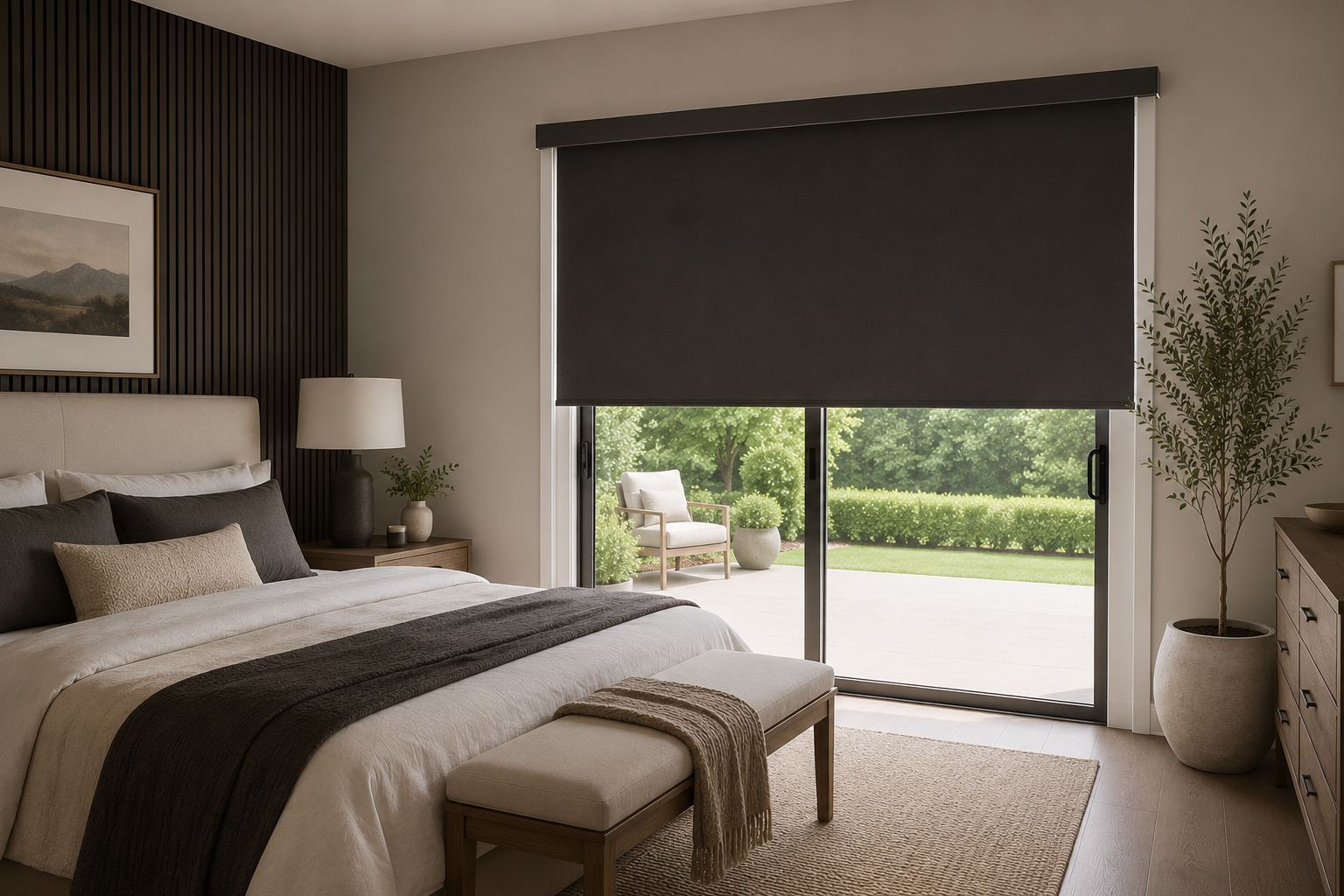
Compare vertical blind alternatives for bedrooms, home theaters and other light-sensitive rooms based on fabric opacity, edge gaps, panel overlap and overall room-darkening performance.
When replacing vertical blinds in a room where darkness matters, the fabric is only part of the equation. Blackout performance also depends on how the treatment is mounted, how much light enters around the sides, whether multiple shades create center gaps and how overlapping panels behave when fully closed.
The best vertical blind alternative for blackout is usually an opaque roller shade, vertical cellular treatment or lined drapery system, depending on the opening and how the door is used. Panel track blinds can also provide strong room darkening when selected with an opaque fabric, but overlapping panels and edge gaps may still allow some light into the room.
This guide focuses specifically on blackout and room-darkening performance. For a broader product comparison, visit our Vertical Blind Alternatives: Comparing Your Best Options guide or explore our Vertical Blind Alternatives Expert Advice Center or shop alternatives to vertical blinds.
Blackout vs. Room Darkening: What Is the Difference?
Blackout and room darkening are often used interchangeably, but they are not the same. Blackout describes a material designed to block light from passing through the fabric itself. Room darkening describes the overall effect of reducing light in the room, which depends on both the fabric and the installation.
A blackout fabric can still allow light around the sides, top or bottom of the treatment. Multiple shades can also leave narrow gaps between units, while sliding panels may allow light through the overlapping areas or around the perimeter.
For maximum darkness, evaluate the entire system rather than the fabric label alone. Learn more: compare light filtering vs room darkening vs blackout.
What Is the Best Vertical Blind Alternative for Blackout?
Opaque roller shades, vertical cellular treatments and lined drapery are generally the strongest vertical blind alternatives for blackout or room darkening. Each can block a large amount of light when correctly sized and mounted, but the best choice depends on whether the opening is a sliding door, wide window or standard window.
Panel track blinds are a good option when you want horizontal operation for a sliding door and a modern appearance. They can significantly darken a room with an opaque fabric, but the overlapping panel design and outer edge gaps may prevent complete darkness.
| Window Treatment | Room-Darkening Potential | Main Light Gap Concern | Best Application |
| Blackout Roller Shades | Very good to excellent | Side gaps and gaps between multiple shades | Bedrooms, media rooms and divided sliding doors |
| Vertical Cellular Treatments | Very good | Outer edge gaps | Bedrooms, family rooms and energy-efficient applications |
| Lined Drapery | Very good to excellent | Center split and side gaps | Bedrooms, living rooms and layered installations |
| Panel Track Blinds | Good to very good | Panel overlap and outer edge gaps | Sliding glass doors and wide windows |
| Traditional Vertical Blinds | Moderate to good | Vane spacing, misalignment and movement | Frequently used patio doors |
1. Blackout Roller Shades: Best for Strong Room Darkening
Roller shades are one of the strongest options for room darkening because they are available in opaque and blackout fabrics that prevent light from passing through the material itself.
Advantages for Blackout
- Blackout fabrics block light through the material.
- Simple design provides broad coverage across the glass.
- Available in many colors and textures.
- Can be used as multiple independently operated shades across a wide opening.
- Can be paired with side channels or layered treatments on select applications.
Potential Light Gaps
- Inside mounts typically leave side gaps between the fabric and the opening.
- Multiple roller shades may leave gaps between adjacent units.
- The active door section may require one shade to be raised frequently.
- Bottom gaps can remain if the floor or sill is uneven.
An outside mount can improve room darkening by extending the shade beyond the opening. On a wide or divided door, align gaps between shades with mullions or door frames whenever the product layout allows.
2. Vertical Cellular Treatments: Best for Darkness and Insulation
Vertical cellular treatments combine side-to-side operation with honeycomb fabric. They are especially useful when you want both strong room darkening and improved insulation around a large glass door. Read more about the best alternatives to vertical blinds for insulation and energy savings.
Advantages for Room Darkening
- Opaque cellular fabric blocks direct light through the material.
- Continuous fabric reduces center gaps compared with multiple narrow vanes.
- Honeycomb construction helps reduce heat transfer.
- Side-to-side operation works well on sliding doors.
- Soft fabric creates a cleaner appearance than traditional vertical blinds.
Potential Light Gaps
- Light may enter around the outer edges.
- Inside mounts can leave larger side gaps.
- Product size and fabric availability vary by manufacturer.
- Very large openings may require specific configurations or limitations.
Vertical cellular treatments are a strong choice for bedrooms and other spaces where darkness and energy efficiency are both priorities.
3. Lined Drapery: Best for Layered Blackout
Lined drapery can provide excellent room darkening when the panels extend beyond the glass and overlap sufficiently in the center. Blackout liners add another layer that prevents light from passing through the decorative face fabric.
Advantages for Blackout
- Fabric can extend beyond the top and sides of the opening.
- Blackout lining blocks light through the fabric.
- Center overlap can reduce light between panels.
- Floor-length panels can reduce gaps near the bottom.
- Drapery can be layered over another shade for even stronger light control.
Potential Light Gaps
- Panels can separate at the center if there is not enough overlap.
- Light can enter above the rod or track.
- Airflow can move lightweight fabric away from the opening.
- Insufficient width can expose the sides of the glass.
Drapery is one of the most effective choices when maximum darkness is more important than maintaining a compact profile. shop custom drapery panels.
4. Panel Track Blinds: Best Modern Sliding-Door Option
Panel track blinds use wide fabric panels that overlap as they slide across a track. With an opaque or room-darkening material, they can significantly reduce incoming light while maintaining convenient side-to-side operation.
Advantages for Room Darkening
- Wide panels cover large sections of glass.
- Opaque fabrics can block most light through the material.
- Horizontal operation works naturally with sliding doors.
- Fewer panel divisions than traditional vertical vanes.
- Modern appearance works well in contemporary rooms.
Potential Light Gaps
- Light can enter where adjacent panels overlap.
- Outer edge gaps can remain around the installation.
- Panels may shift slightly during use.
- Solar or screen fabrics should not be expected to provide blackout.
Before choosing panel tracks for a light-sensitive room, review the pros and cons of panel track blinds and compare panel track blinds vs. vertical blinds.
5. Traditional Vertical Blinds: Good for Adjustable Light Control, Not Maximum Blackout
Traditional vertical blinds can provide good room darkening when the vanes are opaque and close tightly, but they are generally less effective than continuous blackout fabrics.
Advantages
- Rotating vanes allow adjustable light control.
- Side-to-side operation is convenient for frequently used doors.
- Opaque vinyl vanes can block direct light.
- Individual vanes can often be replaced if damaged.
Limitations
- Light may pass between vanes.
- Vanes can become misaligned.
- Airflow can cause vanes to move.
- Light can enter around the outer edges.
Vertical blinds are usually better when adjustable light control and door access are priorities rather than maximum darkness.
Where Does Light Usually Leak Around Window Treatments?
Understanding common light gaps can help you choose the right product and installation method.
Side Gaps
Inside-mounted roller shades and cellular treatments usually require clearance between the fabric and the sides of the opening. These gaps can create visible strips of light.
Center Gaps
Multiple roller shades and split-draw drapery can create a gap in the center. Aligning the gap over a door frame or mullion can reduce its impact.
Panel Overlap
Panel tracks rely on overlapping panels. Light can enter where the panels meet, especially if the fabric shifts or the panels do not overlap enough.
Top Gaps
Light can enter above a shade or drapery track if the treatment does not extend high enough beyond the opening.
Bottom Gaps
Uneven floors, thresholds and door tracks can create space beneath the treatment. Measure the height at multiple locations before ordering.
Inside Mount vs. Outside Mount for Room Darkening
Inside Mount
An inside mount provides a clean, recessed appearance, but it usually leaves more visible light around the sides of the treatment.
- Creates a built-in appearance.
- Keeps surrounding trim visible.
- Requires adequate mounting depth.
- Can leave side and top light gaps.
Outside Mount
An outside mount is usually better when room darkening is a priority because the treatment can extend beyond the glass and reduce edge gaps.
- Allows wider coverage.
- Can reduce light along the sides.
- Can extend above the opening to reduce top light.
- May improve privacy as well as room darkening.
- Requires sufficient wall space and secure mounting points.
Best Blackout Alternatives by Room
Bedrooms
Blackout roller shades, vertical cellular treatments and lined drapery are strong choices for bedrooms. Outside mounting or layered treatments can improve darkness when sleep quality is the main concern.
Home Theaters
Blackout roller shades with generous coverage are often the best choice for media rooms and home theaters. Layering with drapery or using additional light-blocking methods can further reduce edge light.
Nurseries
Opaque cellular treatments and blackout roller shades can provide strong room darkening for daytime naps and early bedtimes. Choose cordless or motorized operation where available.
Living Rooms
Panel track blinds and lined drapery work well when you want strong light reduction without making the space feel permanently dark.
Family Rooms
Roller shades, panel tracks and vertical cellular treatments can reduce glare from televisions while maintaining practical everyday operation.
How to Improve Blackout Performance
- Choose an opaque or blackout fabric: Start with a material that blocks light through the fabric itself.
- Consider an outside mount: Extend the treatment beyond the glass to reduce side and top gaps.
- Increase overlap: Use sufficient panel or drapery overlap where possible.
- Align multiple shades carefully: Position gaps over door frames or mullions instead of exposed glass.
- Layer treatments: Combine shades with drapery when maximum darkness is needed.
- Check the floor and threshold: Account for uneven surfaces that may create bottom gaps.
- Review hardware placement: Make sure handles and trim do not force the treatment away from the glass.
- Order samples: Test the fabric against a bright window before placing your order.
Common Blackout Mistakes to Avoid
Assuming Blackout Fabric Means a Blackout Room
Blackout fabric only prevents light from passing through the material. Light can still enter around the perimeter or between multiple treatments.
Using Multiple Shades Without Planning the Gaps
Separate roller shades create spaces between units. Align those spaces with structural elements whenever possible.
Choosing Screen Fabrics for a Dark Room
Solar and screen fabrics are designed for glare control and view-through, not blackout performance.
Ignoring Door Access
A treatment may darken the room well but become inconvenient if it must be fully raised each time the door is used.
Not Considering Mounting Location
An outside mount often improves room darkening, but it requires enough wall space and proper support.
Related Article: Common Ordering Mistakes to Avoid When Buying Blackout Shades
Expert Guidance from Blinds Chalet
Blinds Chalet has helped homeowners shop for custom window treatments since 2006. In our experience, customers often focus on the word "blackout" in the fabric description without considering how the complete treatment is mounted and operated.
For the best room-darkening results, evaluate fabric opacity, side gaps, center gaps, panel overlap, mounting position and everyday door use together. The best product is the one that balances darkness with practical operation in the room.
Because product specifications vary by manufacturer, size and selected options, always review the measuring instructions and available configurations for the exact product you plan to order.
Continue Researching Vertical Blind Alternatives
- Vertical Blind Alternatives Expert Advice Center
- Best Vertical Blinds Alternatives for Privacy.
- Shop the Most Popular Vertical Blind Alternatives.
- Vertical Blind Alternatives Compared
- How to Choose Vertical Blind Alternatives
- Panel Track Blinds vs. Vertical Blinds
- Pros and Cons of Panel Track Blinds
- Best Window Treatments for Sliding Glass Doors
- Can roller shades be used on sliding patio doors?
When you are ready to compare products, browse our vertical blind alternatives, panel track blinds, roller shades and vertical blinds.
Vertical Blind Alternatives for Blackout & Room Darkening FAQs
What is the best alternative to vertical blinds for blackout?
Blackout roller shades, vertical cellular treatments and lined drapery are generally the strongest alternatives for room darkening. The final result depends on the fabric, mounting method and the size of any gaps around the treatment.
Do panel track blinds provide blackout?
Panel track blinds can significantly darken a room when made with an opaque or blackout material, but light may still enter around the outer edges and where the panels overlap.
Are blackout roller shades completely blackout?
Blackout roller shade fabric blocks light through the material, but the installation may still allow light around the sides, top or bottom. Multiple shades may also create narrow gaps between units.
Is an outside mount better for blackout?
An outside mount is generally better for room darkening because the treatment can extend beyond the glass and reduce side and top light gaps. The exact improvement depends on the product and available mounting space.
Which vertical blind alternative is best for a bedroom?
Blackout roller shades, vertical cellular treatments and lined drapery are strong bedroom options because they can provide both privacy and significant room darkening.
Which vertical blind alternative is best for a home theater?
Blackout roller shades are often a strong choice for home theaters because they use opaque fabric and provide broad coverage. Layering with drapery or using additional light-blocking methods can reduce remaining edge light.
Do solar shades provide blackout?
No. Solar shades are designed to reduce glare, heat and ultraviolet exposure while preserving some outside view. They are not intended to provide blackout performance.
How can I reduce light gaps around a blackout shade?
Consider an outside mount that extends beyond the glass, align multiple-shade gaps with window or door frames, use sufficient panel overlap and add drapery or other light-blocking layers when maximum darkness is required.
Shop our collection of alternative vertical blinds to discover more options for larger windows.
For more information, visit our alternatives to vertical blinds expert advice hub, where you’ll find in-depth guides and expert advice.