









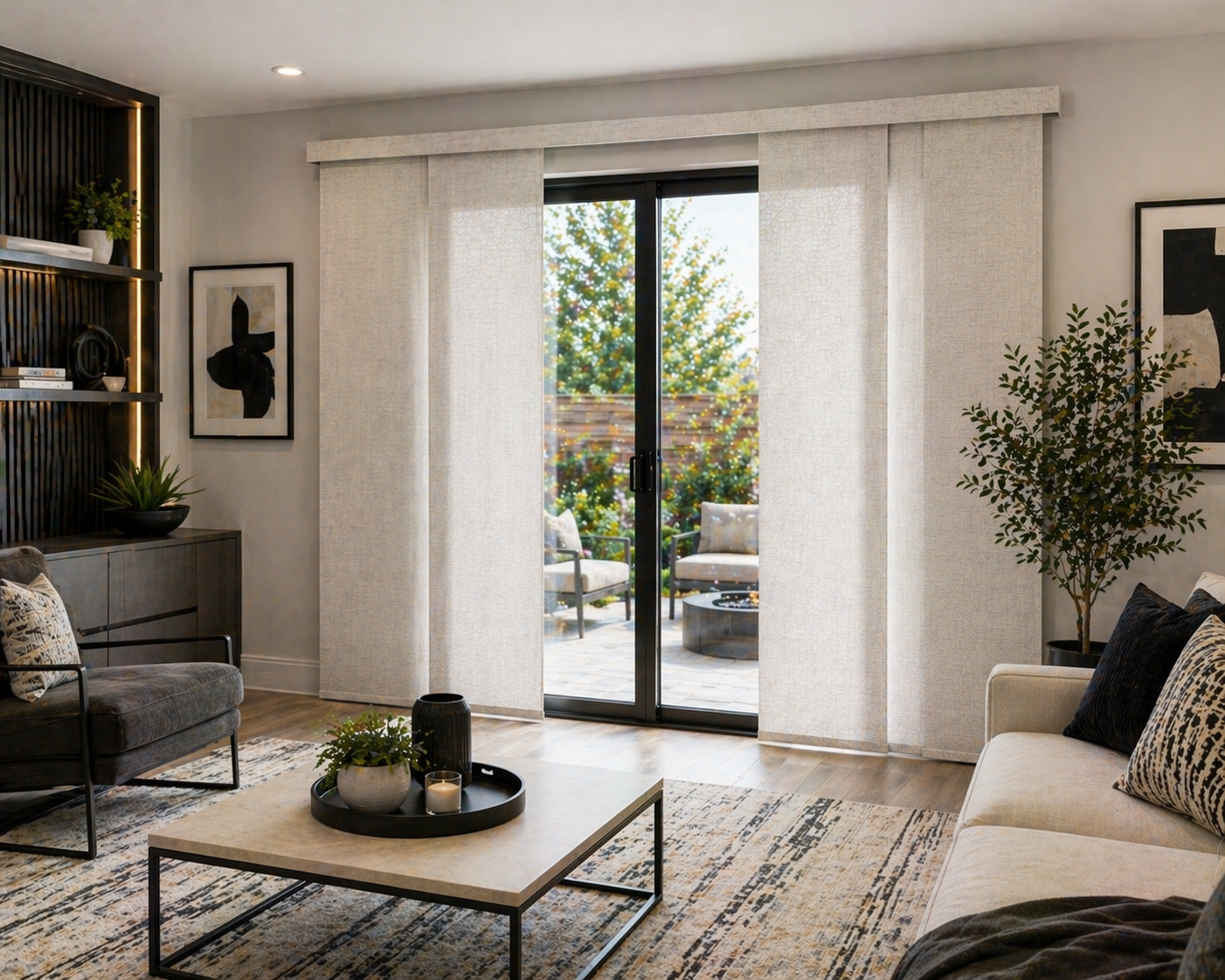
Vertical blinds have long been a practical choice for sliding glass doors, patio doors, and wide windows. Their rotating vanes provide adjustable light control, and their side-to-side operation makes it easy to access a frequently used doorway.
However, vertical blinds are not the only option for covering a large opening. Panel track blinds, drapery panels, vertical cellular shades, and coordinated roller shades can provide a different appearance, operating style, or level of insulation.
This guide compares the most popular alternatives to vertical blinds so you can decide which window treatment best fits your sliding door, large window, décor, and light-control needs. You can also compare these options with our selection of custom vertical blinds or browse additional custom-measure window blinds.
Why Consider an Alternative to Vertical Blinds?
Vertical blinds remain an affordable and functional solution for many large windows and doors. Still, another type of window treatment may be a better fit when your priorities include a softer appearance, improved insulation, wider fabric panels, or a more minimalist design.
Homeowners commonly explore vertical blind alternatives because they want:
- A softer or more decorative appearance
- Wider panels instead of individual vertical vanes
- Improved insulation around a large glass door
- A quieter operating system
- More fabric, texture, or pattern choices
- A cleaner, more contemporary design
- Better coordination with other shades in the room
The best replacement depends on how often the door is used, how much privacy you need, whether insulation is a priority, and how much space is available around the opening.
Vertical Blind Alternatives Comparison
The following comparison provides a quick overview of the most common options for sliding doors and wide windows.
| Window Treatment | Best For | Light Control | Insulation | Style | Important Consideration |
|---|---|---|---|---|---|
| Panel Track Blinds | Modern sliding doors and wide windows | Good, depending on fabric | Moderate | Clean and contemporary | Wide panels stack together when opened |
| Drapery Panels | Decorative living rooms and bedrooms | Good with the appropriate lining | Good with lined fabric | Soft and decorative | Requires space beside the opening for the fabric stack |
| Vertical Cellular Shades | Energy efficiency and insulation | Good | Very good | Soft and streamlined | Fewer material and texture options than drapery |
| Roller Shades | Minimalist rooms and coordinated windows | Excellent fabric-dependent control | Moderate | Simple and modern | Usually requires multiple shades across a wide opening |
| Vertical Blinds | Frequent door access and adjustable light control | Excellent and highly adjustable | Moderate | Traditional to contemporary | Individual vanes may move in drafts or require replacement |
1. Panel Track Blinds: Best Modern Alternative
Panel track blinds are often the closest modern alternative to vertical blinds. Instead of multiple narrow vanes, a panel track system uses several wide fabric panels that glide horizontally along a track.
The wider panels create a clean, structured appearance that works especially well in contemporary living rooms, family rooms, offices, and open-concept spaces. They can also be used as room dividers or to conceal storage areas.
Advantages of Panel Track Blinds
- Designed for sliding glass doors and wide windows
- Wide panels create a modern appearance
- Panels glide smoothly along an overhead track
- Available in a range of colors, textures, and fabric opacities
- Can coordinate with roller or solar shades in the same room
- Suitable for light-filtering, glare-control, and room-darkening needs
Potential Drawbacks
- Panels overlap and form a wider stack when opened
- They do not provide the same vane-by-vane light adjustment as vertical blinds
- The track requires adequate mounting space above the opening
Panel tracks are a strong choice when appearance and smooth operation are more important than precise tilting control.
For a more detailed comparison, read panel track blinds vs. vertical blinds.
2. Drapery Panels: Best Decorative Alternative
Custom drapery panels provide a softer and more decorative alternative to vertical blinds. They are especially well suited to living rooms, bedrooms, dining rooms, and formal spaces where fabric and visual warmth are important.
Drapery can be made from a wide range of fabrics, colors, patterns, and textures. Optional linings can improve privacy, reduce outside light, protect the face fabric, and increase insulation.
Advantages of Drapery Panels
- Offers extensive fabric and pattern choices
- Adds softness, texture, and visual height to the room
- Can provide light filtering, room darkening, or blackout performance
- Layering options allow drapery to be combined with shades or blinds
- Can cover unusually wide doors and windows
Potential Drawbacks
- Fabric requires space beside the opening when the panels are open
- Drapery may require more maintenance than hard window coverings
- The finished look depends heavily on accurate measuring and hardware placement
Drapery is usually the best alternative when your primary goal is to make the window treatment part of the room’s overall design.
3. Vertical Cellular Shades: Best for Insulation
Vertical cellular shades use honeycomb-shaped fabric cells that extend across a sliding door or wide window. The cellular construction traps air within the shade and helps reduce heat transfer through large areas of glass.
This makes vertical cellular shades particularly useful in rooms with strong sun exposure, very hot summers, cold winters, or drafty patio doors.
Advantages of Vertical Cellular Shades
- Provides strong insulation for a fabric window covering
- Creates a soft, streamlined appearance
- Stacks compactly at the side when properly configured
- Available in different fabric opacities
- Can improve comfort around large glass doors
Potential Drawbacks
- Offers fewer textures and decorative fabric choices than drapery
- Does not provide rotating vanes for directional light control
- May cost more than a basic vertical blind
Vertical cellular shades are worth considering when energy efficiency and temperature control are more important than decorative fabric selection.
You can also browse our honeycomb cellular shades for coordinating standard windows throughout the room.
4. Roller Shades: Best Minimalist Alternative
Roller shades provide one of the cleanest and simplest window-treatment designs. Although a single roller shade may not be practical for an extremely wide sliding door, multiple coordinated shades can be installed across the opening.
Roller shades are especially useful when the sliding door is divided into separate glass panels or when you want each section to operate independently.
Advantages of Roller Shades
- Provides a simple, low-profile appearance
- Available in sheer, screen, light-filtering, room-darkening, and blackout fabrics
- Easy to coordinate with other windows in the room
- Offers cordless and motorized operating options on many products
- Fabric rolls neatly into a compact headrail area
Potential Drawbacks
- Wide openings may require two or more separate shades
- Light gaps can appear between adjacent shades
- The shades generally need to be raised for direct door access
Roller shades work best when you want a minimalist design and do not need the entire sliding door covered by one continuous window treatment.
Are Vertical Blinds Still a Good Choice?
Vertical blinds are sometimes described as outdated, but that does not mean they are no longer useful. Modern vertical blinds are available in updated colors, textures, fabrics, and vane materials that can fit both traditional and contemporary homes.
They continue to offer several practical advantages that alternatives may not duplicate as easily:
- Individual vanes rotate for precise directional light control
- The treatment opens sideways for convenient door access
- Damaged vanes can often be replaced individually
- They can be more affordable than some specialty alternatives
- They are designed specifically for tall and wide openings
A vertical blind may still be the best choice for a frequently used patio door, a rental property, a commercial space, or a room where adjustable glare control is the highest priority.
What Is the Best Alternative for a Sliding Glass Door?
Panel track blinds are often the most direct alternative for a sliding glass door because they open horizontally and are specifically designed for wide openings. However, the best option depends on how the room is used.
- Choose panel track blinds for a clean, modern appearance.
- Choose drapery panels for softness, pattern, and decorative impact.
- Choose vertical cellular shades when insulation is the main concern.
- Choose roller shades for a minimalist look and coordinated windows.
- Choose vertical blinds for adjustable light control and frequent door access.
How to Choose the Right Vertical Blind Replacement
Consider How Often the Door Is Used
A frequently used sliding door needs a treatment that opens easily and does not interfere with the doorway. Side-opening systems such as vertical blinds, panel tracks, vertical cellular shades, and drapery are usually more convenient than shades that must be raised from the bottom.
Measure the Available Stacking Space
Every side-opening window treatment needs somewhere to stack when opened. Determine whether the panels, fabric, or vanes will stack over the glass or beyond the edge of the doorway.
Decide How Much Light Control You Need
Vertical blinds provide highly adjustable light control because the vanes can rotate while remaining closed across the opening. Panel tracks, drapery, and vertical cellular shades primarily control light by opening or closing the entire covering. Read more about the best vertical blind alternatives for light control.
Consider Privacy at Night
Light-filtering fabrics may provide daytime privacy but can reveal shapes or silhouettes at night when interior lights are on. Select an appropriate fabric opacity or lining when nighttime privacy is important.
Evaluate Energy Efficiency
Large glass doors can gain and lose substantial heat. Vertical cellular shades and lined drapery generally provide the strongest insulation among the options discussed in this guide.
Match the Treatment to the Room
A formal dining room may benefit from custom drapery, while a family room may be better suited to durable panel tracks or vertical blinds. A modern office may work well with solar roller shades or streamlined fabric panels. Learn more about the best energy efficient vertical blind alternatives.
When Should You Replace Vertical Blinds?
You do not need to replace vertical blinds simply because newer alternatives are available. Replacement is most appropriate when the existing blinds no
longer function properly or no longer meet your design and performance needs.
It may be time to consider a replacement when:
- Multiple vanes are cracked, bent, missing, or difficult to replace
- The track no longer opens or rotates smoothly
- The blinds do not provide the privacy or light control you need
- You want better insulation around a large glass opening
- The current style no longer coordinates with the room
- You are remodeling and want a different type of window treatment
Read more about the best privacy alternatives to vertical blinds. Shop the Most Popular Vertical Blind Alternatives.
Which Vertical Blind Alternative Is Right for You?
There is no single replacement that is best for every sliding door or large window. Each option solves a different design or performance need.
Panel track blinds are generally the closest modern alternative to vertical
blinds. Drapery panels provide the greatest decorative flexibility, vertical cellular shades offer strong insulation, and roller shades provide a clean, minimalist appearance.
Vertical blinds remain worth considering when you want affordable coverage, convenient side-to-side operation, and adjustable directional light control. Comparing the way each treatment opens, stacks, filters light, and coordinates with your room will help you make the right decision.
Ready to review product options? Browse custom panel track blinds, custom drapery panels, roller shades, or vertical blinds to compare materials, colors, operating systems, and light-control options.
For additional research, visit our vertical blinds Expert Advice center for buying guides, product comparisons, measuring information, and design tips.
Ready to shop products? Visit our alternatives to vertical blinds shopping page to browse panel tracks, roller shades, drapery, and other options for large windows and sliding doors.
Vertical Blind Alternatives FAQs
What is the best alternative to vertical blinds?
Panel track blinds are often the best direct alternative to vertical blinds because they are designed for sliding doors and large windows. Their wide fabric panels create a more contemporary appearance while continuing to open horizontally along a track.
What can I use instead of vertical blinds on a sliding glass door?
Common alternatives for sliding glass doors include panel track blinds, drapery panels, vertical cellular shades, and multiple roller shades. The best option depends on your preferred style, insulation needs, available stacking space, and how frequently the door is used.
Are panel track blinds better than vertical blinds?
Panel track blinds may be better when you want a clean, modern appearance with wide fabric panels. Vertical blinds may be better when you want precise directional light control, a smaller vane stack, easy replacement of individual vanes, or a more budget-friendly option.
Are vertical blinds outdated?
Vertical blinds are still a practical choice for sliding doors and large windows. Although some homeowners prefer newer fabric-panel designs, modern vertical blinds are available in updated colors, textures, and materials and continue to provide convenient operation and adjustable light control.
Which vertical blind alternative provides the best insulation?
Vertical cellular shades generally provide the best insulation because their honeycomb cells trap air and help reduce heat transfer. Lined drapery panels can also improve insulation when they cover the full opening and extend beyond the edges of the glass.
Can roller shades be used on a sliding glass door?
Roller shades can be used on a sliding glass door, but a wide opening will often require multiple shades. This allows each section to operate independently, although small light gaps may appear between adjacent shades.
Do panel track blinds provide blackout?
Panel track blinds may be available with room-darkening or blackout fabrics, but overlapping panels and edge gaps can allow some light into the room. They can significantly darken a space, but they may not create complete darkness without additional light-blocking measures.
Should I repair or replace my vertical blinds?
Repair may be appropriate when only one or two vanes, carriers, or valance components are damaged. Replacement may be a better choice when the track no longer operates properly, many vanes are damaged, or you want improved insulation, updated materials, or a different style.
If you're ready to get started, explore our vertical blinds collection to compare finishes, colors, and lift systems.
Learn more by visiting our vertical blinds expert advice center for detailed guides and helpful insights.