









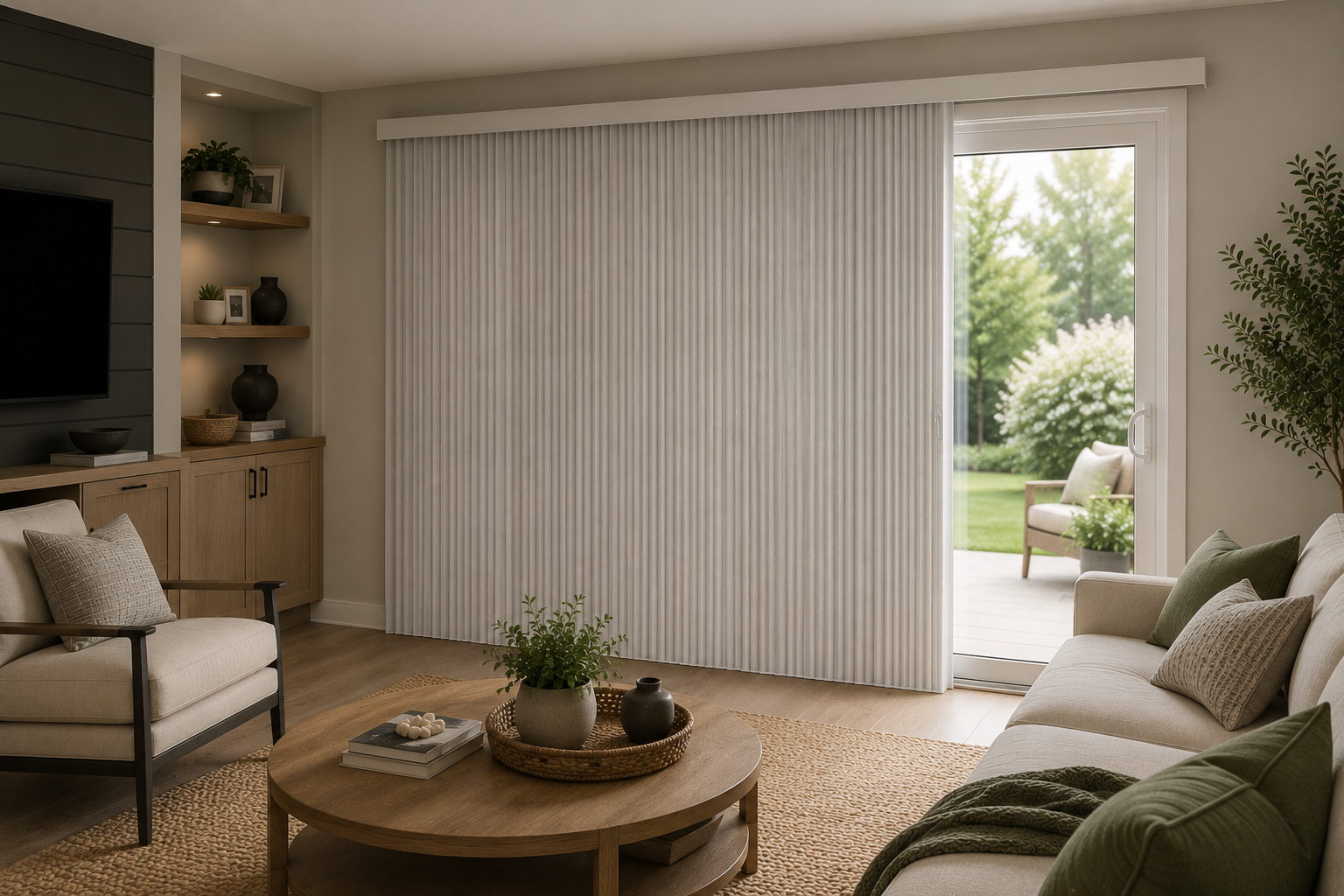
Compare energy-efficient window treatments for sliding glass doors and wide windows, including insulating vertical cellular shades, solar shades, drapery and panel track blinds.
Sliding glass doors and large windows can make a room feel warmer in summer and colder in winter because they contain a large area of glass. If you are replacing traditional vertical blinds, choosing the right window treatment can help reduce direct solar heat, create an insulating layer near the glass and improve comfort throughout the room.
Vertical cellular shades are one of the strongest energy-efficient alternatives to vertical blinds because their honeycomb construction traps air between the room and the glass. Lined drapery can also provide substantial coverage, while solar roller shades are particularly useful for controlling sunlight and heat gain. Panel track blinds can provide moderate protection depending on the selected fabric and how completely the panels cover the opening.
This guide focuses specifically on energy efficiency and thermal comfort. For a broader comparison of product types, read our Vertical Blind Alternatives: Comparing Your Best Options guide. You can also visit our Vertical Blind Alternatives Expert Advice Center for additional buying guides. Shop our selection of alternatives to vertical blinds.
What Is the Most Energy-Efficient Alternative to Vertical Blinds?
Vertical cellular shades are generally the first option to consider when insulation is the primary goal. Their honeycomb-shaped cells create air pockets that help separate the room from the surface of the glass. This can help reduce heat transfer through large sliding doors and windows while maintaining convenient side-to-side operation.
However, energy efficiency can mean different things depending on the problem you are trying to solve. Cellular shades are particularly useful for insulation, solar shades can help manage direct sunlight and solar heat gain, and lined drapery can create a broad insulating layer across and beyond the opening.
| Window Treatment | Best Energy Benefit | Insulation | Solar Heat Control | Best Application |
|---|---|---|---|---|
| Vertical Cellular Shades | Reducing heat transfer | Excellent | Good | Sliding doors and wide windows where insulation is the priority |
| Lined Drapery | Creating broad insulating coverage | Very Good | Very Good with appropriate fabric and lining | Bedrooms, living rooms and large patio doors |
| Solar Roller Shades | Reducing solar heat and glare | Moderate | Very Good | Sunny rooms and windows with strong direct exposure |
| Panel Track Blinds | Reducing direct sunlight across large openings | Moderate | Good depending on fabric | Modern sliding doors and wide windows |
| Traditional Vertical Blinds | Adjustable control of direct sunlight | Limited to Moderate | Good when vanes are closed or angled | Frequently used doors where adjustable light control is important |
Shop our selection of energy efficient window treatments.
How Window Treatments Can Improve Energy Efficiency
A window treatment does not change the insulating value of the glass itself, but it can affect how heat and sunlight move between the window and the room. The amount of improvement depends on the construction of the treatment, the selected material, the fit around the opening and how the treatment is used.
Reducing Heat Transfer
Window treatments that create trapped air spaces or thick layers between the room and the glass can help slow heat movement. Cellular shades are specifically designed around this principle, while lined drapery can create a substantial fabric barrier over the opening.
Controlling Solar Heat Gain
Direct sunlight entering through glass can heat floors, furniture and other interior surfaces. Solar shades, opaque fabrics and closed window treatments can reduce the amount of direct solar energy entering the room.
Reducing Drafts and Cold-Surface Discomfort
A large glass door can feel uncomfortable during colder weather even when the room itself is heated. A closely fitted cellular shade or broad drapery treatment creates another layer between occupants and the cold glass surface.
Managing Energy Throughout the Day
Energy performance also depends on how the window treatment is operated. Closing shades during periods of intense sun can reduce solar heat gain, while opening appropriate treatments during favorable conditions may allow useful natural light or solar warmth into the room.
1. Vertical Cellular Shades: Best Overall for Insulation
Vertical cellular shades are one of the strongest alternatives to vertical blinds when energy efficiency is the primary goal. Unlike standard cellular shades that raise from the bottom, vertical cellular systems move horizontally across the opening, making them well suited to sliding glass doors and large windows.
The fabric is constructed with honeycomb-shaped cells that trap air within the treatment. These air pockets create an additional insulating layer between the room and the glass.
Energy-Efficiency Advantages
- Honeycomb cells trap air and help reduce heat transfer.
- Continuous fabric provides broad coverage across large glass openings.
- Side-to-side operation is convenient for sliding glass doors.
- Opaque fabrics can provide insulation, privacy and room darkening at the same time.
- The soft fabric design can reduce the feeling of exposure to hot or cold glass.
- Cellular treatments can coordinate with standard horizontal cellular shades on nearby windows.
Potential Limitations
- Small gaps around the outer edges can reduce overall performance.
- Inside mounts may provide less overlap around the glass than outside mounts.
- Available sizes and configurations vary by product.
- Fabric and operating choices may be more limited than with standard cellular shades.
If you want coordinating treatments on standard windows in the same room, explore our cellular and honeycomb shades.
Why Cellular Construction Helps Insulate Windows
The key difference between cellular shades and many other window treatments is the air trapped inside the honeycomb-shaped cells. Instead of relying only on a thin layer of fabric, the cellular construction creates pockets of relatively still air between the room and the glass.
This makes cellular shades particularly useful for large windows and doors where temperature differences between the glass and the room can be noticeable.
Cell Size and Construction
Cellular shades are available in different cell sizes and constructions. Depending on the product, multiple layers of cells may provide additional insulating structure, while larger cells may be used to accommodate larger windows and create an appropriate appearance.
Fabric Opacity
Light-filtering cellular fabrics can provide insulation while allowing diffused daylight into the room. Room-darkening and blackout cellular fabrics provide stronger light control while retaining the insulating benefits of the cellular construction.
Fit Around the Opening
The treatment's fit is an important part of its performance. Large gaps around the sides allow more air movement between the glass and the room. A properly sized treatment with appropriate overlap can improve coverage. Shop the top insulating window treatments.
2. Lined Drapery: Best for Broad Insulating Coverage
Drapery panels can be an effective energy-conscious alternative because it can cover not only the glass but also extend above, below and beyond the sides of the opening. Adding a lining creates additional fabric layers between the room and the glass.
Energy-Efficiency Advantages
- Can extend well beyond the glass to reduce exposed areas around the opening.
- Multiple fabric layers create additional insulation.
- Floor-length panels can cover drafts near sliding-door thresholds.
- Blackout and thermal-style linings can improve light and heat control.
- Drapery can be layered with another window treatment for additional performance.
Potential Limitations
- Panels must close completely to provide the greatest benefit.
- Large center gaps can allow air movement and sunlight through the opening.
- Drapery requires sufficient wall space for the fabric stack.
- Fabric can move when doors, fans or HVAC systems create air currents.
Drapery can be particularly effective when layered with cellular or roller shades because each treatment addresses a different part of the opening.
3. Solar Roller Shades: Best for Reducing Solar Heat Gain
Roller shades made with solar screen fabrics are useful when the primary problem is intense sunlight rather than winter insulation. Solar fabrics are designed to reduce glare and incoming solar energy while maintaining varying degrees of outward visibility.
Energy-Efficiency Advantages
- Helps reduce direct solar heat entering the room.
- Reduces glare from bright windows.
- Can reduce ultraviolet exposure to furnishings and flooring.
- Available in different openness levels for balancing view and solar control.
- Provides a compact appearance when rolled up.
- Can be motorized on many products for easier daily adjustment.
Potential Limitations
- Screen fabric provides less insulation than cellular construction.
- Solar fabrics may provide limited nighttime privacy.
- Multiple shades across a sliding door may create gaps between units.
- The shade generally needs to be raised for access through the active door.
Solar roller shades are especially useful in rooms with intense afternoon sun, large west- or south-facing windows, home offices with glare problems and spaces where maintaining an outside view is important. Shop our solar roller shades.
Solar Shades vs. Vertical Cellular Shades for Energy Efficiency
Solar shades and cellular shades address different energy concerns. Solar shades are primarily useful for reducing direct sunlight and solar heat entering through the glass, while cellular shades are designed to create an insulating air layer that helps reduce heat transfer.
If your primary concern is a room becoming excessively hot from direct sunlight, a solar shade may be a strong option. If your concern includes both summer heat and winter heat loss, vertical cellular shades generally provide a more complete insulating solution.
In some applications, the strongest approach may involve controlling sunlight before it enters the room while also using an insulating treatment on the interior. The appropriate solution depends on the window orientation, climate and how the room is used.
4. Panel Track Blinds: Best Modern Option for Large Openings
Panel track blinds use wide fabric panels that slide horizontally across a multi-channel track. Their energy performance depends largely on the material selected and how completely the panels cover the opening.
Energy-Efficiency Advantages
- Wide panels provide broad coverage across large glass doors and windows.
- Opaque and solar materials can reduce direct sunlight entering the room.
- Panels can be moved easily as sun conditions change during the day.
- Horizontal operation works naturally with sliding glass doors.
- Panel fabrics can coordinate with roller shades used elsewhere in the room.
Potential Limitations
- Overlapping panels do not trap air as effectively as cellular construction.
- Air can move around the sides and between overlapping panels.
- Screen fabrics emphasize solar control rather than insulation.
- The finished stack can cover a portion of the glass when the treatment is open.
Panel tracks can be a good compromise when you want better solar control and a contemporary appearance but do not need the maximum insulation provided by a cellular treatment.
Before deciding, review the pros and cons of panel track blinds and our comparison of panel track blinds vs. vertical blinds.
Summer Heat Control vs. Winter Insulation
The most energy-efficient window treatment for your home depends partly on whether summer heat, winter heat loss or both are the primary concern.
For Hot, Sunny Conditions
Focus on reducing solar heat before it warms the room. Solar roller shades, opaque panel tracks, cellular shades and fully closed drapery can reduce direct sunlight entering through the glass.
In climates with intense sunlight, managing west- and south-facing windows during the hottest part of the day can be particularly important.
For Cold Conditions
Focus on creating an insulating layer between the room and the glass. Vertical cellular shades and lined drapery are generally stronger choices because their construction creates additional air and fabric layers.
For Year-Round Performance
Vertical cellular shades provide one of the best combinations of summer and winter performance because the cellular construction helps reduce heat transfer while the fabric also limits direct sunlight when closed.
How Mounting Style Affects Energy Efficiency
Inside Mount
An inside mount positions the window treatment within the opening and creates a recessed appearance. However, required clearances around the treatment can leave portions of the glass exposed or allow air movement around the edges.
- Provides a clean built-in appearance.
- Keeps surrounding trim visible.
- Requires adequate mounting depth.
- May leave more exposed space around the treatment.
Outside Mount
An outside mount allows the window treatment to extend beyond the glass. Greater overlap can improve coverage and reduce direct sunlight or air movement around the perimeter.
- Allows the treatment to extend beyond the sides of the glass.
- Can provide additional top and side coverage.
- May improve room darkening and privacy at the same time.
- Can provide more flexibility for panel stacking.
- Requires adequate wall space and secure mounting points.
More coverage does not automatically make every outside-mounted treatment more insulating, but reducing exposed glass and large perimeter gaps can improve the overall effectiveness of many window treatments.
Best Vertical Blind Alternative by Energy Concern
Best for Overall Insulation
Choose vertical cellular shades when reducing heat transfer through a sliding door or large window is the primary goal. Their honeycomb construction is specifically suited to creating an insulating air layer.
Best for Intense Direct Sun
Choose solar roller shades when controlling glare and solar heat gain while preserving some outward view is most important.
Best for Both Insulation and Blackout
Choose an opaque or room-darkening vertical cellular treatment or lined drapery when insulation, privacy and room darkening are all priorities.
Best for Modern Sliding Doors
Choose panel track blinds when you want side-to-side operation, broad fabric panels and moderate energy performance with a contemporary appearance.
Best for Decorative Rooms
Choose lined drapery when you want extensive coverage around the opening while also adding fabric, color, pattern and texture to the room.
Best for Adjustable Sunlight
Traditional vertical blinds remain useful when you want to redirect direct sunlight by rotating the vanes rather than completely opening or closing the treatment.
Energy-Efficient Alternatives by Room
Bedrooms
Room-darkening cellular treatments or lined drapery can combine insulation, privacy and reduced incoming light. This can be useful in rooms affected by strong morning or afternoon sun.
Living Rooms
Vertical cellular shades, panel track blinds and lined drapery work well on large patio doors. The best option depends on whether insulation, view-through or decorative appearance is the highest priority.
Family Rooms
Cellular treatments can improve comfort near large glass doors, while solar roller shades can reduce television glare and intense daytime sunlight.
Home Offices
Solar roller shades are useful when glare and heat from direct sunlight make computer work uncomfortable. Cellular shades may be preferable when insulation and privacy are more important than preserving the view.
Home Theaters
Opaque cellular treatments, blackout roller shades and lined drapery can help reduce incoming light while also creating another layer between the room and the glass.
Energy-Efficient Window Treatment Buying Checklist
- Identify the main problem: Determine whether you are primarily trying to reduce summer heat, winter heat loss, direct sunlight or all three.
- Consider the window orientation: Note which openings receive intense morning or afternoon sunlight.
- Measure the entire opening: Record the width, height, depth and available space around the glass.
- Look for large gaps: Consider how much exposed glass will remain around the selected treatment.
- Choose the appropriate construction: Consider cellular shades for insulation and solar fabrics for direct sun control.
- Select the proper opacity: Decide whether maintaining daylight and view-through or blocking direct sunlight is more important.
- Plan for door access: Make sure the treatment can be operated conveniently on frequently used sliding doors.
- Consider an outside mount: Additional overlap may improve coverage when installation space allows.
- Order samples: Compare fabric opacity, color and solar performance in the actual room.
- Review product specifications: Confirm size limits, mounting requirements and available operating systems before ordering.
Common Energy-Efficiency Mistakes to Avoid
Assuming Every Thick Fabric Provides the Same Insulation
Material thickness is only one consideration. Construction, trapped air space, fit and coverage all affect how the complete treatment performs.
Confusing Solar Control with Insulation
Solar shades can be highly effective at reducing direct sunlight and glare but do not create the same insulating air pockets as cellular shades.
Ignoring Edge Gaps
A treatment that leaves large areas of exposed glass or large gaps around the perimeter may provide less benefit than one that covers the opening more completely.
Choosing Only for Summer
If you live in an area with both hot summers and cool winters, consider year-round performance rather than focusing only on blocking summer sunlight.
Ignoring How the Treatment Will Be Used
Even an insulating window treatment cannot provide its full benefit while it is left open. Choose a system that is convenient enough to operate regularly.
Expert Guidance from Blinds Chalet
Blinds Chalet has helped homeowners shop for custom window treatments since 2006. Large sliding glass doors and oversized windows require special consideration because their extensive glass area can have a noticeable effect on room comfort.
In our experience, customers looking specifically for insulation should begin by considering cellular construction rather than choosing only by fabric thickness. Vertical cellular shades are especially useful because they combine the insulating honeycomb design of a cellular shade with side-to-side operation appropriate for sliding doors.
For homes where direct solar heat is the primary issue, fabric selection and sun control may be just as important as insulation. Solar shades, opaque fabrics and properly positioned treatments can help reduce the amount of direct sunlight entering the room.
Because product specifications, fabrics and size limitations vary, always review the details and measuring instructions for the exact product you plan to order.
Continue Researching Vertical Blind Alternatives
- Vertical Blind Alternatives Expert Advice Center
- Vertical Blind Alternatives: Comparing Your Best Options
- Shop the Most Popular Alternatives to Vertical Blinds.
- How to Choose Vertical Blind Alternatives
- Panel Track Blinds vs. Vertical Blinds
- Pros and Cons of Panel Track Blinds
- Best Window Treatments for Sliding Glass Doors
- Best Blackout Vertical Blind Alternatives
- Best Vertical Blind Alternatives for Privacy
When you are ready to compare available products, browse our vertical blind alternatives, cellular shades, panel track blinds, and roller shades.
Energy-Efficient Alternatives to Vertical Blinds FAQs
What is the most energy-efficient alternative to vertical blinds?
Vertical cellular shades are generally one of the strongest alternatives when insulation is the main priority. Their honeycomb-shaped cells trap air between the room and the glass, helping reduce heat transfer while providing side-to-side operation appropriate for sliding doors.
Are vertical cellular shades energy efficient?
Yes. Vertical cellular shades use honeycomb-shaped fabric cells that create pockets of trapped air between the room and the glass. This construction helps reduce heat transfer and makes cellular treatments especially useful for large sliding doors and windows.
Are cellular shades better than vertical blinds for insulation?
Cellular shades generally provide better insulation because their honeycomb construction traps air, while traditional vertical blinds consist of separate vanes with more space for air movement. Vertical blinds may still provide better directional light control and convenient door access.
Are solar shades or cellular shades better for heat control?
The better option depends on the source of the heat. Solar shades are useful for reducing direct solar heat and glare, while cellular shades provide an insulating air layer that helps reduce heat transfer through the glass. Cellular shades generally provide broader year-round insulation.
Do panel track blinds help with energy efficiency?
Panel track blinds can reduce direct sunlight and provide some separation between the room and the glass, especially when opaque or solar-control fabrics are selected. However, their overlapping panels do not create the same insulating air pockets as cellular shades.
Does lined drapery help insulate a sliding glass door?
Lined drapery can improve insulation by creating multiple fabric layers across the glass and extending beyond the edges of the opening. Its effectiveness depends on the lining, coverage, center overlap and how closely the treatment surrounds the door.
Is an outside mount more energy efficient?
An outside mount can improve coverage by allowing the treatment to extend beyond the glass and reduce exposed areas around the opening. The actual energy benefit depends on the product, fabric, fit and size of the remaining gaps.
What is the best vertical blind alternative for hot climates?
Vertical cellular shades are a strong choice when insulation is important, while solar shades are particularly useful for controlling intense direct sunlight and glare. The best option depends on the direction the window faces, the amount of direct sun and whether preserving an outside view is important.
Which vertical blind alternative is best for year-round energy efficiency?
Vertical cellular shades are generally one of the best year-round options because their honeycomb construction helps reduce heat transfer during both hot and cold conditions while also providing broad coverage across a sliding door or large window.
Explore our full range of quality vertical blind alternatives for those who want something different.
Learn more by visiting our vertical blind alternatives expert advice center for detailed guides and design ideas.