









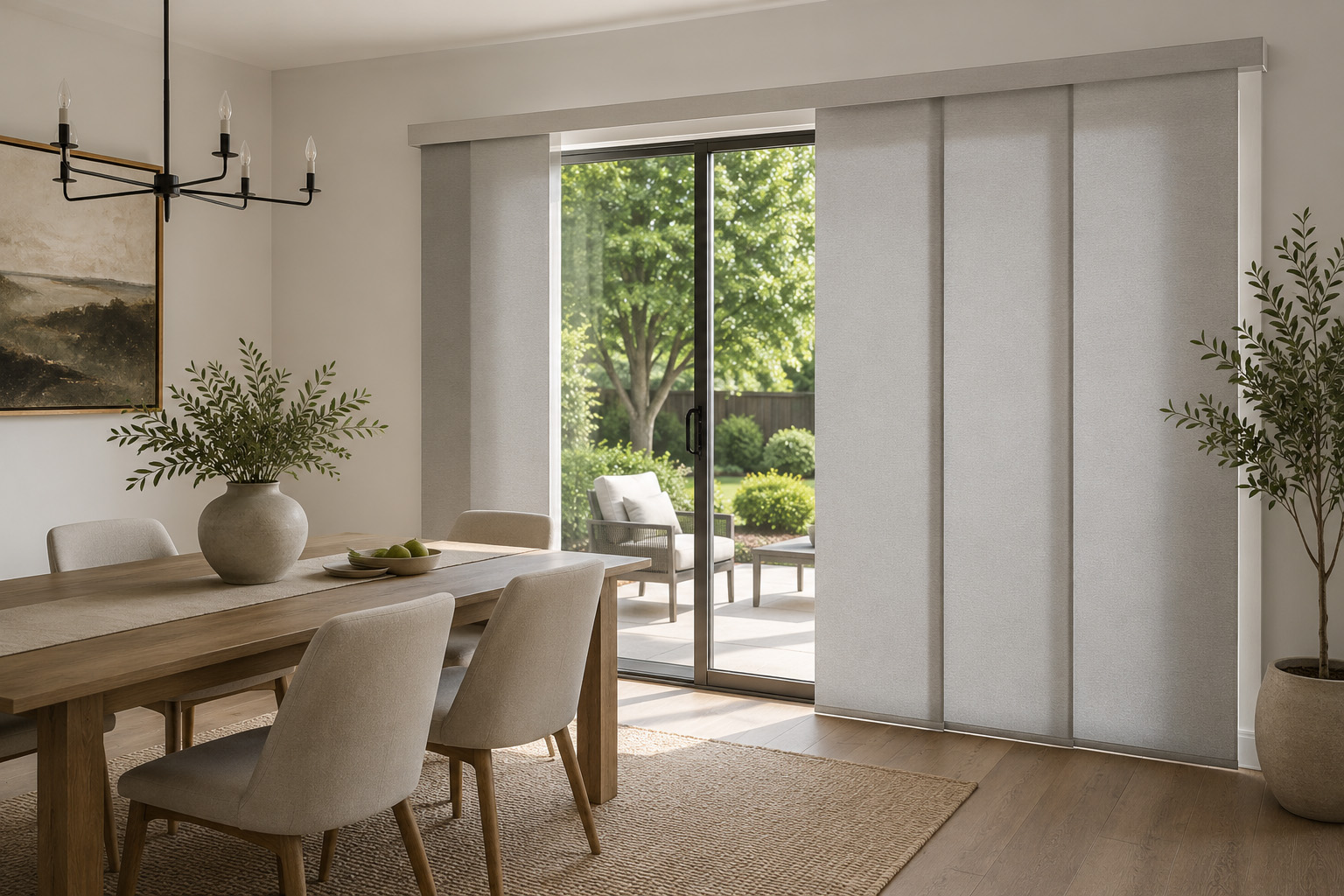
Choose the right window treatment for a sliding door, patio door or wide window by comparing operation, privacy, light control, insulation, mounting space and everyday use.
Replacing vertical blinds involves more than choosing a newer style. The best alternative must fit the opening, provide convenient access, deliver the privacy and light control you need and work with the available mounting and stacking space.
This guide explains how to evaluate the most important buying factors before selecting panel track blinds, roller shades, vertical cellular treatments, drapery or updated vertical blinds. For a broad overview of the available product types, read our vertical blind alternatives comparison.
When you are ready to browse products, visit our vertical blind alternatives shopping page or explore our custom panel track blinds, roller shades and vertical blinds.
How Do You Choose the Best Vertical Blind Alternative?
Start by identifying how the opening is used and which performance feature matters most. Panel track blinds are often chosen for a modern appearance, roller shades for a minimalist design, vertical cellular treatments for insulation, drapery for decorative softness and traditional vertical blinds for adjustable light control and easy door access.
The best choice is not necessarily the newest or most decorative option. It is the treatment that works with the width of the opening, clears the door hardware, stacks in an acceptable location and operates conveniently throughout the day.
| Your Main Priority | Option to Consider First | Why It May Work |
|---|---|---|
| Modern appearance | Panel track blinds | Wide fabric panels create a clean, contemporary look. |
| Frequent door access | Panel track blinds or vertical blinds | Both open horizontally instead of lifting from the bottom. |
| Adjustable light control | Vertical blinds | Rotating vanes redirect light without fully uncovering the opening. |
| Energy efficiency | Vertical cellular treatments | Honeycomb construction helps reduce heat transfer through large glass areas. |
| Decorative style | Drapery panels | Fabric adds softness, color, texture and pattern. |
| Minimalist design | Roller shades | The fabric rolls into a compact headrail for a simple appearance. |
| Room darkening | Opaque roller shades, cellular treatments or lined drapery | These options are available in materials designed to reduce incoming light. |
1. Identify the Type of Opening
The type of opening determines which operating systems will be practical. A sliding glass door, French door, oversized window, closet opening and room divider each create different requirements.
Sliding Glass Doors
Sliding doors are used horizontally, so side-opening window treatments are usually the most convenient. Panel track blinds, vertical blinds, vertical cellular systems and drapery can move in the same general direction as the door.
Wide Windows
Wide windows may offer more flexibility because the treatment does not need to clear a walking path. Panel tracks, multiple roller shades, vertical blinds and decorative fabric treatments may all be suitable depending on the width and desired appearance.
Closets and Room Dividers
Panel track blinds can be useful for concealing a closet, storage area or open section of a room. Before choosing them, make sure the panels have enough space to stack without blocking the area you need to access.
2. Measure the Width and Height
Measure the approximate width and height before becoming attached to a particular product. Every window treatment has minimum and maximum size limits that can vary by fabric, control type and manufacturer.
- Measure the width at the top, middle and bottom of the opening.
- Measure the height at the left, center and right.
- Record the available wall space above and beside the opening.
- Check the depth of the mounting surface.
- Identify any handles, locks, trim or molding that projects into the operating area.
- Confirm which door panel moves and which panel remains fixed.
Large openings may require multiple shades or panels. Dividing a wide opening can improve operation, but it may also create additional gaps or separate stacks.
3. Consider How Frequently the Door Is Used
A window treatment that works well on a rarely used patio door may become frustrating on a doorway that is opened throughout the day. Frequent use makes operating direction one of the most important buying considerations.
Frequently Used Doors
Panel track blinds and traditional vertical blinds are often practical because they open horizontally and can be moved away from the active door panel. Vertical cellular treatments and drapery can also provide convenient access when their stack is positioned correctly.
Occasionally Used Doors
Roller shades become more practical when the door is not opened continuously or when separate shades can be aligned with individual glass panels. Only the shade covering the active section may need to be raised.
For more product-specific guidance, visit our article about the best window treatments for sliding glass doors.
4. Evaluate the Available Stacking Space
Every side-opening window treatment forms a stack when opened. The size and location of that stack can affect the view, usable doorway width and overall appearance of the installation.
Panel Track Stacks
Panel track blinds use wide overlapping panels that gather at one side or split toward both sides. The finished stack is typically wider than the stack created by narrow vertical vanes.
Vertical Blind Stacks
Vertical blind vanes rotate and gather together at one side or split in the center. Their narrower vanes may produce a more compact stack than wide-panel systems.
Drapery Stacks
Drapery can require substantial wall space because the fabric gathers at one or both sides. Extending the rod beyond the opening may allow more of the glass and doorway to remain clear.
Before selecting panel tracks, read the pros and cons of panel track blinds for more information about stacking, overlap and mounting considerations.
5. Decide How Much Light Control You Need
Different alternatives control light in different ways. Consider whether you want to filter sunlight, reduce glare, redirect light or darken the room.
Directional Light Control
Vertical blinds offer one of the most adjustable systems because the vanes can rotate while remaining closed across the opening. This allows you to redirect sunlight without fully opening the blind.
Fabric-Based Light Control
Panel tracks, roller shades, cellular treatments and drapery rely heavily on fabric opacity. Depending on the product, you may be able to choose sheer, solar, light-filtering, room-darkening or blackout materials.
Glare Reduction
Solar roller shades and screen-style panel fabrics can reduce glare while preserving part of the outside view. These materials are useful in living rooms and offices but may provide limited privacy at night.
Room Darkening
Opaque roller shades, cellular treatments and lined drapery can significantly reduce incoming light. However, even blackout materials may allow light around the edges, between adjacent shades or where sliding panels overlap. Learn more about the best alternatives to vertical blinds for blackout.
6. Determine Your Privacy Requirements
Privacy should be evaluated separately for daytime and nighttime conditions. A material that limits the view into the room during the day may become more transparent after dark when the interior lights are on.
Daytime Privacy
Solar and sheer materials may reduce visibility from outside during daylight, especially when the exterior is brighter than the interior. They may still allow people inside the room to see outdoors.
Nighttime Privacy
Opaque, room-darkening and blackout materials generally provide stronger nighttime privacy. Drapery liners and cellular fabrics can also improve coverage when privacy is a primary concern.
Privacy Gaps
Consider gaps around the sides, bottom and center of the treatment. Multiple roller shades may leave spaces between units, while panel tracks rely on overlapping panels that can shift slightly during operation.
Explore more about the Best Alternative to Vertical Blinds for Privacy.
7. Consider Insulation and Energy Efficiency
Sliding doors and oversized windows contain large areas of glass that can contribute to heat gain in summer and heat loss in winter. The construction and fit of the window treatment influence how much insulation it can provide.
Vertical Cellular Treatments
Vertical cellular treatments are often the first option to consider when insulation is the highest priority. Their honeycomb cells trap air and create a buffer between the room and the glass. Learn more about the top insulating vertical blind alternatives.
Lined Drapery
Drapery with an appropriate lining can improve comfort when it covers the entire opening and extends beyond the edges of the glass. Floor-length fabric may also reduce drafts near the bottom of a door.
Roller Shades and Panel Tracks
Roller shades and panel tracks can reduce direct sunlight and heat gain depending on the selected fabric. Their energy performance also depends on how closely they fit the opening and how much space remains around the edges.
8. Match the Treatment to Your Interior Style
The window treatment should coordinate with the room while still meeting practical requirements. Consider whether you want the covering to blend into the space or become a decorative feature.
Modern and Contemporary Rooms
Panel track blinds and roller shades provide clean lines and relatively simple profiles. Neutral solids and subtle textures can create a streamlined appearance without drawing excessive attention to the opening.
Traditional and Transitional Rooms
Drapery, natural woven treatments and updated vertical blinds can work well in traditional or transitional interiors. Fabric, texture and valance choices can soften the appearance of a large opening.
Natural and Textured Interiors
Woven wood drapery or natural panel materials can introduce warmth and texture. Because natural weaves vary in openness, consider adding a liner when privacy or room darkening is important.
9. Choose the Right Operating System
Operation affects convenience, safety and cost. Available options vary by product and size, so review the specifications for the exact treatment you are considering.
Manual Operation
Manual systems are often the most affordable and straightforward choice. Depending on the product, operation may involve a wand, cord, chain, baton or hand-drawn panel.
Cordless Operation
Cordless options provide a cleaner appearance and eliminate exposed operating cords. Availability may be limited on very wide or heavy window treatments.
Motorized Operation
Motorization can be useful for oversized openings, hard-to-reach installations and treatments that are adjusted several times each day. Confirm the available power source, control method and product size limits before ordering.
10. Choose Between an Inside and Outside Mount
Inside Mount
An inside mount positions the headrail or track within the opening. It creates a recessed appearance but requires sufficient depth, a reasonably level mounting surface and clearance from the door hardware.
- Creates a built-in appearance.
- Keeps surrounding trim visible.
- May reduce usable mounting and stacking space.
- Can leave more visible gaps around the treatment.
Outside Mount
An outside mount positions the treatment above or around the opening. This is often the more flexible choice for sliding doors because it can provide additional room for the track and panel stack.
- Can extend beyond the opening for improved coverage.
- May reduce edge gaps and improve privacy.
- Can allow the stack to move farther away from the active doorway.
- Requires adequate wall space and secure mounting points.
Which Vertical Blind Alternative Should You Choose?
Choose Panel Track Blinds When
- You want a modern replacement for narrow vertical vanes.
- The opening is a sliding door, wide window, closet or room divider.
- You have enough space for wide panels to stack.
- You prefer a coordinated fabric look throughout the room.
Compare available materials and options by visiting our panel track blinds category. You can also read our comparison of panel track blinds vs. vertical blinds.
Choose Roller Shades When
- You want a simple and compact design.
- The opening can be divided into separate independently operated sections.
- You want a broad selection of fabric opacities.
- The door is not opened constantly or only one section needs to be raised.
Browse our custom roller shades to compare solar, light-filtering, room-darkening and blackout materials.
Choose Vertical Cellular Treatments When
- Insulation and energy efficiency are top priorities.
- You want a soft fabric appearance.
- You prefer side-to-side operation.
- You want to reduce discomfort near a large glass opening.
Choose Drapery When
- You want the treatment to be a decorative feature.
- You prefer fabric, color, pattern and texture.
- You have enough wall space for the fabric stack.
- You want the option to add a privacy or blackout lining.
Browse our custom drapery panels for layering, light control and added color and texture.
Choose Vertical Blinds When
- You want adjustable directional light control.
- The door is opened frequently.
- You prefer a compact side stack.
- You want the ability to replace individual vanes if needed.
- Budget and practical operation are more important than a wide-panel appearance.
Modern vertical blinds remain a practical option and are available in updated fabrics, vinyls, textures and colors. Shop the Best Selling Vertical Blind Alternatives.
Common Mistakes to Avoid
Choosing Appearance Before Operation
A treatment can look attractive but become inconvenient if it blocks the active door panel or requires excessive effort to open each day.
Ignoring the Finished Stack
Measure where the panels, vanes or fabric will gather. A wide stack can reduce the view or make the doorway more difficult to use.
Assuming Every Material Provides Nighttime Privacy
Solar, screen and sheer materials may become less private after dark. Review the fabric opacity and order samples before choosing a privacy-sensitive treatment.
Expecting Blackout Fabric to Eliminate All Light
Blackout describes the material rather than the complete installation. Light can still enter around edges, between separate shades or through panel overlaps.
Forgetting Door Handles and Trim
Handles, locks, trim and molding can interfere with operation. Measure how far each obstruction projects from the door or wall.
Not Reviewing Product Size Limits
Available fabrics, control systems and upgrades may change at larger sizes. Confirm all specifications before finalizing the product selection.
Vertical Blind Alternative Buying Checklist
- Identify the opening: Determine whether it is a sliding door, wide window, closet or room divider.
- Measure the space: Record the width, height, depth and surrounding wall area.
- Locate the active panel: Identify which section of the door opens and where access is required.
- Choose your primary goal: Prioritize style, access, privacy, light control, insulation or room darkening.
- Select an operating direction: Decide between side-opening panels, rotating vanes, lifting shades or fabric drapery.
- Plan the stack: Determine where the treatment will gather when completely open.
- Review fabric opacity: Evaluate daytime privacy, nighttime privacy and light control.
- Confirm mounting requirements: Check depth, clearance, headrail size and mounting surface.
- Order samples: View materials in the room during both daytime and nighttime conditions.
- Verify product specifications: Confirm size limits, options and measuring instructions before ordering.
Expert Guidance from Blinds Chalet
Blinds Chalet has helped customers shop for custom window treatments since 2006. Our team works with treatments designed for standard windows, sliding glass doors, patio doors, oversized openings and specialty applications.
In our experience, the most successful installation begins with the way the opening is used. Door access, panel stacking, mounting clearance and material opacity are often more important to long-term satisfaction than choosing a product based on appearance alone.
Because size limits and specifications vary by manufacturer, product and selected options, always follow the measuring instructions for the exact treatment you plan to order.
Content developed by: Blinds Chalet's window treatment team
Continue Researching Vertical Blind Alternatives
- Vertical Blind Alternatives Expert Advice Center
- Vertical Blind Alternatives Compared
- Panel Track Blinds vs. Vertical Blinds
- Pros and Cons of Panel Track Blinds
- Best Window Treatments for Sliding Glass Doors
- Pros and Cons of Traditional Vertical Blinds
After narrowing your options, browse our vertical blind alternatives to compare available products, colors, materials and operating systems.
How to Choose Vertical Blind Alternatives FAQs
What is the first thing to consider when replacing vertical blinds?
Start with how the opening is used. Identify whether it is a frequently used sliding door, a wide window or another type of opening. The operating direction and required access will help determine whether a side-opening treatment, lifting shade or drapery system is most practical.
What is the easiest vertical blind alternative to use on a sliding door?
Panel track blinds, vertical blinds, vertical cellular treatments and drapery are generally convenient because they open horizontally. The easiest choice depends on where the treatment stacks and which door panel is used most frequently.
How do I choose between panel track blinds and roller shades?
Choose panel track blinds when side-to-side operation and wide fabric panels are priorities. Choose roller shades when you want a compact minimalist appearance and the opening can be divided into independently operated sections. Roller shades generally need to be raised for direct access through the door.
Which vertical blind alternative provides the best light control?
Traditional vertical blinds provide the most adjustable directional light control because their vanes can rotate while covering the opening. Roller shades offer the widest selection of fabric opacities, while panel tracks and cellular treatments primarily control light by opening or closing across the glass.
Which option provides the best insulation?
Vertical cellular treatments are generally the strongest insulating alternative because their honeycomb-shaped cells trap air and help reduce heat transfer. Lined drapery can also improve comfort when it covers the full opening and extends beyond the glass.
How much stacking space do I need?
The required stacking space depends on the treatment width, number of panels or vanes and whether the system opens to one side or splits in the center. Measure the available wall space and review the product specifications before ordering.
Should I use an inside or outside mount for a sliding door?
An outside mount is often more flexible because it can provide additional room for the track and stack while improving coverage around the opening. An inside mount can create a recessed appearance but requires sufficient depth and clearance from handles, locks and trim.
Should I order samples before choosing an alternative?
Yes. Samples allow you to evaluate the material's color, texture, openness and opacity under the actual lighting conditions in your room. Check the samples during the day and at night when privacy and light control are important.
Ready to upgrade your windows? Browse our full selection of quality vertical blind alternatives to find the window treatment for your space.
Want to learn more before you decide? Explore our vertical blind alternative buying guides and expert advice for helpful tips, comparisons, and inspiration.