









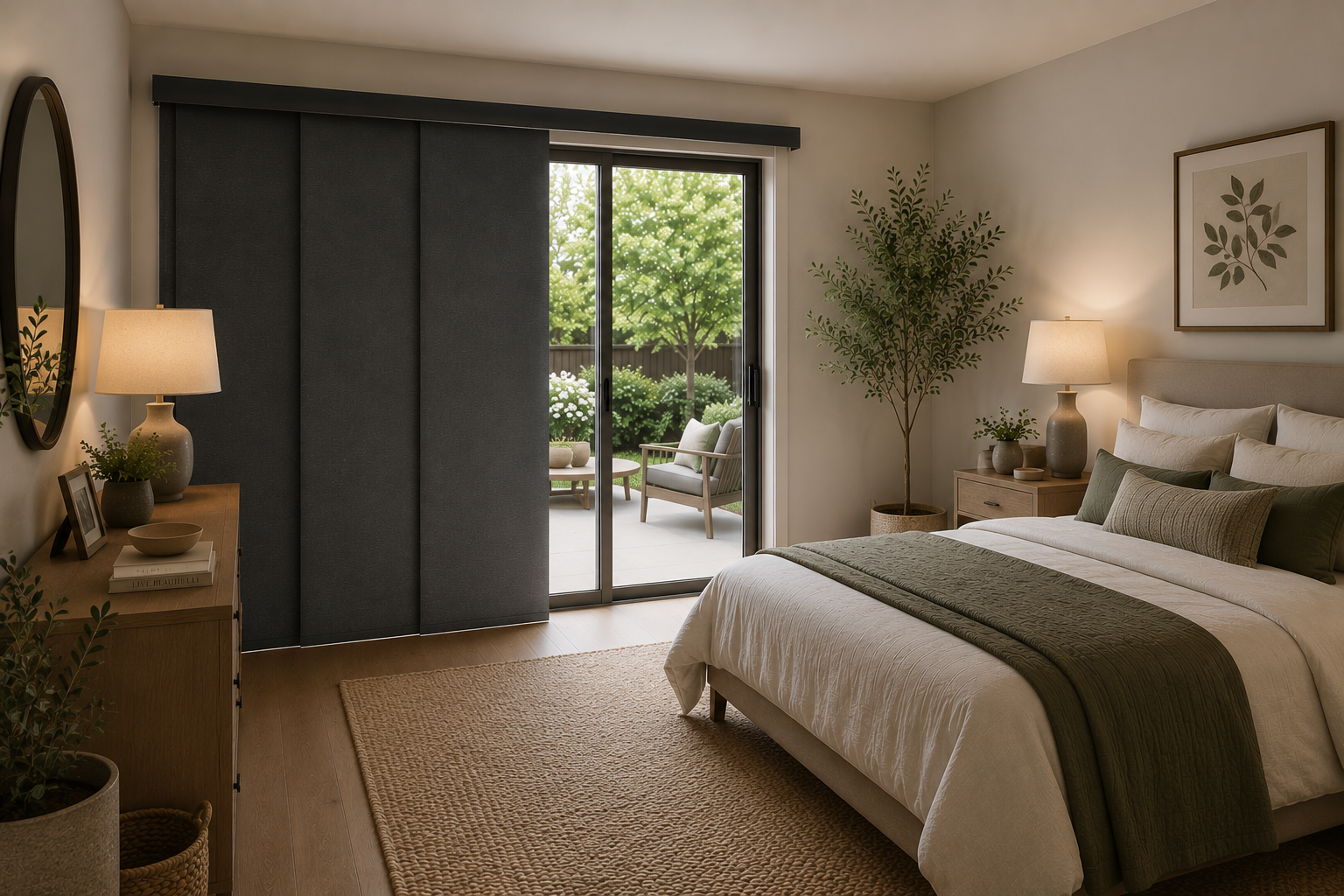
Compare vertical blind alternatives for daytime and nighttime privacy, including panel track blinds, roller shades, cellular treatments and drapery for sliding doors and wide windows.
Privacy is often one of the biggest concerns when replacing vertical blinds on a sliding glass door, patio door or wide window. While many window treatments can cover a large opening, they do not all provide the same level of privacy during both the day and night.
The best alternative to vertical blinds for privacy depends on more than the material itself. Fabric opacity, panel overlap, side gaps, mounting style and the way the treatment moves all affect how easily someone outside can see into the room.
This guide focuses specifically on privacy performance. For a broader comparison of different products, visit our Vertical Blind Alternatives: Comparing Your Best Options guide. You can also learn how to evaluate the different choices in our How to Choose Vertical Blind Alternatives buying guide. Shop our vertical blind alternatives.
What Is the Best Alternative to Vertical Blinds for Privacy?
For strong daytime and nighttime privacy, opaque vertical cellular treatments, roller shades and lined drapery are generally among the best alternatives to traditional vertical blinds. Panel track blinds can also provide very good privacy when they use an opaque fabric and have sufficient overlap between the panels.
The right choice depends on how the opening is used. A sliding door that is opened frequently may benefit from a side-opening panel track or cellular system, while a wide fixed window may work well with roller shades. Drapery can provide excellent coverage when enough fabric extends beyond the glass and overlaps properly in the center.
| Window Treatment | Daytime Privacy | Nighttime Privacy | Main Privacy Concern | Best For |
|---|---|---|---|---|
| Vertical Cellular Treatments | Very Good | Very Good with Opaque Fabric | Outer edge gaps | Privacy plus insulation |
| Opaque Roller Shades | Very Good | Very Good | Side gaps and gaps between multiple shades | Minimalist rooms and divided openings |
| Lined Drapery | Excellent | Excellent | Center opening and insufficient side overlap | Bedrooms and decorative spaces |
| Panel Track Blinds | Good to Very Good | Good to Very Good with Opaque Fabric | Panel overlap and perimeter gaps | Sliding glass doors and wide windows |
| Traditional Vertical Blinds | Good to Very Good | Good | Vane gaps, movement and misalignment | Frequently used sliding doors |
| Solar or Screen Shades | Varies with lighting conditions | Limited | Visibility into the room after dark | Glare reduction where nighttime privacy is less important |
Daytime Privacy vs. Nighttime Privacy
One of the most important things to understand when choosing a window treatment is that daytime privacy does not automatically mean nighttime privacy.
Daytime Privacy
During the day, outdoor light is usually brighter than the light inside your home. This can make some solar, screen and semi-sheer fabrics difficult to see through from the exterior while still preserving part of your view outside.
The amount of daytime privacy depends on fabric openness, color, sun exposure and the difference between indoor and outdoor light levels. A shaded patio or cloudy day can change how private the same fabric appears.
Nighttime Privacy
At night, the lighting relationship is reversed. When the lights are on inside your home and it is dark outdoors, solar and screen fabrics may allow people outside to see into the room much more easily.
If dependable nighttime privacy is important, choose an opaque, room-darkening or blackout material rather than relying on a screen or sheer fabric.
Learn more: Best Blackout Vertical Blind Alternatives
1. Vertical Cellular Treatments: Best for Privacy and Insulation
Vertical cellular treatments use honeycomb-style fabric that moves horizontally across a sliding door or wide window. Because the treatment is made from continuous fabric rather than individual vanes, it can provide strong privacy when an opaque material is selected.
Privacy Advantages
- Continuous fabric blocks direct views through the treatment.
- Opaque materials provide strong daytime and nighttime privacy.
- There are no individual vanes that can become misaligned.
- Side-to-side operation works naturally with sliding doors.
- Honeycomb construction can also help reduce heat transfer through large glass areas.
Privacy Limitations
- Small gaps may remain around the sides of the treatment.
- Inside-mounted installations may have more visible edge gaps.
- Light-colored fabrics can sometimes reveal shadows when someone stands close to the shade.
- Available sizes and configurations vary by product.
Vertical cellular treatments are particularly useful in bedrooms, family rooms and other spaces where both privacy and insulation are priorities. Learn more: best insulating window treatments other than vertical blinds
2. Opaque Roller Shades: Best Minimalist Privacy Option
Quality roller shades provide a clean, simple design and are available in a broad range of fabric opacities. Opaque, room-darkening and blackout roller fabrics can prevent direct views through the material during both the day and night.
Privacy Advantages
- Opaque fabrics provide dependable privacy through the material.
- Room-darkening and blackout options provide strong nighttime coverage.
- Individual shades can operate independently across divided openings.
- Roller shades coordinate easily with other windows throughout the room.
- The fabric rolls into a compact area when opened.
Privacy Limitations
- Inside-mounted shades usually have gaps along the sides.
- Multiple roller shades can create gaps between adjacent units.
- The shade over the active door may need to be raised for access.
- Blackout fabric does not eliminate privacy gaps around the installation.
When multiple roller shades are used across a sliding door, try to position the gaps between shades over door frames or mullions rather than directly over exposed glass whenever the product configuration allows.
3. Lined Drapery: Best Decorative Privacy Option
Drapery can provide excellent privacy because the fabric can extend beyond the edges of the glass and overlap in the center. A privacy or blackout liner can also prevent visibility through decorative face fabrics that would otherwise allow silhouettes to show at night.
Privacy Advantages
- Fabric can extend beyond both sides of the opening.
- Privacy or blackout lining can prevent visibility through the fabric.
- Center overlap can reduce sightlines between panels.
- Floor-length drapery provides broad coverage around large doors.
- Drapery can be layered over blinds or shades for additional privacy.
Privacy Limitations
- Panels can separate in the center if there is not enough fabric or overlap.
- Airflow from open doors, fans or vents can move lightweight fabric.
- The fabric stack may require significant wall space.
- Unlined decorative fabrics may show silhouettes after dark.
Lined drapery is a strong choice when you want maximum privacy while also making the window treatment an important part of the room's décor.
4. Panel Track Blinds: Best Modern Privacy Option for Sliding Doors
Custom panel track blinds are one of the most popular modern alternatives to vertical blinds. They use wide fabric panels that overlap as they move horizontally across an overhead track.
For privacy, the selected fabric is especially important. Opaque and room-darkening fabrics can prevent direct views through the panel, while screen or solar fabrics may provide significantly less nighttime privacy.
Privacy Advantages
- Wide panels create fewer vertical divisions than traditional vertical vanes.
- Opaque fabrics can provide strong daytime and nighttime privacy.
- Panels move horizontally for convenient sliding-door access.
- Fabric selections may include light-filtering, decorative and room-darkening options.
- The broad-panel design creates a clean, contemporary appearance.
Privacy Limitations
- Small sightlines can occur where panels overlap.
- Spaces may remain along the outer edges of the treatment.
- Panels can shift slightly during operation.
- Screen and solar fabrics may provide poor nighttime privacy.
Before ordering, review the pros and cons of panel track blinds to better understand panel overlap, stacking and operation.
You can also compare panel track blinds vs. vertical blinds when deciding whether wide fabric panels or rotating vanes better fit your privacy and light-control needs.
5. Traditional Vertical Blinds: Best for Adjustable Privacy
Although this guide focuses on alternatives, modern vertical blinds remain one of the easiest window treatments for adjusting privacy throughout the day.
The individual vanes can rotate from open to closed without moving the entire blind away from the window. This allows you to change both the viewing angle and the amount of incoming light.
Privacy Advantages
- Rotating vanes provide adjustable privacy.
- Closed opaque vanes block direct sightlines.
- The entire blind can slide aside for convenient door access.
- Individual damaged vanes can often be replaced.
- Opaque vinyl and fabric options are available.
Privacy Limitations
- Small gaps can appear between vanes.
- Vanes may become misaligned over time.
- Air movement can temporarily separate lightweight vanes.
- Tilting the vanes for light control can reduce privacy.
If you are considering replacement because of privacy concerns, compare whether the problem comes from the vertical blind design itself or from damaged, misaligned or unsuitable vanes.
Are Solar Shades Private?
Solar shades can provide useful daytime privacy, but they generally should not be selected when dependable nighttime privacy is required.
Solar fabrics contain small openings that allow some outward visibility while reducing glare, ultraviolet exposure and solar heat. During daylight hours, the brighter outdoor environment can make it difficult to see into the room from outside.
After dark, interior lighting can make furniture, people and activity visible through the same fabric. The more open the fabric, the greater the potential visibility.
If you like the glare control of a solar shade but also need nighttime privacy, consider layering it with an opaque roller shade or drapery.
How Fabric Opacity Affects Privacy
Sheer Fabrics
Sheer materials soften incoming light and maintain an airy appearance, but they provide limited privacy. At night, shapes and activity inside the room may be easily visible.
Solar and Screen Fabrics
Solar fabrics are designed primarily for glare reduction, heat control and maintaining an outside view. Their privacy depends heavily on lighting conditions and fabric openness.
Light-Filtering Fabrics
Light-filtering fabrics diffuse incoming sunlight while providing greater privacy than sheer or screen materials. Some light-filtering fabrics may still reveal shadows or silhouettes after dark.
Room-Darkening Fabrics
Room-darkening materials are substantially more opaque and generally provide strong daytime and nighttime privacy. Light may still enter around the edges of the installation.
Blackout Fabrics
Blackout fabrics prevent light and visibility from passing directly through the material. They provide excellent privacy, but gaps around the treatment can still create sightlines into the room.
Privacy Gaps to Check Before Ordering
A privacy-focused fabric can still produce a less-private installation if there are direct sightlines around or between the materials.
Side Gaps
Inside-mounted shades typically require clearance between the fabric and the sides of the opening. These spaces can allow someone standing at an angle outside to see into the room.
Gaps Between Multiple Shades
Large sliding doors may require several roller shades. Small gaps between the shades can create direct sightlines unless they are positioned over structural door frames.
Panel Overlap
Panel track blinds depend on adjacent panels overlapping. Proper overlap reduces visibility through the treatment, while insufficient overlap can create a narrow viewing angle into the room.
Center Gaps
Drapery panels and split-draw systems can separate where the two sides meet. Additional overlap can improve privacy.
Bottom Gaps
Door tracks, thresholds and uneven flooring can create gaps beneath a window treatment. Measure the opening at multiple locations and account for changes in floor height.
Inside Mount vs. Outside Mount for Privacy
Inside Mount
An inside mount places the window treatment within the opening and creates a clean, recessed appearance. However, the hardware and operating system typically require clearance along the sides.
- Creates a streamlined appearance.
- Keeps surrounding trim visible.
- Requires sufficient mounting depth.
- May leave larger side gaps.
- May provide less complete privacy at extreme viewing angles.
Outside Mount
An outside mount allows the treatment to extend beyond the glass. This can reduce side sightlines and is often the better choice when maximum privacy is more important than preserving the appearance of the surrounding trim.
- Allows wider coverage around the opening.
- Can reduce side and top privacy gaps.
- Can help improve room darkening at the same time.
- Provides more flexibility for stacking outside the glass.
- Requires adequate wall space and secure mounting points.
Best Vertical Blind Alternatives for Privacy by Room
Bedrooms
Opaque vertical cellular treatments, blackout roller shades and lined drapery are strong bedroom choices because they can provide nighttime privacy while also reducing unwanted light.
Living Rooms
Panel track blinds, cellular treatments and lined drapery can balance privacy with appearance. If maintaining some daytime view is important, consider how the fabric behaves under changing light conditions.
Family Rooms
Panel track blinds, roller shades and vertical blinds provide practical operation in frequently used rooms. Select an opaque material when windows or patio doors face neighboring homes or a public area.
Home Offices
Light-filtering roller shades and panel tracks can reduce glare while providing moderate privacy. Choose a more opaque material when the office is used at night or faces a sidewalk or neighboring property.
Dining Rooms
Panel track blinds and drapery can provide strong evening privacy while adding texture and visual interest to a large door or window.
How to Choose a Vertical Blind Alternative for Privacy
- Determine when privacy matters: Decide whether you need privacy during the day, at night or at all times.
- Evaluate the view from outside: Look at the window from sidewalks, neighboring properties and other likely viewing angles.
- Choose the right opacity: Use opaque, room-darkening or blackout materials when nighttime privacy is essential.
- Check for edge gaps: Consider the sides, bottom and top of the finished treatment.
- Consider panel overlap: Make sure sliding panels or drapery provide enough overlap to prevent direct sightlines.
- Plan around the active door: Choose an operating system that restores privacy easily after someone uses the door.
- Consider an outside mount: Extending beyond the opening can improve overall coverage.
- Order samples: Evaluate fabric opacity against the actual glass during both daytime and nighttime conditions.
Common Privacy Mistakes to Avoid
Assuming Daytime Privacy Means Nighttime Privacy
A screen or sheer fabric that appears private during the day can become highly transparent from outside once interior lights are turned on.
Focusing Only on Fabric Opacity
An opaque material cannot provide complete privacy if there are large spaces around the edges or between separate shades.
Ignoring Viewing Angles
A treatment may look private when viewed straight on but allow visibility from a sidewalk, neighboring balcony or side yard. Check the window from realistic outdoor viewing positions.
Not Planning the Panel Overlap
Panel track treatments rely on overlapping sections of fabric. Insufficient overlap can create direct sightlines even when the material itself is completely opaque.
Ignoring Air Movement
Open doors, ceiling fans and HVAC vents can move drapery, lightweight panels or vertical vanes and temporarily reduce privacy.
Expert Guidance from Blinds Chalet
Blinds Chalet has helped homeowners shop for custom window treatments since 2006. In our experience, privacy complaints are often caused by the complete installation rather than the fabric alone.
When privacy is a priority, we recommend evaluating fabric opacity, panel overlap, mounting position, side gaps and the way the treatment will be operated each day. A well-chosen opaque material can still provide disappointing results if the finished installation leaves direct sightlines into the room.
Because specifications and available configurations vary by manufacturer, product and size, always review the measuring instructions and product details for the exact window treatment you plan to order.
Continue Researching Vertical Blind Alternatives
- Vertical Blind Alternatives Expert Advice Center
- Vertical Blind Alternatives: Comparing Your Best Options
- Shop the Best Selling Vertical Blind Alternatives.
- How to Choose Vertical Blind Alternatives
- Panel Track Blinds vs. Vertical Blinds
- Pros and Cons of Panel Track Blinds
- Best Window Treatments for Sliding Glass Doors
- Pros and Cons of Traditional Vertical Blinds
- Are Roller Shades an Option for Large Sliding Doors?
When you are ready to compare products, browse our vertical blind alternatives, panel track blinds, roller shades and vertical blinds.
Best Alternatives to Vertical Blinds for Privacy FAQs
What is the best alternative to vertical blinds for privacy?
Opaque vertical cellular treatments, roller shades and lined drapery are generally among the strongest options for both daytime and nighttime privacy. Panel track blinds can also provide strong privacy when an opaque fabric and sufficient panel overlap are used.
Do panel track blinds provide privacy at night?
Panel track blinds can provide good nighttime privacy when they use an opaque, room-darkening or blackout fabric. Visibility can still occur around the outer edges or between panels if there is not enough overlap.
Are roller shades good for privacy?
Opaque roller shades can provide excellent privacy through the fabric. However, inside-mounted shades may leave side gaps, and multiple shades across a wide opening may create gaps between individual units.
Are solar shades private at night?
Solar shades generally do not provide dependable nighttime privacy. When interior lights are on and it is dark outside, people may be able to see through the screen fabric into the room.
Do light-filtering shades provide nighttime privacy?
Many light-filtering fabrics provide good privacy, but some may reveal shadows or silhouettes at night. Privacy varies according to the material's weave, color and opacity, so samples should be evaluated under nighttime lighting conditions.
Is an outside mount better for privacy?
An outside mount is often better when maximum privacy is the goal because the treatment can extend beyond the glass and reduce direct sightlines along the sides. An inside mount usually leaves more space between the treatment and the edges of the opening.
Which vertical blind alternative is best for bedroom privacy?
Opaque vertical cellular treatments, blackout roller shades and lined drapery are strong choices for bedrooms because they provide nighttime privacy and can also reduce incoming light.
How can I improve privacy on a sliding glass door?
Choose an opaque material, reduce edge gaps, provide sufficient panel or drapery overlap and consider an outside mount that extends beyond the glass. For multiple roller shades, align the gaps with door frames or mullions whenever possible.
Are blackout fabrics better for privacy than room-darkening fabrics?
Both blackout and sufficiently opaque room-darkening fabrics can provide strong privacy because they prevent direct views through the material. Blackout fabric also blocks light through the fabric, but neither option eliminates privacy gaps around the edges of the installation.
If you're ready to get started, explore our vertical blind alternatives collection to compare finishes, lift systems, and styles for your home.
You can also browse our vertical blind alternatives guide hub for additional information and recommendations.