









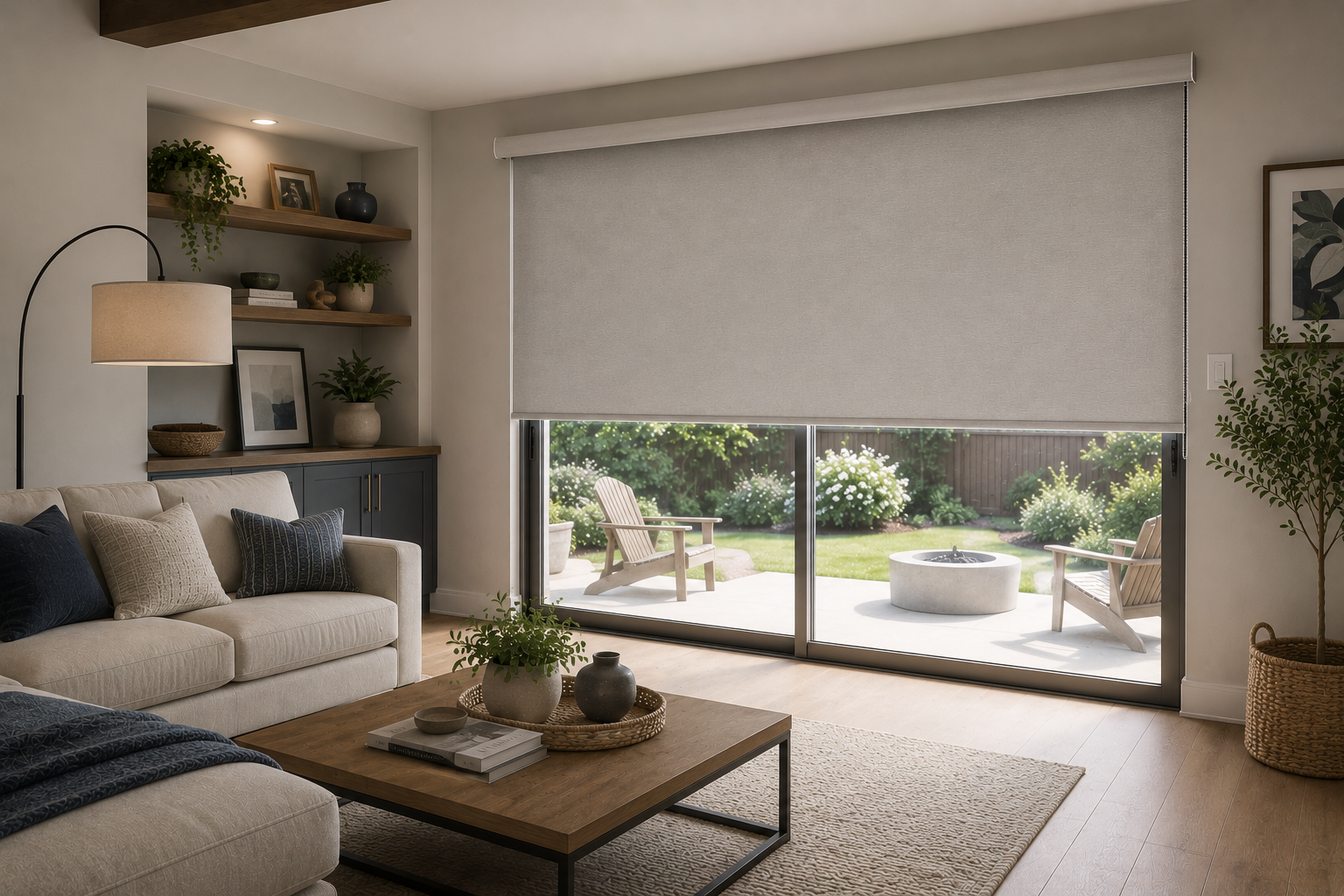
Roller shades can be an attractive alternative to vertical blinds for sliding glass doors, but the right configuration depends on door access, opening width, shade placement, light gaps and how often the door is used.
Yes, roller shades can work on sliding glass doors, especially when the opening can be divided into two or more independently operated shades. Their clean appearance, broad fabric selection and compact design make them an appealing alternative to traditional vertical blinds.
However, roller shades operate differently from a sliding door. A roller shade moves vertically while the door moves horizontally, so the shade covering the active door panel generally needs to be raised before someone can walk through the opening. This makes roller shades more practical for some sliding doors than others.
This guide explains when roller shades work well on sliding doors, when another treatment may be more convenient and what you should consider before ordering. For additional options, visit our Vertical Blind Alternatives Expert Advice Center or read our Vertical Blind Alternatives: Comparing Your Best Options guide. Shop alternatives to vertical blinds for large windows.
Are Roller Shades a Good Choice for Sliding Glass Doors?
Roller shades can be a good choice for sliding glass doors when you want a minimalist appearance, broad fabric selection and the ability to control separate sections of the door independently. They work particularly well when the opening can be divided so one shade covers the active door panel and another shade covers the stationary glass.
They may be less convenient on a door that is opened constantly because the shade covering the active panel usually needs to be raised before someone passes through the doorway. For frequently used doors, side-opening treatments such as panel track blinds, vertical cellular shades or traditional vertical blinds may provide easier access.
| Consideration | Roller Shade Performance | What to Know |
|---|---|---|
| Modern Appearance | Excellent | Provides a clean, simple look with minimal visible hardware. |
| Fabric Selection | Excellent | Available in solar, light-filtering, room-darkening and blackout fabrics. |
| Frequent Door Access | Moderate | The active shade generally needs to be raised before using the door. |
| Privacy | Very Good with Opaque Fabric | Gaps between multiple shades should be considered. |
| Room Darkening | Very Good with Appropriate Fabric | Side gaps and gaps between adjacent shades can allow light into the room. |
| Glare Control | Excellent | Solar fabrics can reduce glare while preserving some outside view. |
| Independent Control | Excellent | Multiple shades allow separate sections of the door to operate independently. |
Using Multiple Roller Shades on a Sliding Door
Large sliding glass doors often exceed the practical width of a single roller shade or are easier to operate when divided into multiple shades. A common approach is to install one shade over each major section of glass.
For example, a two-panel sliding door may use one roller shade over the stationary panel and another over the active sliding panel. The stationary shade can remain lowered while the active shade is raised only when the doorway is being used.
Advantages of Multiple Roller Shades
- Each section of the door can be controlled independently.
- Individual shades are generally easier to operate than one extremely wide shade.
- The shade covering the stationary panel can remain closed for privacy or glare control.
- Separate shades can reduce the amount of fabric that needs to move each time the door is used.
- Multiple shades can align with the architectural divisions of the door.
Potential Drawbacks
- Narrow gaps typically remain between adjacent shades.
- Multiple shades require careful alignment for a clean appearance.
- Blackout performance can be reduced by center gaps.
- Each shade may require its own control or motor.
Whenever possible, position the gap between adjacent roller shades over the vertical frame or mullion of the sliding door rather than over an exposed section of glass. This makes the gap less noticeable and can improve privacy and room darkening.
Plan Around the Active Door Panel
Before ordering roller shades, identify which glass panel slides and which remains stationary. The active panel determines how often each shade will need to be operated.
If one roller shade covers the active section, you can raise only that shade when someone needs to use the door while leaving the remaining shades lowered.
Frequently Used Sliding Doors
If the door is opened many times throughout the day, repeatedly raising and lowering a roller shade may become inconvenient. In this situation, a horizontally opening treatment may be easier to use.
Occasionally Used Sliding Doors
Roller shades become more practical when the door is used occasionally or when the active shade can remain raised during periods of frequent use.
Stationary Glass Sections
Roller shades work especially well over stationary sections because the shade can remain at the preferred height without interfering with door operation.
Advantages of Roller Shades for Sliding Glass Doors
Clean, Minimalist Appearance
Roller shades have one of the simplest profiles among custom window treatments. When raised, the fabric rolls compactly near the top of the opening rather than forming a large stack along the side of the door.
Wide Selection of Fabrics
Custom made roller shades are available in a wide variety of materials, colors and textures. This makes it possible to choose a fabric based on privacy, glare, heat control, room darkening or décor.
Independent Light Control
When several roller shades are used across the opening, each section can be adjusted independently. You may be able to block strong sunlight on one side of the door while leaving another section partially or completely open.
Easy Coordination With Nearby Windows
One advantage of roller shades is the ability to use the same or coordinating fabrics throughout the room. Standard windows can use matching roller shades while the sliding door uses a multi-shade configuration.
Motorization Options
Many roller shade products offer motorized operation. Motorization can make a large multi-shade installation easier to use, particularly when the shades are adjusted several times throughout the day.
Potential Drawbacks of Roller Shades on Sliding Doors
The Shade Must Move in a Different Direction Than the Door
A sliding door moves horizontally, while a roller shade moves vertically. This is the biggest functional difference compared with panel track blinds or vertical blinds.
Gaps Between Multiple Shades
Multiple roller shades require clearance between each unit. These spaces can allow light through and may reduce privacy when the gap falls over exposed glass.
Light Gaps Around the Sides
Inside-mounted roller shades usually have small gaps between the fabric and the sides of the opening. This is especially important when blackout or maximum privacy is the goal.
Very Wide Shades Can Become Large and Heavy
Extremely wide roller shades require more fabric, a larger roller tube and appropriate hardware. Product size limits vary based on the material and operating system.
Door Handles and Hardware Can Interfere
Sliding-door handles, locks and trim may project into the space where the shade travels. Always measure these obstructions before deciding on an inside or outside mount.
Which Roller Shade Fabric Works Best on a Sliding Door?
The best fabric depends on what you are trying to accomplish. Roller shades offer more fabric choices than many sliding-door treatments, making material selection one of their biggest advantages.
Solar Screen Fabric
Solar shades are a strong choice for sliding doors that receive intense sunlight. The screen material reduces glare and solar heat while preserving varying degrees of outward visibility.
Solar fabrics generally provide better daytime than nighttime privacy, so they may not be appropriate when complete evening privacy is required.
Light-Filtering Fabric
Light-filtering roller shades diffuse direct sunlight and create a softer interior environment while providing more privacy than an open screen fabric.
Privacy varies by material, so evaluate samples at night if the sliding door faces neighboring homes or a public area.
Room-Darkening Fabric
Room-darkening fabrics substantially reduce incoming light and generally provide strong privacy. They can work well in bedrooms, family rooms and television rooms.
Blackout Fabric
Blackout roller shade material blocks light from passing through the fabric itself. However, multiple shades and perimeter gaps can still allow light around the installation.
If maximum darkness is your goal, read our guide to the Vertical Blind Alternatives Expert Advice Center for additional room-darkening options.
Do Roller Shades Provide Privacy on Sliding Doors?
Opaque roller shades can provide excellent privacy through the fabric itself. The main privacy concern on a sliding door is usually the gaps around or between the shades rather than visibility through the material.
Daytime Privacy
Opaque and many light-filtering fabrics can provide strong daytime privacy. Solar fabrics may also reduce visibility into the room during daylight depending on fabric openness and lighting conditions.
Nighttime Privacy
For dependable nighttime privacy, choose an opaque, room-darkening or blackout material. Solar screen fabrics can become much easier to see through from outside when interior lights are on.
Gaps Between Shades
Align the space between adjacent shades with the sliding-door frame whenever possible. This can reduce direct sightlines through the installation.
Can Roller Shades Black Out a Sliding Glass Door?
Blackout roller shades can block light through the fabric, but a multi-shade sliding-door installation generally should not be expected to create complete darkness by itself.
Light can enter around the outer edges and through the spaces between individual shades. An outside mount, greater overlap around the opening or an additional layer of drapery may improve room-darkening performance.
Roller shades can still provide substantial room darkening and may be a strong choice for bedrooms, home theaters and family rooms when the installation is planned carefully.
Inside Mount vs. Outside Mount for Sliding-Door Roller Shades
Inside Mount
An inside mount positions the roller shades within the opening. This can create a clean architectural appearance but requires sufficient mounting depth and clearance from the door hardware.
- Creates a recessed appearance.
- Keeps surrounding trim visible.
- Requires adequate mounting depth.
- May create larger side gaps.
- Can reduce clearance between the shade and door handles.
Outside Mount
An outside mount positions the shades above or around the opening. This often provides greater flexibility on sliding doors because the shades can extend beyond the glass and clear projecting hardware.
- Allows more flexibility around door handles and trim.
- Can reduce side light and privacy gaps.
- Can make the opening appear taller.
- Does not require deep window or door framing.
- Requires sufficient mounting surface above the opening.
Roller Shades vs. Panel Track Blinds for Sliding Doors
Roller shades and panel track blinds are both modern alternatives to traditional vertical blinds, but they operate very differently.
Panel track blinds move horizontally in the same direction as a sliding door. Roller shades move vertically and roll above the opening. This makes panel tracks generally more convenient for frequently used doors, while roller shades provide a cleaner open view because the fabric does not stack along the side.
| Feature | Roller Shades | Panel Track Blinds |
|---|---|---|
| Operating Direction | Up and down | Side to side |
| Door Access | Active shade typically needs to be raised | Panels slide away from active doorway |
| Open View | Fabric rolls above the opening | Panels stack along one or both sides |
| Fabric Choices | Very broad | Broad, depending on product |
| Independent Sections | Excellent with multiple shades | Panels operate as part of one track system |
| Light Gaps | Possible between multiple shades | Possible at panel overlaps |
| Frequent Door Use | Good to Moderate | Very Good |
Panel tracks are generally the more convenient choice when the doorway is used constantly. Roller shades may be preferable when you want a minimal appearance, broad fabric selection and the ability to independently control different sections of glass.
For more information about panel systems, read the pros and cons of panel track blinds.
Roller Shades vs. Traditional Vertical Blinds
Traditional vertical blinds remain highly functional for sliding doors because their operating direction matches the movement of the door. Their rotating vanes also allow light to be redirected without completely opening the treatment.
Roller shades provide a cleaner and more minimal appearance but generally sacrifice some of that convenience. When the active shade is lowered, it normally needs to be raised before using the doorway.
If frequent access and adjustable directional light control are your priorities, vertical blinds may still be the better solution. If appearance, fabric selection and coordinated window treatments are more important, roller shades may be preferable.
Are Motorized Roller Shades a Good Choice for Sliding Doors?
Motorization can make roller shades considerably easier to use on a sliding glass door, especially when the installation contains several shades.
Instead of manually raising and lowering individual shades, motorized controls can simplify frequent adjustments. Depending on the product, multiple shades may also be operated together or separately.
Motorization Is Particularly Useful When
- The sliding door is very wide.
- Multiple shades need to be adjusted together.
- The shades are operated several times throughout the day.
- The roller is mounted high above the opening.
- You want easier control of glare and sunlight throughout the day.
Motorization availability, power options and maximum shade sizes vary by product, so confirm the specifications for the exact roller shade you are considering.
When Roller Shades Are a Good Choice for Sliding Doors
Roller shades are worth considering when several of the following conditions apply:
- You want a clean, modern or minimalist appearance.
- The opening can be divided into separate shades.
- One part of the door is stationary.
- The door is not opened constantly throughout the day.
- You want solar, light-filtering, room-darkening or blackout fabric choices.
- You want the window treatment to disappear above the opening when fully raised.
- You want to coordinate the sliding door with roller shades on nearby windows.
- You are interested in motorized operation.
When Roller Shades May Not Be the Best Choice
A different type of window treatment may be more practical when:
- The sliding door is opened constantly throughout the day.
- You want to walk through the doorway without raising a shade.
- Maximum blackout with minimal center gaps is required.
- The opening cannot be divided into practical shade widths.
- Door handles or other hardware interfere with the shade path.
- You want directional light control without opening the treatment.
In these situations, consider panel track blinds, vertical cellular shades or vertical blinds.
Roller Shades for Sliding Doors Buying Checklist
- Measure the complete opening: Record the width and height at multiple locations.
- Identify the active door panel: Determine which section must remain easiest to access.
- Decide how to divide the shades: Align separate shades with the architectural sections of the door whenever possible.
- Check product size limits: Verify that the selected fabric and operating system are available in the required dimensions.
- Measure door hardware: Account for handles, locks, trim and other projections.
- Choose the appropriate fabric: Select solar, light-filtering, room-darkening or blackout material based on your needs.
- Plan for privacy gaps: Position gaps between shades over door frames whenever possible.
- Choose the mounting style: Compare inside and outside mount requirements.
- Consider motorization: Determine whether automated operation would make a multi-shade installation easier to use.
- Order samples: Evaluate color, texture, opacity and view-through in the actual room.
Expert Guidance from Blinds Chalet
Blinds Chalet has helped homeowners shop for custom window treatments since 2006. When considering roller shades for a sliding glass door, we recommend starting with the way the doorway is used rather than selecting a product based only on appearance.
Roller shades can work very well when the opening is divided into logical sections and the active shade can be raised independently. For doors that are used continuously, a side-opening treatment may provide more convenient everyday operation.
Pay particular attention to the active door panel, gaps between adjacent shades, door-handle clearance, mounting depth and product size limits. These details often determine whether a roller shade installation works well over the long term.
Because specifications vary by product, fabric and selected operating system, always follow the measuring instructions and size requirements for the exact roller shade you plan to order.
Continue Researching Sliding-Door Window Treatments
- Vertical Blind Alternatives Expert Advice Center
- Vertical Blind Alternatives: Comparing Your Best Options
- How to Choose Vertical Blind Alternatives
- Best Window Treatments for Sliding Glass Doors
- Panel Track Blinds vs. Vertical Blinds
- Pros and Cons of Panel Track Blinds
- Panel Track Blinds vs. Drapery Panels
When you are ready to compare products, browse our custom roller shades, panel track blinds, vertical blind alternatives and vertical blinds.
Roller Shades for Sliding Glass Doors FAQs
Can you put roller shades on a sliding glass door?
Yes. Roller shades can be installed over sliding glass doors, often as two or more separate shades aligned with the individual glass panels. The shade covering the active door section generally needs to be raised before someone walks through the doorway.
Is one roller shade or multiple shades better for a sliding door?
Multiple roller shades are often more practical for a wide sliding door because each section can operate independently. This allows the shade over the stationary glass to remain lowered while only the shade covering the active door is raised for access.
Will there be gaps between roller shades on a sliding glass door?
Yes. Separate roller shades require some clearance between adjacent units, which can create narrow light and privacy gaps. Aligning these gaps with the door frame or mullions whenever possible can make them less noticeable.
Are roller shades better than vertical blinds for sliding doors?
Roller shades may be better when you want a minimalist appearance, broad fabric selection and independent control of different glass sections. Vertical blinds are generally more convenient for frequently used doors because they open horizontally and their vanes can rotate for adjustable light control.
Are panel track blinds better than roller shades for sliding doors?
Panel track blinds are generally more convenient on frequently used sliding doors because they move horizontally and can slide away from the active doorway. Roller shades provide a cleaner open view and more independent section control but generally need to be raised before using the door.
Can roller shades provide blackout on a sliding glass door?
Blackout roller shade fabric can block light through the material, but gaps around the sides and between multiple shades can still allow light into the room. An outside mount or layered window treatment can improve overall room-darkening performance.
What type of roller shade is best for a sunny sliding door?
Solar roller shades are useful for sliding doors with strong direct sunlight because they can reduce glare and solar heat while maintaining some outward visibility. Choose an opaque or room-darkening fabric instead when nighttime privacy is more important.
Should roller shades for a sliding door be inside or outside mounted?
Either mounting style may work depending on the opening. An inside mount creates a recessed appearance but requires sufficient depth and may leave larger side gaps. An outside mount provides greater flexibility around door hardware and can improve light and privacy coverage.
Are motorized roller shades worth considering for a sliding door?
Motorization can be especially useful on wide sliding doors with multiple roller shades because the shades can be adjusted more easily throughout the day. Available controls, power options and maximum sizes vary by product.
Compare styles, fabrics, and lift options in our collection of roller blinds to find styles designed for light control, privacy, and modern living.
You can also learn more by visiting our roller window shades guides for more articles and tips.