









Sliding Glass Door Window Treatment Comparison
Use this quick comparison to find the right window treatment based on your priorities for style, light control, insulation, budget, and everyday operation.
| Window Treatment | Best For | Light Control | Insulation | Door Access | Relative Cost |
|---|---|---|---|---|---|
| Panel Track Blinds | Modern style | Very Good | Good | Excellent | $$–$$$ |
| Vertical Blinds | Value & light control | Excellent | Fair | Excellent | $–$$ |
| Vertical Cellular Shades | Energy efficiency | Good | Excellent | Very Good | $$$ |
| Roller Shades | Minimalist style | Good | Good | Fair | $$ |
| Drapery Panels | Decorative style | Good | Good | Good | $$–$$$ |
Our quick recommendation: Choose panel track blinds for a modern look and easy access, vertical blinds for maximum light control and value, or vertical cellular shades when insulation and energy efficiency are your top priorities.
Top Window Treatments for Sliding Doors
The right window covering should complement the way your patio door operates. Because sliding doors move horizontally, treatments that also travel from side to side are often the easiest to live with, especially on doors that are used frequently.
1. Panel Track Blinds — Best Modern Option
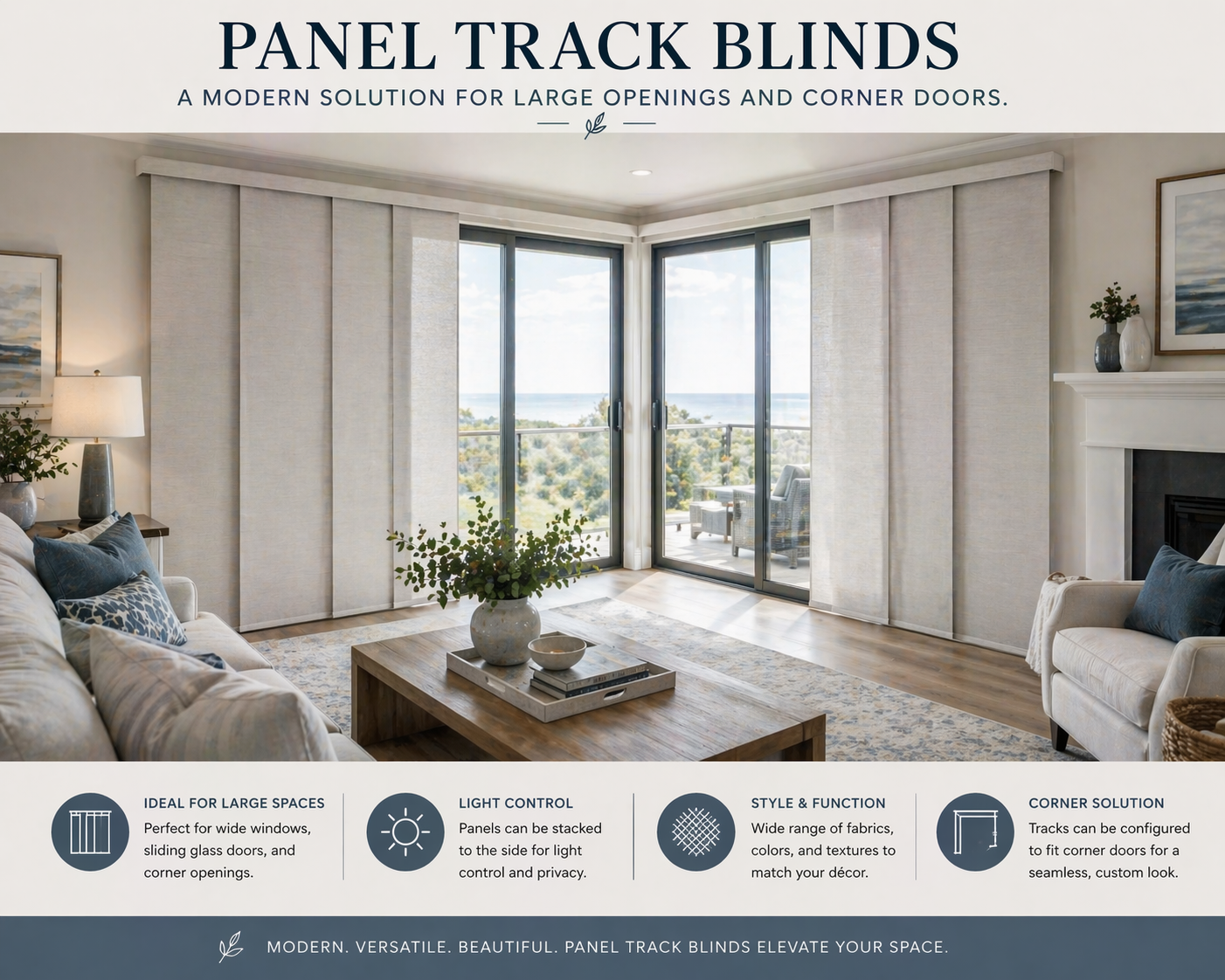
Sliding panel blinds are one of our favorite modern window treatment solutions for large sliding doors. Instead of narrow individual vanes, they use wide fabric sliding panels that glide horizontally along a track. This creates a streamlined appearance that works particularly well in contemporary rooms.
Their side-to-side movement is also practical. The sliding panels can be moved away from the portion of the door you use for entry and exit, allowing easier access without having to raise an entire shade.
- Clean, contemporary appearance
- Smooth side-to-side operation
- Well suited for wide doors and windows
- Available in a variety of fabrics, colors, textures, and opacity levels
- Provides privacy and glare control
- Excellent alternative to traditional vertical blinds
One consideration is the amount of space the sliding panels occupy when the treatment is open. Because the panels overlap and stack together, consider where you want them to collect in relation to the active portion of your patio door.
Panel tracks are an especially good fit for homeowners who want their window covering to become part of the room's design rather than simply provide functional coverage.
2. Vertical Blinds — Best for Light Control and Value
Vertical blinds have been used on sliding patio doors for decades for good reason. Their individual vertical vanes are designed for wide openings and move in the same direction as a sliding door.
One of their biggest advantages is adjustable light control. Instead of completely opening the blind, you can rotate the vanes to change the amount and direction of incoming light while maintaining varying levels of privacy.
- Excellent control over light and privacy
- Designed for large windows and patio doors
- Easy side-to-side access
- Available in multiple materials, colors, and styles
- Typically a budget-friendly solution for large openings
Vertical blinds can be particularly practical for high-traffic doors because they don't need to be raised overhead each time someone wants to go outside. Opening the vanes or moving them to the side provides access to the door.
Learn more: Best Vertical Blinds for Patio Sliding Doors
3. Vertical Cellular Shades — Best for Insulation
For homeowners concerned about energy efficiency, vertical cellular shades offer another approach to covering a large glass door. Cellular shades use a honeycomb-style construction that creates air pockets that traps air within the material.
Those pockets help create an insulating barrier between the room and the glass for superior energy efficiency. This can be especially useful on a large patio door that receives substantial sun or is exposed to outdoor temperature changes.
- Energy-efficient honeycomb construction
- Soft, fabric appearance
- Good choice when insulation is a priority
- Provides privacy when closed
- Contemporary alternative to individual vertical vanes
The tradeoff is that homeowners who prioritize precise light adjustment may prefer vertical blinds. Cellular material does not tilt like individual vertical vanes, so light is generally controlled by changing how much of the glass is covered.
4. Roller Shades — Best Minimalist Option
Roller shades provide one of the cleanest looks available and can work on sliding glass doors when the size and configuration of the opening are appropriate. They are available in a broad range of fabrics, including light-filtering, room-darkening, blackout, and solar-screen materials.
Unlike vertical blinds and panel tracks, however, roller shades operate up and down rather than side to side. That distinction matters on a frequently used patio door because a shade covering the active door may need to be raised before someone walks through.
- Clean, minimalist appearance
- Large selection of fabrics and opacity levels
- Excellent choice for contemporary interiors
- Can coordinate with roller shades on nearby windows
- Works well when the door configuration accommodates vertical operation
For doors that are opened constantly throughout the day, a horizontal-traversing treatment may be more convenient. For less frequently used doors, the simple appearance of a roller shade can make it an attractive option. Roller shades also offer cordless and motorized options.
How to Choose a Sliding Door Window Treatment
There isn't one window covering that is right for every patio door. Before choosing, think about how the door is actually used in your home, not just how the treatment will look when it is closed.
Consider How Often You Use the Door
A patio door leading to a backyard, deck, pool, or outdoor living area may be opened many times each day. In high-traffic areas, treatments that move horizontally are often convenient because they can be moved away from the active door panel.
If the door is rarely opened and functions more like a large window, you have greater flexibility and may prefer a treatment based primarily on appearance, insulation, or light control.
Think About Light and Privacy
Large expanses of glass can bring significant natural light into a room, but they can also create glare and reduce privacy. Consider when the door receives direct sunlight and whether you want to preserve your view during the day.
Vertical blinds provide particularly flexible light control because their vanes can be tilted. Light-filtering fabrics soften incoming sunlight, while room-darkening and blackout materials are better suited to spaces where greater privacy and light reduction are priorities.
Consider Energy Efficiency
A large glass door can be a significant source of heat transfer. If insulation is one of your primary concerns, cellular construction is worth considering because the honeycomb pockets help create an additional barrier at the glass.
Fabric selection can also make a difference. The appropriate treatment will depend on your climate, the direction the door faces, and the amount of direct sunlight it receives.
Match the Treatment to Your Decorating Style
Panel tracks and roller shades tend to create a clean, contemporary appearance. Vertical blinds offer a more traditional and highly functional solution, while cellular shades introduce a softer fabric look.
Also consider nearby windows. Using complementary fabrics, colors, or window treatment styles can help the patio door feel connected to the rest of the room.
Panel Track Blinds vs. Vertical Blinds
Panel tracks and vertical blinds are two of the most practical choices because both are designed to cover wide openings and travel horizontally. The primary differences are appearance, light control, and price.
Panel track blinds use fewer, much wider panels. This gives them a clean architectural appearance and makes them a popular choice for contemporary interiors.
Vertical blinds use narrower individual vanes that can rotate. This gives you greater control over incoming light without completely opening the treatment and generally makes vertical blinds an economical way to cover a large area.
- Choose panel tracks when modern style and wide fabric panels are priorities.
- Choose vertical blinds when adjustable light control, practicality, and value are more important.
Compare: Sliding Panel Track Blinds vs Vertical Blinds
What Works Best for High-Traffic Patio Doors?
If family members, children, or pets regularly use the patio entrance, ease of operation should be near the top of your list. A beautiful window treatment can quickly become frustrating if it must be completely opened every time someone goes outside.
For frequently used doors, panel track and vertical blinds are particularly practical because they travel horizontally. The covering can be moved toward the inactive side of the opening, providing easier access through the active door.
For a door that is used less frequently, roller or cellular options may be perfectly suitable and allow other priorities, such as insulation or a minimalist appearance, to guide your decision.
Are Drapery Panels a Good Alternative?
Drapery panels are another option for sliding glass doors and can add softness, texture, and color to a room. Depending on the fabric and lining, curtains can also provide privacy, room darkening, and additional insulation.
The main consideration is operation. Fabric can occupy significant space when stacked and may be less convenient around a heavily used doorway. Homeowners who place decorative style ahead of precise light adjustment may still prefer drapery over blinds or shades.
Compare: Drapery Panels vs Window Blinds
Which Option Should You Choose?
For many homeowners, panel track blinds provide an excellent combination of style, coverage, and easy operation. Their wide panels complement large glass doors while creating a more contemporary alternative to traditional vertical treatments.
Vertical blinds remain hard to beat when affordability and precise light control are the priorities. Vertical cellular shades deserve consideration when insulation is especially important, while roller shades work well for homeowners seeking a simple, minimalist appearance.
Ultimately, the right choice depends on your door, room, budget, and how you use the space. A heavily traveled patio entrance has different requirements than a sliding door that is primarily used to bring natural light into a room.
Explore Your Options
Still deciding? These additional Blinds Chalet guides and product collections can help you compare your options:
- Panel Track Blinds
- Are Sliding Panel Track Worth It
- Vertical Blinds
- Panel Track vs Vertical Blinds
- What are Window Blinds?
- Two Separate Blinds vs 2 on 1 Headrail
- Top Vertical Blind Alternatives for Privacy
- Top Blackout Vertical Blind Alternatives
- How to Measure for Vertical Blinds on a Sliding Glass Door
Final Thoughts
The best solution for a sliding patio door balances appearance with everyday function. Panel tracks offer a modern, streamlined design; vertical blinds provide excellent flexibility and value; cellular shades focus on insulation; and roller shades deliver a simple, minimalist look.
Before ordering, think about which portion of the door opens, how frequently you use it, how much privacy and sunlight control you need, and where the treatment will sit when opened. Those practical considerations can be just as important as choosing a color or fabric you love.
Sliding Glass Door FAQs
What are the best blinds for sliding glass doors?
Panel track blinds, vertical blinds, vertical cellular shades, and roller shades are all good choices. Panel tracks are ideal for a modern appearance, vertical blinds provide excellent adjustable light control and value, cellular shades emphasize insulation, and roller shades provide a clean, minimalist look.
Are panel track blinds good for sliding doors?
Yes. Panel tracks are particularly well suited to wide sliding doors because their large panels move horizontally along a track. They provide easy access to the door while offering a clean, contemporary alternative to vertical blinds.
Are vertical blinds still a good option?
Yes. Vertical blinds remain one of the most practical choices for patio doors. Their vanes rotate for adjustable privacy and light control, and the entire treatment can move to the side for convenient access through the doorway.
What is better, panel track blinds or vertical blinds?
Panel tracks are usually better for homeowners who prioritize contemporary design and wide fabric panels. Vertical blinds are generally better when adjustable light control, simple operation, and affordability are the main priorities.
What can I use instead of vertical blinds on a sliding glass door?
Popular alternatives include panel track blinds, vertical cellular shades, roller shades, and drapery. Panel tracks are one of the closest functional alternatives because they also move horizontally and are designed to cover wide openings.
What window covering is best for an energy-efficient sliding door?
Vertical cellular shades are a strong choice when insulation is a priority. Their honeycomb construction creates air pockets that help provide an additional insulating barrier between the room and the glass.
Can roller shades be used on sliding patio doors?
Yes, depending on the dimensions and configuration of the door. Keep in mind that roller shades travel vertically rather than horizontally, so a shade covering the active door may need to be raised to provide convenient access.
What blinds are best for a sliding door that is used frequently?
Panel track and vertical blinds are especially practical for frequently used patio doors because they move horizontally. This allows the window covering to be moved away from the active portion of the doorway for easier entry and exit.
Compare materials, vane sizes, and control options in our selection of custom made vertical blinds to find the best fit for your windows and patio doors.
For more information, visit our vertical blinds guide hub to explore more articles and tips.