









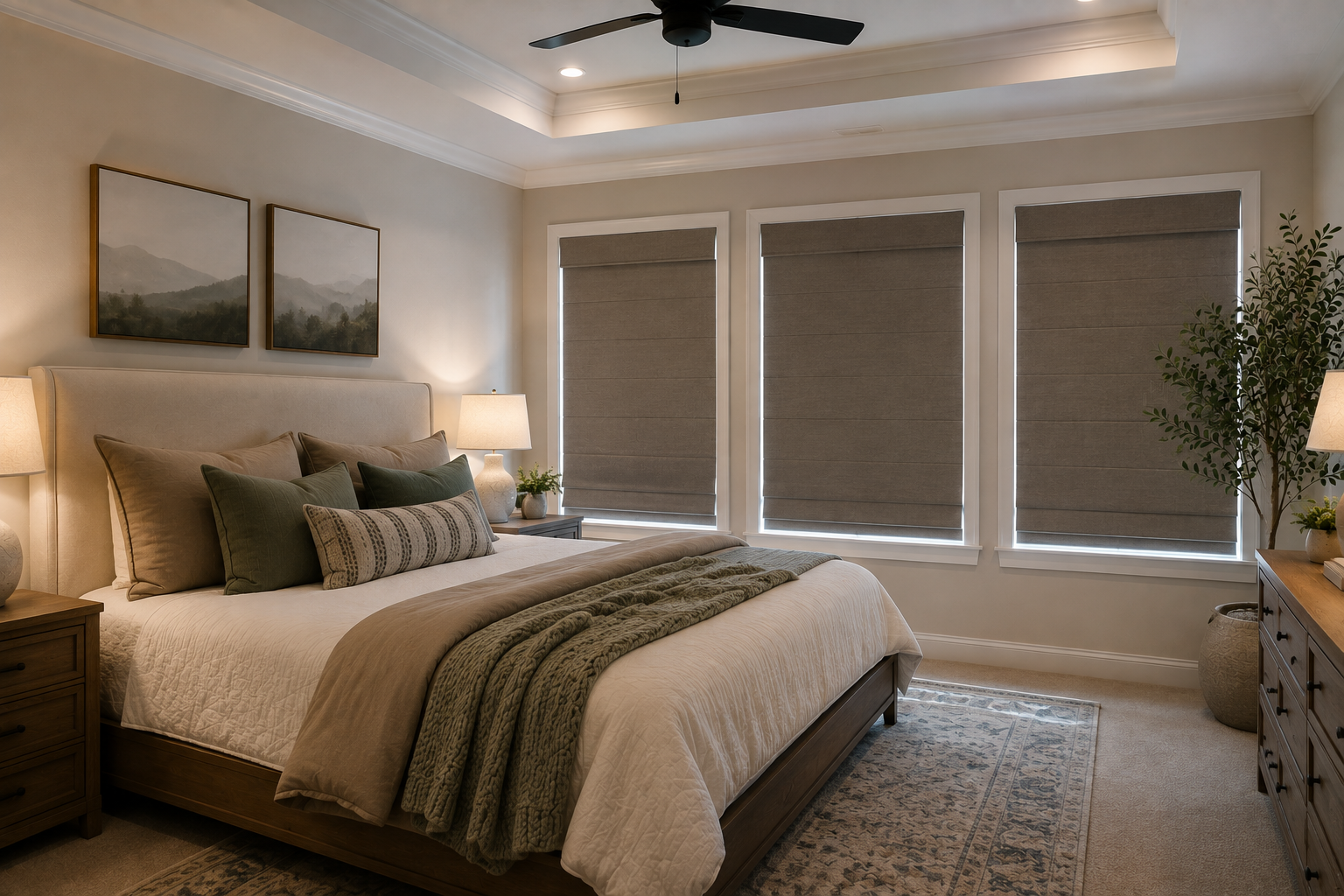
Avoid the most common blackout shade buying mistakes by understanding fabric opacity, light gaps, mounting style, measurements, privacy and how the finished shade will actually perform in your room.
Blackout shades can dramatically reduce incoming light, improve nighttime privacy and make bedrooms, nurseries and media rooms more comfortable. But one of the biggest mistakes shoppers make is assuming that choosing a fabric labeled "blackout" automatically creates a completely dark room.
The fabric is only one part of the finished window treatment. Light can still enter around the sides, above or below the shade, between multiple shades or through areas created by the mounting and operating hardware. The type of shade, mounting position, measurements and surrounding window construction all affect the final result.
At Blinds Chalet, we recommend choosing blackout shades by looking at the complete installation rather than focusing only on the fabric description. Understanding these common mistakes before ordering can help you choose a treatment that better matches your expectations for darkness, privacy and everyday operation.
Blackout Shade Mistakes at a Glance
The table below summarizes some of the most common blackout shade buying mistakes and what to consider instead.
| Common Mistake | What Can Go Wrong | What to Consider Instead |
|---|---|---|
| Assuming blackout fabric means total darkness | Light can still enter around the perimeter of the shade. | Evaluate the fabric, mount and light gaps together. |
| Choosing inside mount without considering gaps | Small spaces along the sides can create visible strips of light. | Consider an outside mount when maximum room darkening is the priority. |
| Measuring only once | Uneven windows can create unexpected gaps or installation problems. | Measure the opening at multiple locations according to the product instructions. |
| Ignoring shade type | Different shade styles create different edge and center gaps. | Choose the operating system as carefully as the blackout fabric. |
| Using multiple shades without planning the gaps | Light can enter between adjacent shades. | Align shade gaps with window mullions or structural divisions when possible. |
| Confusing blackout with privacy | The fabric may be private, but installation gaps can still create sightlines. | Evaluate nighttime privacy around the complete perimeter. |
| Forgetting handles or obstructions | The shade may not hang close enough to the window. | Measure handles, trim, cranks and other projections before ordering. |
| Skipping fabric samples | Color, texture and appearance may differ from what you expected. | View samples in the actual room during the day and at night. |
Mistake #1: Assuming Blackout Fabric Means a Completely Blacked-Out Room
This is probably the most important misconception to understand before buying blackout shades. A blackout fabric is designed to prevent light from passing directly through the material. It does not automatically prevent light from entering around the shade.
Even with a completely opaque fabric, visible light may enter along the sides, top or bottom of the installation. Roller shades can have side gaps because the fabric is narrower than the complete hardware assembly. Cellular shades and Roman shades can also have perimeter gaps depending on the mount and window opening.
Blackout Fabric vs. Blackout Installation
Think of blackout as two separate issues: how much light passes through the material and how much light can travel around the material. Selecting blackout fabric solves the first issue. Proper measuring, mounting and coverage help address the second.
If you need a bedroom to become as dark as practical, pay close attention to the complete system rather than relying only on a "blackout" label.
Mistake #2: Choosing Inside Mount Without Considering Light Gaps
Inside-mounted shades are popular because they fit neatly within the window opening and leave the surrounding trim visible. However, an inside mount usually requires clearance between the shade and the sides of the opening.
Those small spaces can become bright vertical lines when direct sunlight hits the window.
When Inside Mount Makes Sense
An inside mount can be an excellent choice when appearance is the priority, the window has sufficient mounting depth and a small amount of edge light is acceptable.
When Outside Mount May Be Better
An outside mount can allow the shade to extend beyond the glass on the top and sides. The additional overlap can reduce the amount of light entering around the perimeter.
If maximum room darkening is more important than maintaining a recessed appearance, an outside mount is often worth considering.
Mistake #3: Measuring the Window Only Once
Window openings are not always perfectly square. The width may vary slightly between the top, middle and bottom, and the height may vary from one side to the other.
Using one measurement without following the product-specific measuring instructions can result in an incorrect fit or unexpected gaps.
Measure at Multiple Points
For many window treatments, you should measure the width and height in multiple locations. The exact measurement you submit depends on the product and whether you are ordering an inside or outside mount, so always follow the instructions for the specific shade you are purchasing.
Do Not Make Your Own Factory Deductions
When ordering an inside-mount custom shade, do not automatically subtract additional width unless the product instructions specifically tell you to do so. Manufacturers commonly account for required operating clearances when producing the shade.
Making an unnecessary additional deduction can increase the size of the finished light gaps.
Mistake #4: Choosing Blackout Fabric Without Considering the Type of Shade
The same blackout material can perform differently depending on the window treatment that uses it. Shade construction affects where gaps occur, how close the material sits to the glass and how the treatment operates.
Blackout Roller Shades
Blackout roller shades provide a clean appearance and excellent light blockage through the fabric. Their primary limitation is typically the space along the sides of the shade, particularly with an inside mount.
Blackout Cellular Shades
Cellular shades combine light control with honeycomb construction that can also improve insulation. Edge gaps still need to be considered, but the combination of room darkening and energy efficiency makes them a strong bedroom option.
Blackout Roman Shades
Roman shades can combine decorative fabric with a room-darkening or blackout lining. They are a good option when style is important, but light may still enter around the outer edges.
Blackout Treatments for Sliding Doors
Large doors introduce additional challenges because multiple shades or overlapping panels may be required. If you are replacing vertical blinds on a large opening, our guide to the best vertical blind alternatives for blackout and room darkening explains these issues in more detail.
Shop our collection of blackout window shades.
Mistake #5: Ignoring the Gaps Between Multiple Shades
Wide windows and sliding glass doors sometimes require two or more shades rather than one extremely wide unit. This can improve operation and allow different sections of the opening to be controlled independently.
The tradeoff is that separate shades normally require clearance between them.
Align Gaps With Window Frames When Possible
If the window or door has vertical mullions or frame sections, try to position the gaps between shades over those structural divisions whenever the product configuration allows. This can make the light gaps much less noticeable.
For sliding glass doors, separate roller shades can be very practical because only the shade covering the active door needs to be raised. Our guide Can Roller Shades Work on Sliding Glass Doors? explains the advantages and limitations of that layout.
Mistake #6: Confusing Blackout With Room Darkening
Blackout and room darkening describe related but different concepts.
A blackout material is designed to prevent light from passing through the fabric itself. A room-darkening treatment reduces the overall amount of light in the room, but it may not use completely opaque fabric or eliminate every source of incoming light.
Choose Based on the Result You Actually Need
If your goal is simply to reduce glare on a television or make a bedroom noticeably darker, a room-darkening treatment may provide the performance you want.
If you are trying to create a very dark environment for daytime sleeping, a nursery or a home theater, blackout fabric combined with careful mounting and greater perimeter coverage may be more appropriate.
Mistake #7: Assuming Blackout Automatically Means Complete Privacy
Blackout fabric itself is opaque, so someone cannot see directly through the material. However, privacy still depends on the entire installation.
A person viewing the window from an angle may be able to see through a sufficiently large side gap. Multiple shades can also create narrow sightlines between units.
Evaluate Privacy at Night
Nighttime is the most important time to evaluate privacy because interior lighting makes the inside of your home brighter than the exterior.
Look beyond the fabric and consider the sides, bottom, center gaps and any areas where the treatment does not overlap the glass.
Mistake #8: Assuming a Blackout Shade Has to Be Dark Colored
A blackout shade does not necessarily need to be black, navy or another dark color. Blackout performance comes from the construction of the material or backing rather than simply the visible color of the room-facing fabric.
Depending on the product, blackout shades may be available in whites, creams, grays and many decorative colors.
Choose Color for the Room, Opacity for the Performance
Instead of assuming a darker color will automatically provide better blackout performance, verify that the specific fabric is classified as blackout or opaque and then choose a color that works with your décor.
Mistake #9: Forgetting About Handles, Cranks, Trim and Other Obstructions
A blackout shade needs room to operate correctly. Window cranks, door handles, locks, deep trim and other hardware can interfere with the fabric or force the treatment farther away from the glass.
The farther the shade sits from the window, the easier it may be for light to enter from an angle.
Check Projection Before Ordering
Measure how far handles and other obstructions project from the window or door. Also verify the available mounting depth for an inside mount and the available wall or trim area for an outside mount.
Mistake #10: Overlooking Light-Blocking Accessories
If reducing edge light is especially important, look at the accessories and upgrades available for the particular shade you are considering. Depending on the product, options such as side channels, sill channels or other light-blocking systems may help reduce light around the perimeter.
These features are especially useful in bedrooms, nurseries, media rooms and other spaces where small strips of edge light may be distracting.
Availability varies by shade and manufacturer, so verify compatible options before selecting the final product.
Mistake #11: Buying the Same Blackout Shade for Every Room
The best blackout treatment for a bedroom is not necessarily the best treatment for every room in the house.
Bedrooms
Prioritize nighttime privacy, reduced morning light and convenient everyday operation. Blackout roller or cellular shades are strong choices, particularly when the mount provides sufficient perimeter coverage.
Nurseries and Children's Rooms
Room darkening can help control daylight during naps and early bedtimes. Also consider cordless or motorized operating systems where available and appropriate.
Home Theaters
Controlling edge light can be particularly important because even small amounts of sunlight may create glare on a television or projection screen. An outside mount or additional light-control accessories may be worth considering.
Living and Family Rooms
You may not need full blackout throughout the day. A treatment that balances glare control, privacy and natural light may be more practical than maximizing darkness at all times.
Mistake #12: Skipping Fabric Samples
Computer screens cannot perfectly reproduce fabric color, texture or the way material responds to the lighting in your home. A sample lets you evaluate the fabric in the actual room before committing to a custom window treatment.
Test the Sample During the Day
Hold the material against the window when direct sunlight is strongest. This helps you evaluate color, texture and opacity under the most demanding lighting conditions.
Look at It at Night
Evaluate the sample with your normal interior lights turned on. This is particularly useful when privacy and the room-facing color are important.
Mistake #13: Ignoring How Often You Will Operate the Shade
A blackout shade only helps when you actually use it. Large, hard-to-reach or frequently adjusted shades should have an operating system that works conveniently for the room.
Manual Operation
Manual operation may be perfectly practical for an easily accessible bedroom window that is adjusted only in the morning and evening.
Motorized Operation
Motorization can be useful for tall windows, multiple shades, hard-to-reach installations and rooms where shades are adjusted frequently throughout the day.
Available controls, power sources and size limitations vary by product, so review the specifications before ordering.
Mistake #14: Expecting Any Window Shade to Eliminate Every Trace of Light
Custom blackout shades can provide excellent room darkening, but creating an environment with virtually no visible light may require more than one window treatment.
Light can enter from unusual angles, reflect from surrounding surfaces or pass through small gaps created by the window construction itself.
Layering Can Improve Room Darkening
When maximum darkness is needed, combining a blackout shade with drapery or another light-blocking treatment can provide additional perimeter coverage.
The goal should be to choose a system that provides the level of darkness appropriate for the room rather than expecting the word "blackout" alone to guarantee a completely light-free environment. Learn more about how to layer window treatments.
How to Choose Blackout Shades Before You Buy
- Define your goal: Decide whether you want reduced glare, room darkening or the darkest room practical.
- Choose the shade type: Compare roller, cellular, Roman and other shade styles based on the window and how you will use it.
- Verify the fabric: Make sure the specific material is designated blackout if blocking light through the fabric is important.
- Decide on inside or outside mount: Consider appearance, mounting depth and perimeter light gaps.
- Measure carefully: Follow the measuring instructions for the exact product you plan to order.
- Check obstructions: Account for window cranks, handles, trim and other projecting hardware.
- Plan multiple shades: Align gaps with window or door frames whenever possible.
- Consider light-control upgrades: Review available side channels or other light-blocking accessories.
- Order samples: Examine the material under actual daytime and nighttime lighting.
- Set realistic expectations: Remember that blackout fabric blocks light through the material but the complete installation determines overall room darkness.
Expert Guidance from Blinds Chalet
Blinds Chalet has helped homeowners shop for custom window treatments since 2006. One of the most important lessons we have learned from helping customers choose blackout treatments is that fabric opacity alone does not determine the final result.
When room darkening is important, we recommend evaluating the entire installation: the shade style, inside or outside mount, width and height, edge gaps, window hardware and any divisions between multiple shades. These details often make the difference between a treatment that simply uses blackout fabric and one that provides the level of darkness the homeowner expected.
We also recommend ordering samples before making a final decision and reviewing the measuring instructions for the exact shade you plan to purchase. Product specifications, deductions, size limits and available light-control options vary between treatments.
Related Articles
- Blackout vs Room Darkening Roller Shades
- Are Blackout Window Shades Worth It?
- Inside vs Outside Mount. What is Best for Blackout?
- Blackout Alternatives for Vertical Blinds
- Are Blackout Dual Layered Shades Worth It?
Blackout Shade FAQs
Do blackout shades make a room completely dark?
Blackout fabric prevents light from passing directly through the material, but light can still enter around the sides, top or bottom of the shade. The mounting method, shade style and amount of overlap around the window all affect the final level of room darkness.
What is the biggest mistake people make when buying blackout shades?
One of the most common mistakes is assuming that selecting blackout fabric guarantees a completely dark room. Blackout performance depends on both the opacity of the fabric and the light gaps around the finished treatment.
Are outside-mount blackout shades better than inside-mount shades?
Outside-mounted shades can provide better room-darkening coverage because the treatment can extend beyond the glass and reduce light entering along the sides and top. Inside mounts provide a cleaner recessed appearance but generally require clearance around the shade.
Why do blackout roller shades have light gaps on the sides?
Roller shade fabric is typically narrower than the complete hardware assembly, and operating clearance is required along the sides. This can create narrow strips of visible light, particularly with an inside-mounted shade.
Are blackout shades also good for privacy?
Blackout fabric is opaque and provides excellent privacy through the material itself. However, large gaps around the sides or between multiple shades can create sightlines, so the complete installation should also be considered when privacy is important.
Do blackout shades have to be a dark color?
No. Blackout performance comes from the construction or backing of the fabric rather than simply its visible color. Depending on the product, blackout materials may be available in white, cream, gray and many decorative colors.
Should I make my blackout shade wider than the window?
For an outside mount, extending the shade beyond the glass can reduce perimeter light gaps. For an inside mount, follow the measuring instructions for the specific product and do not make additional deductions unless instructed to do so.
Which type of shade is best for blackout?
Blackout roller shades, cellular shades and lined Roman shades can all provide strong room darkening. The best choice depends on the window, mounting method, desired insulation, operating preferences and how much edge light you are willing to accept.
Can I improve blackout performance after installing a shade?
Depending on the installation, additional drapery or compatible light-blocking accessories may help reduce remaining edge light. It is generally easier to plan for maximum coverage before ordering by considering mounting style, overlap and available accessories.
Should I order blackout shade samples before buying?
Yes. Samples let you evaluate the color, texture and opacity of the material in the actual room. View the sample against the window during bright daylight and under your normal nighttime interior lighting before making a final selection.