









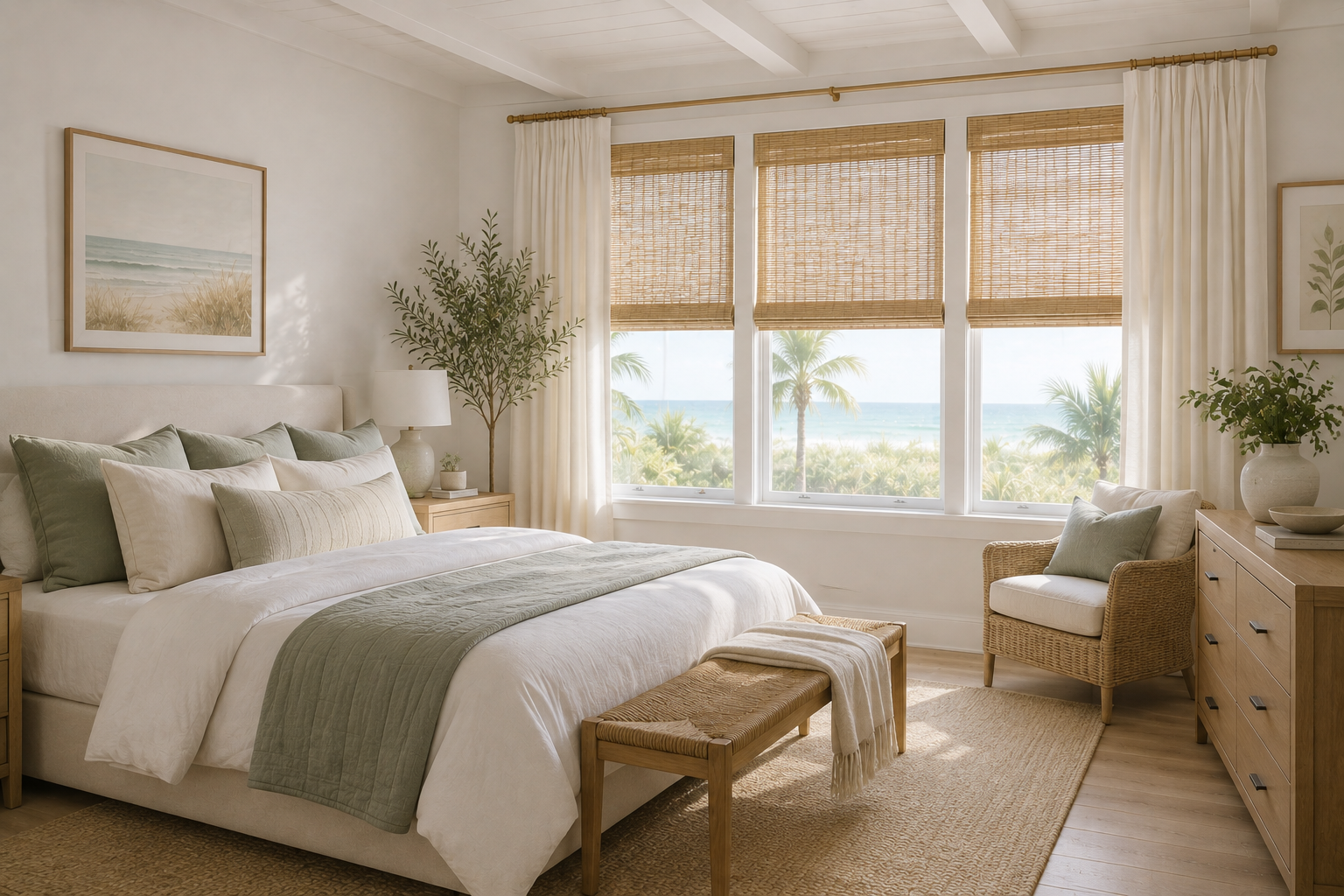
Layering window treatments means using two complementary window coverings on the same window to provide more control over light, privacy, insulation and appearance. A common example is an inside-mounted shade paired with curtains or drapery mounted outside the window.
The best layered window treatments are not simply two products placed together. Each layer should have a purpose. One treatment might provide everyday privacy and light control while the second adds room darkening, insulation, softness or decorative style.
At Blinds Chalet, we recommend choosing the functional layer first and then deciding whether a second treatment adds enough benefit to justify the extra cost and space. This guide explains which treatments work well together, which layer should go closest to the window and how to plan the measurements and mounting space before you order.
What Is the Best Way to Layer Window Treatments?
In most layered window treatment designs, the blind or shade is installed closest to the glass and the more decorative treatment is installed in front of it.
For example, an inside-mounted roller or cellular shade can handle privacy and light control while curtains mounted above and outside the window add softness and additional coverage.
| Combination | Best For | Primary Layer | Secondary Layer |
|---|---|---|---|
| Roller Shade + Curtains | Clean style with added softness and privacy | Roller shade | Curtains or drapery |
| Cellular Shade + Curtains | Insulation, privacy and decorative style | Cellular shade | Curtains or drapery |
| Solar Shade + Curtains | Daytime glare control plus nighttime privacy | Solar shade | Opaque curtains |
| Roman Shade + Curtains | Layered designer appearance | Roman shade | Curtains or drapery |
| Wood or Faux Wood Blind + Curtains | Adjustable light control with a softer finished look | Blind | Curtains or drapery |
| Light-Filtering Shade + Blackout Layer | Flexible daytime light and nighttime darkness | Light-filtering treatment | Room-darkening or blackout treatment |
Why Layer Window Treatments?
Layering allows two window coverings to perform different jobs instead of expecting one product to accomplish everything.
More Light Control
A shade can filter or block direct sunlight while a second layer provides additional room darkening when needed.
Better Privacy
Layering is especially useful when one treatment provides excellent daytime performance but limited nighttime privacy. Solar shades are a good example because visibility can reverse after dark when interior lights are on. Explore our privacy window treatments.
Improved Insulation
A cellular shade or other insulating treatment positioned close to the window can help reduce heat transfer while an additional curtain or drapery layer can provide more coverage around the opening. Explore insulated window treatments.
More Decorative Depth
Blinds and shades are often selected primarily for function. Curtains, drapery or a decorative top treatment can add softness, color and texture without sacrificing the functionality of the underlying treatment.
More Flexibility Throughout the Day
Two independent treatments let you adjust the window based on changing conditions. You might use a solar shade during the day, open it in the evening and close an opaque outer layer at night.
Which Window Treatment Should Go Closest to the Glass?
The most functional window treatment usually goes closest to the glass.
That typically means installing the blind, roller shade, cellular shade, solar shade or Roman shade as the first layer. Curtains or drapery are then mounted farther into the room.
Keeping the functional treatment close to the window also allows it to operate without interference from the decorative layer.
A Typical Layered Window
- Window glass
- Blind or shade
- Optional valance or cornice
- Curtains or drapery
You do not need all four layers. In most homes, one functional shade plus one decorative layer is enough.
Inside Mount + Outside Mount Is Often the Best Combination
One of the cleanest ways to layer window treatments is to install the primary blind or shade as an inside mount and install the secondary treatment as an outside mount.
The inside-mounted shade sits within the window opening, leaving the surrounding trim and wall area available for curtains, drapery or another outside-mounted treatment.
Why This Combination Works Well
- Keeps the window from looking overly bulky.
- Separates the operating space of the two treatments.
- Allows the outside layer to extend beyond the window for additional coverage.
- Keeps the window trim visible when the outer treatment is open.
- Makes it easier to operate each treatment independently.
Before choosing an inside mount, verify that the window has enough mounting depth for the blind or shade you are considering. Related guide: inside vs outside mount window treatments.
Can You Layer Two Outside-Mounted Window Treatments?
Yes, but it requires more planning.
If both treatments must be mounted outside the window, the second layer needs enough projection to clear the headrail, cassette, valance or operating hardware of the treatment behind it.
For example, if an outside-mounted roller shade projects several inches from the wall, a curtain rod needs to project far enough for the curtains to hang freely in front of the shade.
Check These Measurements Before Ordering
- Projection of the inner treatment.
- Depth of any cassette, headrail or valance.
- Projection of the curtain rod or outer hardware.
- Clearance needed for the shade to raise and lower.
- Clearance for handles, cranks and window trim.
Do not assume that two outside-mounted products will automatically fit together simply because there is enough width on the wall.
Roller Shades + Curtains
Roller shades and curtains are one of the easiest layered window treatment combinations to coordinate.
The roller shade provides the functional layer while remaining relatively compact. Curtains can then add color, texture, softness and additional privacy.
Best Uses
- Bedrooms.
- Living rooms.
- Dining rooms.
- Home offices.
- Rooms where you want a clean modern shade without giving up the softness of fabric drapery.
A light-filtering roller shade combined with room-darkening curtains can be especially flexible because you can enjoy filtered daylight during the day and greater light control when the curtains are closed.
Shop roller shades and custom drapery panels.
Cellular Shades + Curtains
Cellular shades and curtains are a strong combination when insulation is one of your priorities.
The cellular shade sits close to the window and provides privacy, light control and insulation. Curtains provide another layer of coverage around the opening while adding decorative fabric to the room.
Consider Top-Down/Bottom-Up Cellular Shades
A top-down/bottom-up cellular shade can make this combination even more flexible because you can maintain privacy at the lower part of the window while allowing daylight through the top.
Shop cellular shades and quality drapery panels.
Solar Shades + Curtains
Solar shades and curtains solve one of the most common solar shade tradeoffs.
During the day, a solar shade can reduce glare and solar heat while allowing some outward visibility. At night, however, privacy can decrease when interior lights are brighter than the exterior.
Adding opaque curtains or drapery gives you a separate nighttime privacy layer.
A Useful Daily Routine
During sunny hours, lower the solar shade and leave the curtains open. At night, close the curtains when additional privacy is needed.
This combination is particularly useful for living rooms, offices and windows with attractive outdoor views.
Shop solar shades and drapery panels.
Roman Shades + Curtains
Roman shades paired with curtains create a softer, more layered appearance than many other combinations.
Because both treatments use fabric, pay attention to color, texture and pattern so the layers complement rather than compete with one another.
Keep One Layer Visually Simpler
If the Roman shade has a strong pattern or texture, consider simpler curtains. If the curtains are the focal point, a more understated Roman shade can provide balance.
Shop Roman shades and custom drapery.
Wood or Faux Wood Blinds + Curtains
Horizontal blinds provide something fabric shades cannot: the ability to tilt the slats and redirect light without fully raising the treatment.
Adding curtains softens the appearance and can provide greater coverage when closed.
Faux Wood vs. Real Wood
Faux wood is often a practical choice for rooms where humidity or easy cleaning matters. Real wood provides authentic natural grain and warmth but requires more consideration in moisture-prone areas.
Shop faux wood blinds and custom wood binds.
How to Layer Window Treatments for Better Blackout
Layering can improve room darkening because one treatment can help cover light gaps left by another.
Even a blackout fabric does not automatically make a room completely dark. Light can enter around the sides, top and bottom of a shade depending on the mounting method and product construction.
A Strong Blackout Combination
An inside-mounted blackout roller or cellular shade paired with outside-mounted room-darkening curtains can provide additional coverage around the window opening.
For even greater light control, an outside-mounted shade with generous overlap or products offering side-channel systems may be worth considering.
How to Layer Window Treatments for Privacy
Layering is useful when you want privacy without keeping the window completely covered all day.
A light-filtering shade can provide daytime privacy while still admitting natural light. A second opaque treatment can then provide greater privacy at night.
For Street-Facing Windows
Consider a cellular shade, roller shade or adjustable blind as the everyday privacy layer, then use curtains primarily for nighttime coverage or decoration.
For Bedrooms
Choose a primary treatment that provides reliable privacy even when the curtains are open. This gives you more flexibility than depending entirely on decorative drapery. Explore our collection of bedroom blinds and shades.
Can You Layer Sheer and Blackout Window Treatments?
Yes. Combining a light-filtering or sheer treatment with a room-darkening layer gives you two very different levels of light control.
During the day, the lighter treatment can soften incoming light while maintaining a brighter room. The blackout or room-darkening layer can be closed when you need greater darkness or privacy.
Some products accomplish a similar effect within one window treatment, while others require two separate treatments.
Can You Add a Valance or Cornice to Layered Window Treatments?
Yes. A valance or cornice can hide the headrail, roller or mounting hardware while adding another decorative element.
However, once you combine a shade, curtains and a top treatment, the window can become visually heavy. Make sure each additional layer serves a purpose.
Keep the Proportions Balanced
A simple shade with a clean cornice may be enough without curtains. Likewise, curtains may already provide enough decorative interest without adding a separate valance.
Should Layered Window Treatments Be the Same Color?
No. The treatments should coordinate, but they do not need to match exactly.
For a Clean, Quiet Look
Choose similar neutral colors with different textures. For example, pair a warm white roller shade with cream or oatmeal-colored curtains.
For More Contrast
Keep the blind or shade neutral and use the outer layer to introduce color or pattern.
For a More Natural Look
Combine wood tones, woven textures and warm neutral fabrics while keeping the overall undertones consistent.
Can You Mix Patterns and Textures?
Yes, but it is usually easier to make one treatment the visual focal point.
If your shade has a noticeable weave, print or texture, choose a quieter outer layer. If your curtains have a bold pattern, a solid shade can keep the window from feeling too busy.
Texture is often easier to layer than multiple competing patterns.
How to Measure for Layered Window Treatments
Measure each treatment based on where it will actually be installed. Do not assume the measurements for one layer can simply be reused for the second.
Step 1: Decide Which Treatment Goes Inside
If the primary blind or shade will be inside mounted, confirm the available width, height and mounting depth of the window opening.
Step 2: Determine the Outside Layer's Coverage
Decide how far beyond the window the outer treatment should extend on the left, right and above the opening.
Step 3: Check Projection
If one treatment sits in front of another, make sure its hardware projects far enough to clear the treatment behind it.
Step 4: Check Operating Clearance
Raise, lower, tilt or traverse each treatment mentally before ordering. Look for potential interference between the layers.
Step 5: Check Nearby Obstacles
Consider window handles, cranks, trim, cabinets, furniture, walls and other objects around the opening.
For general measuring instructions, visit our How to Measure for Blinds and Shades guide.
Common Mistakes When Layering Window Treatments
Choosing Two Treatments That Do the Same Job
There is little value in paying for two layers if they provide essentially identical light control, privacy and appearance.
Forgetting Mounting Depth
An inside-mounted shade needs sufficient depth, while an outer treatment needs enough projection to clear whatever is behind it.
Ignoring Hardware
Headrails, cassettes, brackets and curtain rods all occupy space. Plan around the actual hardware rather than only the fabric.
Making the Window Too Busy
Multiple strong patterns, decorative valances, curtains and a textured shade can compete visually. Often the best layered window has one simple functional layer and one decorative layer.
Expecting Layering to Fix the Wrong Product Choice
Start with a primary treatment that already handles the most important requirement. The second treatment should enhance its performance, not compensate for a product that does not work for the room. Learn more about common mistakes to avoid when ordering blackout shades.
Do You Really Need Two Window Treatments?
Not always.
Modern blinds and shades can often provide privacy, light control, insulation and style in a single product. Layering makes the most sense when the second treatment provides a benefit you cannot easily get from the first.
| Your Goal | One Treatment May Be Enough | Layering May Help |
|---|---|---|
| Basic Privacy | Yes | Usually unnecessary |
| Adjustable Light Control | Often | Useful for more flexibility |
| Maximum Room Darkening | Sometimes | Often beneficial for covering light gaps |
| Daytime View + Night Privacy | Difficult with some products | Very useful |
| Insulation + Decorative Softness | Possible | Can provide additional benefits |
| Decorative Style Only | Often | Personal preference |
Best Layered Window Treatments by Room
Bedroom
Consider a blackout or room-darkening shade with curtains for additional side coverage, softness and privacy.
Living Room
A solar, roller, cellular or Roman shade paired with curtains works well when you want flexible daylight and a finished decorative appearance. Explore living room window treatments.
Home Office
A solar shade can reduce screen glare during the day, while curtains provide privacy after dark. Shop home office window treatments.
Dining Room
Roman shades or wood blinds combined with curtains can create a more decorative layered appearance while maintaining functional light control. Shop window treatments for dining rooms
Bathroom
Use caution with decorative fabric layers in rooms that experience frequent moisture. Start with a treatment appropriate for humidity and add another layer only when the room conditions and available space make it practical.
See our Bathroom Blinds guide for moisture-appropriate options.
Kitchen
Prioritize easy-clean materials and avoid outer fabrics where they could be exposed to cooking residue, sinks or splashing.
See our Kitchen Blinds guide for more room-specific recommendations.
Laundry Room
In laundry areas, moisture resistance and easy cleaning often matter more than decorative layering. If you do use two treatments, keep the combination simple and practical.
See our Best Window Treatments for Laundry Rooms guide.
Choosing the Right Treatments to Layer
Start by identifying the main problem you need the window treatment to solve.
If you need privacy, choose the privacy treatment first. If heat and glare are the main concern, begin with a solar or insulating shade. If room darkening is the priority, start with the treatment that provides the strongest light control.
Then decide whether a second layer would provide a meaningful additional benefit.
Explore our custom window blinds and custom window shades to compare treatment styles, fabrics and operating options.
Expert Guidance from Blinds Chalet
Blinds Chalet has helped homeowners measure, customize and order window treatments since 2006. When we help customers layer window coverings, we recommend starting with function rather than decoration.
The first treatment should handle the window's most important requirement, whether that is privacy, glare control, insulation or room darkening. The second layer should then add something useful such as greater coverage, nighttime privacy or decorative softness.
We also pay close attention to mounting depth and projection. Two treatments can look perfect together on paper but interfere with each other if the headrails, brackets or operating hardware occupy the same space.
If you are planning to install more than one treatment on the same window, contact us before ordering if you are unsure about the available mounting space. We can help you review the dimensions and determine whether the combination you are considering will work together.
Related Window Treatment Guides
- How to Measure for Blinds and Shades
- Shop Custom Blinds
- Shop Custom Shades
- Bathroom Blinds
- Kitchen Blinds
- Best Window Treatments for Laundry Rooms
Layered Window Treatment FAQs
What is the best way to layer window treatments?
A common approach is to install a functional blind or shade closest to the window and add curtains, drapery or another decorative treatment in front. Each layer should provide a different benefit such as privacy, light control, insulation or style.
Should blinds or curtains go closest to the window?
Blinds and shades are normally installed closest to the glass, with curtains or drapery mounted farther into the room. This allows the functional treatment to operate independently while the outer treatment provides additional coverage or decoration.
Can you put curtains over blinds?
Yes. Curtains can be layered over wood blinds, faux wood blinds, roller shades, cellular shades, Roman shades and many other window treatments. Make sure the curtain rod projects far enough to clear the blind or shade and its hardware.
Can you put curtains over roller shades?
Yes. Roller shades are one of the easiest treatments to pair with curtains because of their relatively compact design. An inside-mounted roller shade with outside-mounted curtains is a particularly clean combination.
Can you layer cellular shades with curtains?
Yes. Cellular shades can provide privacy, light control and insulation while curtains add decorative softness and additional coverage around the window opening.
Can solar shades be layered with curtains?
Yes. This is a useful combination because the solar shade can reduce daytime glare and solar heat while curtains can provide additional nighttime privacy when visibility through a solar shade may reverse.
Do layered window treatments improve blackout?
They can. An opaque or blackout shade combined with room-darkening curtains may provide greater coverage around the sides and top of a window than either treatment alone. However, complete darkness depends on the products, mounting method and amount of light entering around the treatments.
Do layered window treatments improve insulation?
Layering may provide additional coverage at the window. An insulating treatment such as a cellular shade can serve as the primary layer while curtains provide another layer over the opening. Actual performance depends on the products, fit and installation.
Should layered window treatments be the same color?
No. The treatments should coordinate but do not need to match. A common approach is to keep the blind or shade relatively neutral and use curtains to introduce additional color, texture or pattern.
Can you install two outside-mounted window treatments together?
Yes, but the mounting hardware must be planned carefully. The outer treatment needs enough projection to clear the headrail, cassette, valance or other hardware of the treatment behind it.
Is inside mount or outside mount better for layered window treatments?
When the window has sufficient mounting depth, an inside-mounted blind or shade paired with an outside-mounted curtain or secondary treatment is often one of the cleanest and easiest configurations.
Do I need two window treatments on every window?
No. A single blind or shade can often provide all the privacy, light control and appearance a room needs. Layering is most useful when the second treatment provides a meaningful additional benefit such as greater room darkening, nighttime privacy, insulation or decorative softness.
How do I measure for layered window treatments?
Measure each treatment according to its actual mounting location. Verify the width, height and mounting depth for an inside treatment, then determine the coverage and projection needed for the outside layer. Also check that the hardware and operating paths of the two treatments will not interfere with each other.