









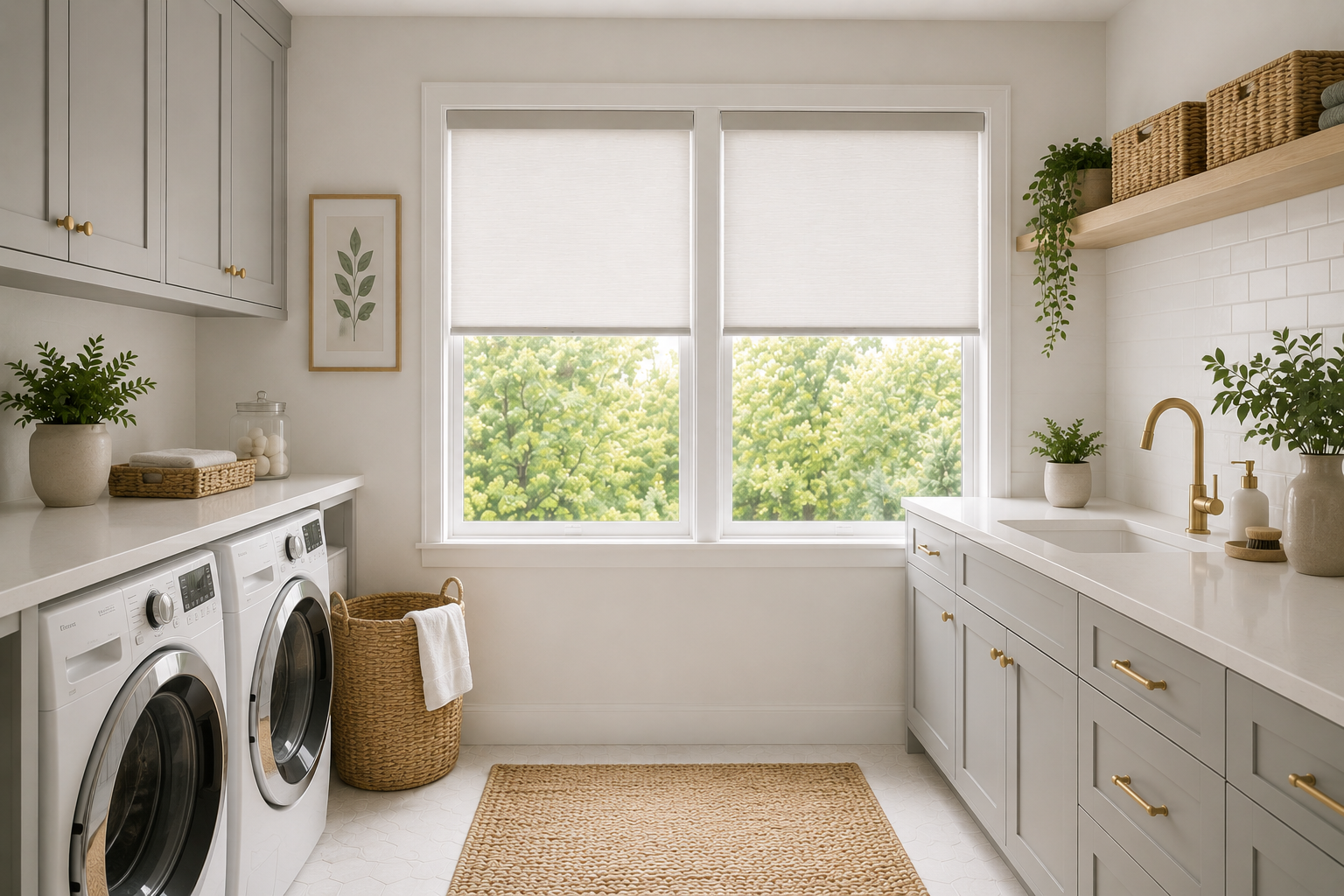
Laundry rooms can be harder on window treatments than many other areas of the home. Washers, dryers, utility sinks, changing temperatures and limited ventilation can create more humidity, moisture and heat than you would typically find in a bedroom or living room.
The best window treatments for laundry rooms are usually durable, easy to clean and appropriate for the amount of humidity in the space. In some laundry rooms, you may also want to consider low-VOC materials, fungal-resistant fabrics or antimicrobial product protection.
At Blinds Chalet, we recommend choosing the treatment based on the actual room conditions rather than assuming every laundry room needs the same solution. A large, well-ventilated laundry room may have very different needs than a small enclosed utility room with a sink and dryer.
This guide compares the best blinds and shades for laundry rooms and explains what to look for when moisture resistance, easy maintenance and healthy-home features are priorities.
What Are the Best Window Treatments for Laundry Rooms?
For most laundry rooms, the best choices are roller shades, cellular shades, faux wood blinds and solar shades. These treatments can provide a good balance of privacy, light control, easy maintenance and durability.
If the room regularly experiences higher humidity or condensation, focus on materials that tolerate moisture well and consider fabrics with documented fungal-resistant or antimicrobial performance.
| Window Treatment | Best For | Advantages | Things to Consider |
|---|---|---|---|
| Roller Shades | Easy care and clean appearance | Simple construction, many performance fabrics, easy to coordinate | Fabric properties vary, so verify moisture or fungal resistance when important |
| Cellular Shades | Insulation and privacy | Good light control, energy efficiency, compact profile | Choose materials appropriate for the humidity level in the room |
| Faux Wood Blinds | Moisture resistance and adjustable light | Durable, easy to wipe clean, good privacy control | Heavier than many shades and can collect dust on horizontal slats |
| Solar Shades | Glare and heat control | Useful for sunny laundry rooms and exterior-facing utility spaces | Privacy varies by openness factor and lighting conditions |
Why Laundry Rooms Need Different Window Treatments
Laundry rooms often combine several conditions that can affect a window covering over time.
Humidity
Washers, dryers and utility sinks can increase moisture in the air, especially when the room has limited ventilation. Learn more about window treatments that are good for humid areas.
Heat
Dryers and enclosed spaces can make the room warmer than surrounding areas, which may increase condensation on cooler window surfaces.
Frequent Cleaning
Laundry rooms are practical work spaces, so window coverings may need to tolerate dust, lint and occasional splashes better than decorative fabrics used elsewhere in the home.
Limited Space
Cabinets, shelving, utility sinks and appliances are often installed close to the window, so a compact treatment may work better than a bulky one.
Roller Shades: A Practical Laundry Room Choice
Roller shades are one of our favorite choices for laundry rooms because their simple construction makes them easy to use and visually unobtrusive.
They are available in a wide range of performance fabrics, including light-filtering, blackout, easy-clean and specialty materials.
Why Roller Shades Work Well
- Simple design with fewer places for dust and lint to collect.
- Available in many moisture-tolerant synthetic fabrics.
- Easy to raise completely when you want maximum daylight.
- Can provide privacy without visually crowding a small utility room.
- Some fabrics may offer antimicrobial or fungal-resistant performance.
If fungal or antimicrobial resistance is important, check the exact fabric documentation rather than assuming every roller shade fabric includes the feature.
Shop our selection of quality roller shades.
Cellular Shades: Good for Insulation and Privacy
Cellular shades can be a strong choice when the laundry room experiences temperature swings or when the window contributes to heat gain or heat loss.
The honeycomb structure helps provide insulation, and the shade can offer excellent privacy while maintaining a compact appearance.
When Cellular Shades Make Sense
- The laundry room faces strong sun.
- The room becomes noticeably hot or cold.
- You want strong privacy.
- You want a clean, soft appearance rather than horizontal slats.
Because cellular fabrics vary, check the material specifications if the room experiences frequent humidity or condensation.
Browse our collection of cellular honeycomb shades
Faux Wood Blinds: Durable and Easy to Clean
Faux wood blinds can be a practical option when moisture resistance and easy cleaning are high priorities.
Unlike real wood, faux wood materials are generally better suited to rooms where humidity may fluctuate. The slats can also be wiped clean, which is useful in a space that may accumulate lint or dust.
Advantages of Faux Wood in a Laundry Room
- Good resistance to normal household humidity.
- Easy-to-clean slats.
- Excellent privacy and adjustable light control.
- Durable construction.
If the room is very small, keep in mind that horizontal blinds have a deeper profile than many roller or cellular shades.
Solar Shades: Best for Sunny Laundry Rooms
If your laundry room receives strong afternoon or morning sun, solar shades can help reduce glare and heat while preserving some outward visibility.
This can be especially useful in laundry rooms with large exterior windows or glass doors.
Check Privacy Before Choosing Solar Shades
Solar shades are designed primarily for glare and solar heat control. They do not provide the same nighttime privacy as an opaque shade when interior lights are on.
If privacy is important, consider a lower openness factor or another shade style.
Explore our collection of solar screen roller shades
How Important Is Moisture Resistance in a Laundry Room?
It depends on the room.
A well-ventilated laundry room with no sink or condensation problems may not require a specialty moisture-resistant fabric. A small enclosed utility room with a washer, dryer, sink and limited airflow may benefit much more from moisture-tolerant materials.
Signs Moisture Resistance Should Be a Priority
- Condensation regularly forms on the window.
- The room feels humid after the dryer runs.
- There is a utility sink close to the window.
- The shade may be exposed to splashing.
- The room has limited ventilation.
If those conditions apply, prioritize synthetic or performance materials that are easier to clean and better suited to moisture.
Should You Consider Mold- or Fungal-Resistant Fabrics?
In a laundry room that experiences frequent humidity or condensation, a fabric with documented fungal resistance can provide an additional material-performance benefit.
This does not mean the shade is mold-proof. Proper ventilation, cleaning and moisture control are still necessary.
For a detailed explanation of the terminology, see Mold-Resistant vs. Mildew-Resistant Window Shades: What's the Difference?.
You can also explore our Bacteria & Fungal Resistant Window Shades guide for qualifying fabrics and related testing.
What About ASTM G21 Tested Fabrics?
ASTM G21 is a standardized laboratory practice used to evaluate fungal resistance of synthetic polymeric materials.
If a laundry room shade fabric has documented ASTM G21 testing, that gives you more specific information about how the material performed under controlled fungal-resistance testing.
It does not mean the treatment is mold-proof, and it does not replace normal moisture control.
Learn more in What Does ASTM G21 Mean for Window Shade Fabrics?.
Are Microban® Fabrics Useful in Laundry Rooms?
Some window treatment fabrics may include Microban® antimicrobial product-protection technology.
Depending on the specific Microban technology used, it may help inhibit certain bacteria, mold, mildew or fungi on the treated material. This can make it worth considering in a frequently used utility space where moisture and easy maintenance are important.
Microban is not a disinfectant and does not replace regular cleaning.
See our Microban® Antimicrobial Window Shades guide for more information.
Are Antimicrobial Shades Worth It in a Laundry Room?
They can be, particularly in laundry rooms with higher humidity, condensation or frequent use.
In a dry, well-ventilated laundry room, you may get more everyday value from choosing the right privacy level, easy-clean material or light-control option instead.
Our guide Are Antimicrobial Window Shades Worth It? explains how to decide whether the feature makes sense for your room.
Should You Consider Low-VOC Window Shades?
Low-emission materials can also be worth considering, particularly if the laundry room connects directly to occupied living areas or if indoor air quality is one of your priorities.
Low-VOC and antimicrobial are different product characteristics. A low-VOC shade focuses on chemical emissions, while antimicrobial or fungal-resistant features relate to microbial performance of the material.
See our guide to Low VOC Window Shades for more information.
Healthy-Home Features to Consider for a Laundry Room
If you are trying to make the laundry room easier to maintain and more suitable for everyday use, consider the complete combination of features rather than focusing on one label.
| Feature | Why It May Matter |
|---|---|
| Moisture Resistance | Helps the treatment tolerate humid conditions and occasional moisture exposure |
| Easy-Clean Material | Useful around lint, dust and utility areas |
| Fungal Resistance | Can provide additional material protection in humidity-prone environments |
| Antimicrobial Product Protection | May help inhibit certain microbial growth on qualifying treated materials |
| Low VOC | May be important when reducing chemical emissions is a priority |
| GREENGUARD | Provides certification related to chemical emissions and indoor air quality |
| OEKO-TEX® | Provides textile testing related to specified harmful substances |
For a broader explanation of these features, visit our Healthy Home Window Treatments resource center.
Don't Forget Privacy
Laundry room windows are often located on the side or back of a home where neighboring properties may be relatively close.
If privacy is important, consider an opaque or light-filtering shade rather than relying only on a solar shade.
For Maximum Privacy
Roller shades, cellular shades and faux wood blinds are all strong options. Faux wood blinds provide adjustable privacy, while opaque roller and cellular fabrics can block direct views through the window.
Choose the Right Amount of Natural Light
Laundry rooms often benefit from natural light, so blackout is not always necessary.
A light-filtering shade can soften daylight while maintaining privacy, which may make the space feel brighter and more comfortable.
If the window receives intense sun and heat, solar or room-darkening fabrics may make more sense.
Best Window Treatments for Small Laundry Rooms
In a small laundry room, compact treatments usually work best.
Roller shades and cellular shades have relatively simple profiles and can stay close to the window, which helps when cabinets, shelves or appliances are nearby.
Before ordering, check that cabinet doors, utility shelves and appliance doors will not interfere with the shade or controls.
What If the Laundry Room Window Is Between Cabinets?
Many laundry rooms have cabinets installed closely around the window. In that situation, the blind or shade may need to fit within a restricted opening.
If the treatment has to physically fit between two fixed cabinets, measure the available space carefully and treat the installation like an inside mount.
Check the headrail depth and make sure cabinet doors or handles will not interfere with operation.
Best Laundry Room Window Treatments Compared
| Feature | Roller Shades | Cellular Shades | Faux Wood Blinds | Solar Shades |
|---|---|---|---|---|
| Easy to Clean | Very good with appropriate fabric | Good | Very good | Very good |
| Humidity Suitability | Depends on fabric | Depends on fabric | Generally good | Generally good with appropriate material |
| Privacy | Excellent with opaque fabric | Excellent | Excellent and adjustable | Varies |
| Light Control | Excellent | Excellent | Excellent and adjustable | Excellent for glare |
| Compact Profile | Excellent | Excellent | Moderate | Excellent |
| Specialty Performance Fabrics | Often available | May be available | Material dependent | Often available |
Window Treatments to Be More Careful With in Laundry Rooms
This does not mean certain products can never be used in a laundry room, but some materials require more consideration in humid or high-use spaces.
Real Wood Blinds
Natural wood can be more sensitive to humidity and moisture than faux wood, so it may not be our first choice in a laundry room that regularly becomes humid.
Delicate Decorative Fabrics
Highly decorative or difficult-to-clean textiles may require more maintenance in a working utility space.
Heavy Fabric Treatments Near Appliances
Bulky treatments may interfere with cabinets, shelves or appliances in compact rooms.
Other Moisture-Prone Rooms
If you are choosing treatments for several utility or moisture-prone areas in your home, the same window covering may not be the best choice in every room.
For cooking and food-preparation spaces, see our Kitchen Blinds guide.
For rooms with frequent steam and higher moisture exposure, see our Bathroom Blinds guide.
How to Choose the Best Laundry Room Window Treatment
- Evaluate the humidity: Determine whether the room regularly becomes damp or humid.
- Check for condensation: Look for moisture on the glass or surrounding trim.
- Consider cleanability: Choose a material you can maintain easily.
- Determine your privacy needs: Consider neighboring homes and nighttime visibility.
- Evaluate sunlight: Decide whether glare or heat control is important.
- Check nearby cabinets and appliances: Make sure they will not interfere with the treatment.
- Review specialty fabric features: Consider fungal resistance, antimicrobial protection or low-VOC options if they address a real need.
- Verify product documentation: Make sure performance claims apply to the exact fabric you are ordering.
Expert Guidance from Blinds Chalet
Blinds Chalet has helped homeowners shop for custom window treatments since 2006. Laundry rooms are one of those spaces where practical material selection usually matters more than choosing a treatment based only on appearance.
When we help customers choose a laundry room window covering, we look at how humid the room becomes, whether there is a utility sink, how close the treatment is to appliances or cabinets, and how much privacy and light control the customer needs.
For many laundry rooms, roller shades, cellular shades or faux wood blinds provide a good balance of durability and function. When humidity is a recurring concern, we also look at the specific fabric documentation for fungal resistance, antimicrobial product protection or other performance features.
We do not assume that a product described as antimicrobial or mold resistant is automatically the best choice. The feature should solve a real problem in the room and should be supported by documentation for the exact material being ordered.
If you are unsure which treatment is right for your laundry room, contact us and our window treatment team can help you compare the available products and fabrics.
Related Window Treatment Guides
- Healthy Home Window Treatments
- Kitchen Blinds
- Bathroom Blinds
- Bacteria & Fungal Resistant Window Shades
- Microban® Antimicrobial Window Shades
- What Does ASTM G21 Mean for Window Shade Fabrics?
- Mold-Resistant vs. Mildew-Resistant Window Shades
- Are Antimicrobial Window Shades Worth It?
- Low VOC Window Shades
- GREENGUARD Window Treatments
- OEKO-TEX® Window Treatments
Laundry Room Window Treatment FAQs
What are the best window treatments for a laundry room?
Roller shades, cellular shades, faux wood blinds and solar shades are all good options depending on the room. The best choice should provide the privacy and light control you need while using materials appropriate for the room's humidity, moisture and cleaning requirements.
Are roller shades good for laundry rooms?
Yes. Roller shades are a practical laundry room option because of their simple design, compact profile and wide range of available performance fabrics. Check the exact fabric specifications if moisture, fungal resistance or antimicrobial performance is important.
Are faux wood blinds good for laundry rooms?
Faux wood blinds can work very well in laundry rooms because they are durable, easy to wipe clean and generally better suited to normal household humidity than natural wood. They also provide excellent adjustable privacy and light control.
Are cellular shades good for laundry rooms?
Yes, especially when insulation, privacy and a compact appearance are priorities. If the laundry room experiences frequent humidity or condensation, review the specific fabric and product recommendations before ordering.
Do laundry room window shades need to be moisture resistant?
Not every laundry room requires a specialty moisture-resistant treatment. Moisture resistance becomes more important when the room regularly experiences high humidity, condensation, splashing or limited ventilation.
Are mold-resistant window shades good for laundry rooms?
A fabric with documented fungal or mold resistance can provide an additional performance benefit in a humid laundry room. Resistant does not mean mold proof, so ventilation, cleaning and moisture control remain important.
Are antimicrobial window shades worth it in a laundry room?
They can be worthwhile when the room experiences higher humidity, condensation, frequent use or other conditions where antimicrobial product protection addresses a real need. In a dry laundry room, other features may provide greater everyday value.
What does ASTM G21 mean for a laundry room shade?
ASTM G21 is a laboratory practice used to evaluate fungal resistance of synthetic polymeric materials. A fabric with documented ASTM G21 testing has been evaluated for fungal resistance under controlled conditions, but that does not mean the shade is mold proof.
Are Microban window shades good for laundry rooms?
Microban-treated fabrics can be useful in laundry rooms when the exact material provides antimicrobial product protection appropriate to the room conditions. Microban does not replace regular cleaning, ventilation or moisture control.
Should laundry room shades be blackout or light filtering?
Light-filtering shades are often a good choice because they provide privacy while allowing useful natural light. Blackout or room-darkening shades may be preferable when the window receives intense sun or when maximum privacy is important.
What window treatment is easiest to clean in a laundry room?
Faux wood blinds and roller shades with appropriate easy-clean fabrics are among the easiest options to maintain. Always follow the manufacturer's cleaning instructions for the specific material.
Can Blinds Chalet help me choose a laundry room window treatment?
Yes. Blinds Chalet can help compare window treatment options based on humidity, moisture exposure, privacy, sunlight, nearby cabinets and appliances, and specialty features such as fungal resistance, antimicrobial protection or low-VOC materials.