








When a window shade fabric is described as tested to ASTM G21, it means the material has been evaluated for its resistance to fungi under controlled laboratory conditions. ASTM G21 is formally known as the Standard Practice for Determining Resistance of Synthetic Polymeric Materials to Fungi.
For window treatment shoppers, ASTM G21 provides useful information about how a qualifying fabric performs when exposed to conditions favorable to fungal growth. This can be particularly relevant when comparing performance fabrics for bathrooms, kitchens, laundry rooms and other areas where humidity or moisture may be a concern.
ASTM G21 is a test practice, not an antimicrobial treatment and not a healthy-home certification. It does not mean a window shade is mold-proof, sterilizes a room or protects people from illness. Instead, it provides evidence about the fungal resistance of the particular material that was tested.
ASTM G21 is one of several performance characteristics you may encounter while researching Healthy Home Window Treatments. Other products may offer antimicrobial technologies, low-emission certifications or textile testing that answer different questions about the materials used in your window coverings.
What Is ASTM G21?
ASTM G21 is a laboratory practice developed by ASTM International for determining the resistance of synthetic polymeric materials to fungi. The material is exposed to fungi under controlled environmental conditions favorable to fungal growth, allowing the material's resistance to be evaluated.
The important distinction is that ASTM G21 does not add fungal resistance to a product. It is a method for evaluating fungal resistance that a material already has because of its composition, treatment or other material properties.
| Question | Answer |
|---|---|
| What is ASTM G21? | A standardized practice for evaluating resistance of synthetic polymeric materials to fungi |
| What does it test? | How a tested material responds when exposed to fungi under controlled conditions favorable to fungal growth |
| Is ASTM G21 a treatment? | No. It is a testing practice |
| Is it a certification? | No. ASTM G21 is a standard test practice rather than a certification program |
| Does it test bacteria? | No. ASTM G21 specifically addresses fungi |
| Does it mean mold-proof? | No. Fungal resistance under laboratory test conditions should not be interpreted as a guarantee that mold can never grow |
Shop Window Shades With ASTM G21 Tested Fabrics
Blinds Chalet offers select window treatments with fabrics that have documented fungal-resistance testing, including fabrics evaluated according to ASTM G21.
Testing may apply only to certain fabrics, colors or collections within a window treatment product. If ASTM G21 testing is important to you, verify that the exact fabric you select is one of the qualifying materials.
If you need help determining whether a particular fabric has documented ASTM G21 testing, contact Blinds Chalet before ordering and our window treatment team can help you review the available options.
Why Test Window Shade Materials for Fungal Resistance?
Many modern window shade fabrics contain synthetic polymeric materials along with coatings, colorants, stabilizers and other components. The way these materials respond to fungal exposure can vary considerably.
Fungal growth can affect more than appearance. Depending on the material, microbial activity can contribute to discoloration, staining or changes in physical properties over time.
Laboratory testing gives manufacturers and consumers more useful information than simply describing a material with broad terms such as "mold resistant" or "mildew resistant."
Learn more: Difference between Mold vs Mildew Resistant Window Treatments
For Window Treatment Shoppers
ASTM G21 testing can be one useful piece of information when comparing fabrics intended for demanding environments. It is especially relevant when fungal resistance is an important material-performance requirement.
It should still be considered alongside moisture resistance, cleanability, product construction and the conditions in the room where the shade will be installed.
How Does ASTM G21 Fungal Resistance Testing Work?
ASTM G21 evaluates a material under controlled laboratory conditions specifically selected to encourage fungal growth. The tested specimen is exposed to fungi and maintained in environmental conditions favorable to microbial activity.
The purpose is to determine how resistant the material is when fungi are given an opportunity to grow.
This Is an Accelerated Laboratory Evaluation
The conditions used for testing should not be confused with the normal environment inside every home. Laboratory testing intentionally creates conditions favorable to fungal activity so differences in material performance can be observed.
That makes the test useful for comparing material resistance, but it does not predict exactly what will happen to every shade in every home.
Explore more: Fungal Resistant Window Treatments.
What Fungi Are Used in ASTM G21 Testing?
ASTM G21 fungal-resistance testing uses specified test organisms. Product or laboratory documentation may identify the organisms used during a particular evaluation.
You may encounter organism references such as ATCC 6275, Aspergillus niger, or ATCC 9645, Trichoderma virens, in fungal-resistance documentation. ATCC numbers identify specific reference strains used for laboratory work and help make testing more consistent and reproducible.
Consumers do not need to memorize the organism names or ATCC numbers. Their primary value is demonstrating that a documented laboratory procedure used identifiable test organisms rather than relying on an undefined claim that a fabric is simply "fungal resistant."
How Do You Read an ASTM G21 Test Result?
When reviewing a window shade fabric, look at the actual manufacturer's or laboratory documentation rather than assuming that every reference to ASTM G21 represents identical performance.
Depending on the laboratory report, manufacturer and version of the test procedure, documentation may describe the observed fungal growth, provide a reported rating or otherwise summarize how the tested specimen performed.
Look for the Exact Fabric That Was Tested
The most important question is whether the test applies to the material you are actually ordering. A manufacturer may offer dozens of fabrics within one shade collection, and test results for one material should not automatically be applied to every fabric in the collection.
Look for the Standard Referenced
The documentation should clearly identify ASTM G21 when that is the basis for the fungal-resistance claim.
Look for the Reported Result
If a manufacturer provides a specific rating or result, that information provides more context than simply stating that the material was "ASTM G21 tested."
At Blinds Chalet, we prefer to present product-level testing information as specifically as the supporting manufacturer documentation allows rather than turning a laboratory test into a broader claim that the documentation does not support.
ASTM G21 Tested vs. Fungal Resistant: Is There a Difference?
Yes. Saying that a fabric was tested according to ASTM G21 tells you which laboratory practice was used. The actual result tells you how the material performed.
Testing alone should not automatically be interpreted as proof of a particular level of fungal resistance. When possible, review the manufacturer's reported test result or performance classification in addition to the name of the standard.
| Statement | What It Tells You |
|---|---|
| Tested to ASTM G21 | Identifies the test practice used to evaluate the material |
| ASTM G21 test result provided | Provides information about how the tested material performed |
| Fungal resistant | A performance description that should be supported by appropriate product documentation |
| Mold proof | An absolute claim that should not be inferred from ASTM G21 testing |
What Does ASTM G21 Testing Tell You?
ASTM G21 can provide evidence about the fungal resistance of the specific material evaluated under the defined laboratory test conditions.
For a window treatment fabric with appropriate documentation, this information can help you compare material-performance characteristics and determine whether fungal resistance is important for your application.
ASTM G21 Can Help Demonstrate
- That a specific material has undergone documented fungal-resistance testing.
- How that material responded to fungal exposure under controlled test conditions.
- Whether a particular performance fabric may be worth considering for an environment where fungal resistance is important.
What ASTM G21 Does Not Prove
ASTM G21 is valuable when used for its intended purpose, but it is equally important not to extend the test beyond what it actually evaluates.
- It does not mean a window treatment is mold-proof.
- It does not guarantee that fungi can never grow on a shade in real-world conditions.
- It does not test the cleanliness of your home.
- It does not mean the shade sanitizes surrounding surfaces or indoor air.
- It does not establish protection against illness or infection.
- It does not replace cleaning, ventilation or moisture control.
- It does not automatically establish resistance to bacteria.
- It does not mean every component of the complete window treatment has been tested unless the documentation specifically says so.
The most accurate interpretation is that ASTM G21 provides information about the fungal resistance of the specific tested material under specified laboratory conditions.
Does ASTM G21 Test for Bacteria?
No. ASTM G21 is specifically focused on fungal resistance. Bacteria and fungi are different types of microorganisms, and a material's resistance to one should not automatically be assumed to prove resistance to the other.
This distinction is particularly important when evaluating fabrics marketed with broader terms such as antimicrobial.
If a product claims resistance to bacteria as well as fungi, look for separate documentation supporting the bacterial claim.
ASTM G21 vs. Microban®: What Is the Difference?
ASTM G21 and Microban® are fundamentally different.
ASTM G21 is a test practice. It provides a standardized way to evaluate the resistance of certain materials to fungi.
Microban is antimicrobial product-protection technology. Depending on the specific Microban technology used, it may be incorporated into or applied to a material to help inhibit certain microbial growth.
| Feature | ASTM G21 | Microban® |
|---|---|---|
| What Is It? | Standardized fungal-resistance test practice | Branded antimicrobial product-protection technology |
| Is It Added to the Fabric? | No | Microban technology may be incorporated into or applied to qualifying materials |
| Main Purpose | Evaluate fungal resistance | Help protect treated materials against specified microbial growth |
| Tests Bacteria? | No | Certain Microban technologies may provide antibacterial protection |
| Provides Protection Itself? | No | Yes, on qualifying treated materials |
| Certification? | No | No; Microban is branded technology |
A material could potentially feature antimicrobial technology and also have separate ASTM G21 test results. One should not be assumed based on the other.
Learn more in our guide to Microban® antimicrobial window shades and Are Antimicrobial Window Treatments Worth It?.
ASTM G21 vs. GREENGUARD vs. OEKO-TEX®
ASTM G21, GREENGUARD and OEKO-TEX® may all appear while researching window treatment materials, but they evaluate very different things.
| Program or Test | Primary Focus | What It Helps You Understand |
|---|---|---|
| ASTM G21 | Fungal resistance of tested synthetic polymeric materials | How the tested material responds to fungi under controlled conditions |
| GREENGUARD | Chemical emissions | Information related to product emissions and indoor air quality |
| OEKO-TEX® | Specified harmful substances in textiles and components | Whether a textile has been evaluated against applicable substance criteria |
None of these should be viewed as a replacement for the others. They answer different questions about a material.
For a broader comparison, visit our Healthy Home Window Treatments resource center and our guide to GREENGUARD vs. OEKO-TEX® certifications for window coverings.
Where Can ASTM G21 Tested Window Shade Fabrics Be Useful?
Fungal resistance can be useful in rooms where humidity or moisture exposure places greater demands on window treatment materials.
Bathrooms
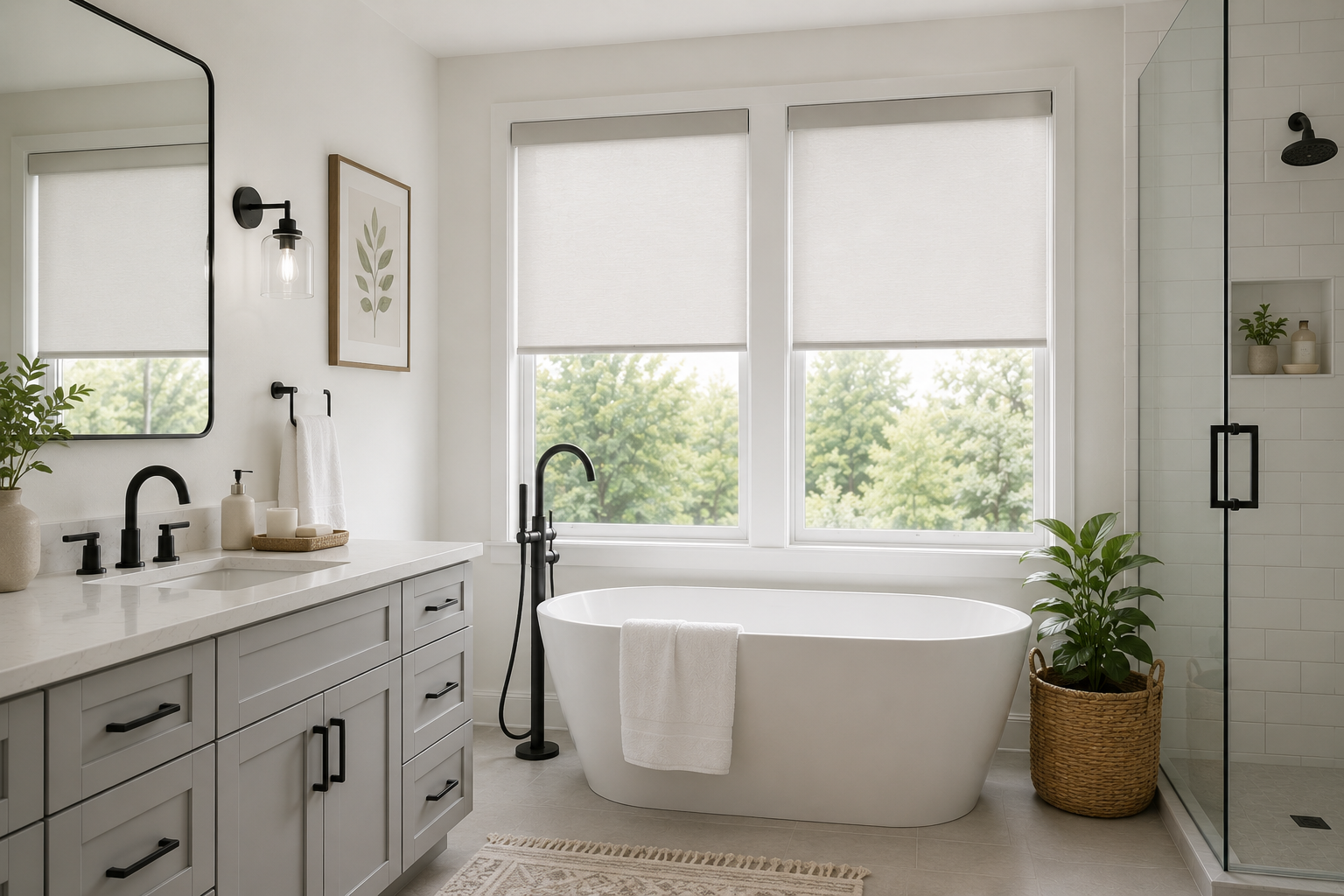
Steam and humidity make bathrooms one of the first rooms where homeowners may want to consider moisture-resistant and fungal-resistant material characteristics. Shop bathroom window treatments.
Kitchens
Cooking, sinks and changing temperatures can create more challenging conditions than in a typical bedroom or living room. Shop kitchen window treatments.
Laundry Rooms
Washers, dryers and limited ventilation can contribute to heat and humidity, making durable performance fabrics particularly useful. See the Top Window Treatments for Laundry Rooms
Other Humidity-Prone Spaces
Depending on the home, sunrooms, utility areas and other spaces may also benefit from materials selected with moisture and fungal resistance in mind.
ASTM G21 testing should be considered alongside the complete suitability of the product for the room, including moisture resistance, cleanability and manufacturer care instructions.
Does ASTM G21 Mean a Shade Is Mold or Mildew Resistant?
ASTM G21 provides evidence about resistance to fungi under the conditions of the test. Manufacturers may use those results as part of the documentation supporting fungal-, mold- or mildew-resistance claims for a particular material.
However, avoid interpreting the test as an absolute guarantee. Real-world fungal growth depends on many factors, including moisture, surface contamination, ventilation, temperature and maintenance.
A better way to describe a qualifying product is "fabric tested for resistance to fungi according to ASTM G21" or to use the exact performance language contained in the manufacturer's supporting documentation.
How ASTM G21 Fits Into a Healthy-Home Window Treatment Strategy
ASTM G21 does not measure indoor air quality or determine whether a textile contains specified harmful substances. Its value is much more specific: it helps document fungal resistance of the tested material.
That makes it one piece of a larger product-selection process. Depending on your priorities, you may also want to consider:
- GREENGUARD certified window treatments for chemical-emissions information.
- OEKO-TEX® window treatment fabrics for harmful-substance testing.
- Low VOC window shades when emissions are a priority.
- Non-toxic window treatment considerations for broader material-selection guidance.
- Window treatments for allergy-conscious homes when cleanability and dust accumulation are important concerns.
No single certification, material test or performance feature tells you everything about a window treatment. The goal is to match the features to the conditions and priorities in your particular room.
How to Choose an ASTM G21 Tested Window Shade
If fungal resistance is an important consideration, begin by identifying products with documented qualifying fabrics rather than choosing a shade style first and assuming every available material offers the same performance.
Confirm the Exact Fabric
Check whether ASTM G21 applies to the specific fabric, color or collection you are considering.
Review the Actual Test Information
When available, look beyond the phrase "ASTM G21 tested" and review the manufacturer's reported performance or rating.
Consider Moisture Resistance Too
Fungal resistance and moisture resistance are related considerations but are not identical. Make sure the complete window treatment is suitable for the environment where it will be installed.
Follow Care Instructions
Even a fungal-resistant performance fabric requires normal maintenance. Follow the manufacturer's cleaning recommendations and address persistent moisture or condensation around the window.
Related Healthy Home Guides
- Healthy Home Window Treatments
- Bacteria & Fungal Resistant Window Shades
- GREENGUARD Window Treatments
- OEKO-TEX® Window Treatments
- GREENGUARD vs. GREENGUARD Gold
- Best GREENGUARD Certified Shades
- Best GREENGUARD Certified Blinds
- Low VOC Window Shades
- Non-Toxic Window Treatments
- Best Window Treatments for Allergies
- GREENGUARD vs. OEKO-TEX® Certifications for Window Coverings
Expert Guidance from Blinds Chalet
Blinds Chalet has helped homeowners shop for custom window treatments since 2006. Performance specifications such as ASTM G21 can be useful, but only when they are explained in the context of what was actually tested and what the results mean.
When we identify a window shade fabric as ASTM G21 tested, we look to the manufacturer or supplier documentation for the specific material. We do not assume that testing performed on one fabric applies to every fabric, color or product in the collection.
We also distinguish between testing and treatment. ASTM G21 evaluates fungal resistance; it does not create that resistance. Antimicrobial technologies such as Microban®, when present, are separate material features and should be evaluated according to their own documentation.
If fungal resistance is an important part of your window treatment decision, contact us before ordering. We can help identify qualifying fabrics and explain the available product information so you can compare options based on documented performance rather than broad marketing terminology.
ASTM G21 Window Shade FAQs
What does ASTM G21 mean?
ASTM G21 is a standardized laboratory practice used to determine the resistance of synthetic polymeric materials to fungi. When a qualifying window shade fabric has ASTM G21 testing, it means that material has been evaluated for fungal resistance under controlled test conditions.
Is ASTM G21 a certification?
No. ASTM G21 is a standardized test practice rather than a certification program. It describes a method for evaluating fungal resistance of qualifying materials.
Does ASTM G21 test for mold and fungi?
ASTM G21 evaluates resistance to fungi under controlled conditions favorable to fungal growth. The results can provide useful evidence when evaluating fungal-resistance performance of a material, but the test should not be interpreted as proving that a finished window treatment is mold-proof.
Does ASTM G21 test bacteria?
No. ASTM G21 is focused on fungi. A bacterial-resistance or antibacterial claim requires separate supporting evidence and should not be inferred from an ASTM G21 result.
Does ASTM G21 mean a window shade is mold proof?
No. ASTM G21 testing provides information about how a specific tested material resisted fungal growth under laboratory conditions. It does not guarantee that mold or fungi can never grow on the shade under real-world conditions.
What is the difference between ASTM G21 tested and fungal resistant?
ASTM G21 tested identifies the laboratory practice used to evaluate a material. Fungal resistant describes a performance characteristic. When possible, review the actual ASTM G21 test result or manufacturer documentation to understand how the tested material performed.
Is ASTM G21 the same as Microban?
No. ASTM G21 is a fungal-resistance test practice. Microban is branded antimicrobial technology that may be incorporated into or applied to qualifying materials. A fabric may potentially have both Microban technology and ASTM G21 testing, but one does not automatically prove the other.
Is ASTM G21 the same as GREENGUARD?
No. ASTM G21 evaluates fungal resistance of qualifying materials, while GREENGUARD certification focuses on chemical emissions and indoor air quality. They evaluate different characteristics of a window treatment.
Is ASTM G21 the same as OEKO-TEX?
No. ASTM G21 evaluates fungal resistance, while OEKO-TEX® programs evaluate textiles and components against specified criteria including harmful-substance requirements. They answer different questions about the material.
Are ASTM G21 tested shades good for bathrooms?
A window shade fabric with documented fungal resistance can be worth considering for a bathroom or another humidity-prone room. The complete treatment should also be suitable for moisture exposure, and proper ventilation, cleaning and humidity control remain important.
Does ASTM G21 apply to the entire window shade?
Not necessarily. ASTM G21 documentation may apply to a particular fabric or material rather than every component of the finished window treatment. Check the product documentation to determine exactly what was tested.
Do all fabrics within a shade collection have the same ASTM G21 rating?
Not necessarily. Testing may apply only to specific fabrics, materials, colors or collections. Do not assume that an ASTM G21 result for one fabric applies to every option offered on the same window shade product.
How can I find window shades with ASTM G21 tested fabrics?
Look for product or fabric specifications that specifically reference ASTM G21 fungal-resistance testing. Blinds Chalet can also help identify qualifying fabrics and review available manufacturer documentation before you order.