








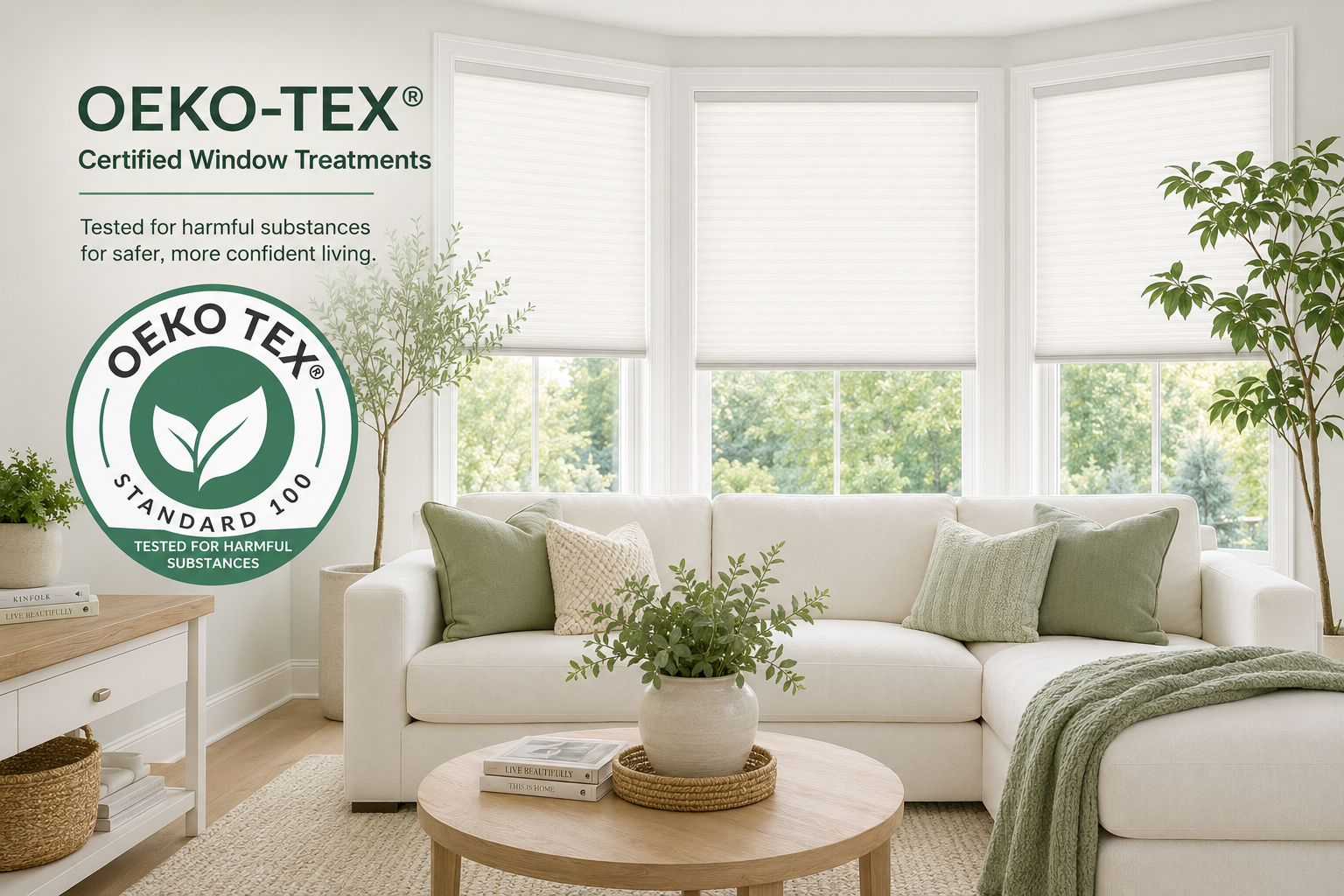
GREENGUARD and OEKO-TEX® certifications can both help you identify window coverings that meet recognized product-safety standards, but they evaluate different things. UL GREENGUARD Certification focuses primarily on chemical emissions that can affect indoor air, while OEKO-TEX® STANDARD 100 evaluates textiles and their components for potentially harmful substances.
Understanding the difference can help you make a more informed choice when selecting blinds or shades for bedrooms, nurseries, classrooms, healthcare facilities, offices, and other indoor spaces.
GREENGUARD vs. OEKO-TEX®: The Quick Answer
GREENGUARD and OEKO-TEX® are not competing versions of the same certification. They address separate aspects of product safety:
- GREENGUARD evaluates how much a finished product emits certain chemicals into indoor air.
- GREENGUARD Gold applies stricter chemical-emission limits and additional criteria intended for sensitive indoor environments.
- OEKO-TEX® STANDARD 100 tests textile materials and components for regulated and potentially harmful substances.
A window treatment may carry one certification, both certifications, or neither. Certification should always be confirmed for the specific product, fabric, color, and configuration being ordered.
GREENGUARD, GREENGUARD Gold and OEKO-TEX® Compared
| Certification | Primary Focus | What Is Evaluated? | Why It Matters | Best Suited For |
|---|---|---|---|---|
| UL GREENGUARD | Indoor chemical emissions | Emissions of VOCs and other chemicals from a finished product into indoor air | Helps identify products that meet established low-emission requirements | Homes, offices and other regularly occupied indoor spaces |
| UL GREENGUARD Gold | Stricter indoor chemical-emission limits | Lower total VOC limits and additional health-based chemical criteria | Provides greater protection for children and other potentially sensitive occupants | Nurseries, schools, childcare facilities, healthcare settings and homes seeking stricter emission standards |
| OEKO-TEX® STANDARD 100 | Textile and material safety | Fabric, thread, dyes and applicable textile components for harmful substances | Confirms that the certified textile has passed the applicable testing requirements for harmful substances | Fabric window treatments and products where textile composition is an important consideration |
What Is UL GREENGUARD Certification?
UL GREENGUARD Certification is designed to identify products with low chemical emissions. Products are evaluated to determine whether their emissions meet established limits for volatile organic compounds, commonly called VOCs, and other chemicals that can affect indoor air.
This certification can be particularly relevant for window blinds and shades because these products remain inside the home for years and may include fabrics, coatings, adhesives, plastics, finishes and other components.
GREENGUARD Certification does not mean that a product is completely free of chemicals. It means the certified product has been tested and shown to comply with the certification program's chemical-emission requirements.
Learn more in our guide to GREENGUARD Certified window blinds and shades .
What Is GREENGUARD Gold Certification?
GREENGUARD Gold is the more stringent level within the UL GREENGUARD program. It includes lower limits for total VOC emissions and health-based criteria for additional chemicals.
The Gold standard was developed with sensitive populations and environments in mind. For that reason, GREENGUARD Gold Certified window coverings may be especially appealing for:
- Nurseries and children's bedrooms
- Schools and childcare facilities
- Healthcare and senior-care environments
- Bedrooms and frequently occupied living spaces
- Homes prioritizing low-emission interior products
Both GREENGUARD and GREENGUARD Gold relate to chemical emissions, but the Gold certification requires compliance with more restrictive limits.
What Is OEKO-TEX® STANDARD 100?
OEKO-TEX® STANDARD 100 is a certification for textiles tested for harmful substances. Testing can apply to the textile itself as well as relevant components used in the finished article.
For a fabric window treatment, testing may relate to materials such as the fabric, fibers, thread, dyes or other textile components included within the certified product.
OEKO-TEX® uses different product classes based on how a textile is intended to be used. Requirements become more stringent as expected skin contact increases, with products intended for babies subject to the strictest class of testing.
OEKO-TEX® STANDARD 100 does not serve the same purpose as GREENGUARD. It primarily evaluates substances within textile materials rather than serving as a finished-product indoor-air-emissions certification.
Read our complete guide to OEKO-TEX® Certified window coverings .
What Is the Main Difference?
The simplest way to understand the distinction is:
GREENGUARD asks what a product emits into indoor air. OEKO-TEX® asks what potentially harmful substances are present in the certified textile and its tested components.
Because the programs address different concerns, one certification does not automatically replace the other. A fabric may satisfy OEKO-TEX® textile-safety requirements without carrying a GREENGUARD emissions certification. Likewise, a finished product may be GREENGUARD Certified without its textile carrying an OEKO-TEX® STANDARD 100 label.
Is GREENGUARD or OEKO-TEX® Better?
Neither certification is universally better. The most relevant certification depends on what matters most for your project.
Choose GREENGUARD when indoor air emissions are the priority
GREENGUARD is most directly relevant when you are looking for a finished product that has been evaluated for low chemical emissions into indoor air.
Choose GREENGUARD Gold for stricter emission requirements
GREENGUARD Gold may be preferable when selecting window coverings for nurseries, schools, healthcare environments or spaces used by potentially sensitive occupants.
Choose OEKO-TEX® when textile testing is the priority
OEKO-TEX® STANDARD 100 is relevant when you want confirmation that a certified textile and its applicable components have been tested for harmful substances.
Look for both when available
A product carrying both certifications may offer assurance in two complementary areas: textile testing and low chemical emissions. However, always verify that both certifications apply to the exact product and configuration you are considering.
How to Evaluate Certified Window Coverings
Certification can be an important shopping consideration, but the presence of a logo or a general brand claim is not always enough. Before ordering, consider the following:
- Confirm whether the certification applies to the complete shade, the fabric only or an individual component.
- Check that the exact fabric, color and product configuration are covered.
- Ask whether optional liners, coatings, edge binding or other upgrades affect certification.
- Request the certificate number or supporting product documentation when certification is required for a commercial project.
- Avoid interpreting either label as meaning that a product is completely “chemical-free.”
Where Certified Window Treatments May Matter Most
Certified window coverings can be considered throughout the home, but they may be particularly valuable in spaces where people spend extended periods of time:
- Nurseries and children's rooms
- Primary and guest bedrooms
- Home offices
- Living and family rooms
- Schools and daycare centers
- Medical and senior-care facilities
- Commercial offices and hospitality environments
Shop Certified Window Blinds and Shades
Blinds Chalet offers window treatments with a variety of fabrics, materials and available certifications. Product certification varies by manufacturer, model, fabric and selected options, so review the individual product information or contact our team when certification is an important requirement.
- Explore GREENGUARD Certified window treatments
- Explore OEKO-TEX® Certified window treatments
- GREENGUARD vs GREENGUARD Gold Certifications
- Best GREENGUARD Window Shades
- Best GREENGUARD Certified Window Blinds
- Shop custom window shades
- Shop custom window blinds
Frequently Asked Questions About GREENGUARD and OEKO-TEX®
Is GREENGUARD the same as OEKO-TEX®?
No. GREENGUARD evaluates chemical emissions from products into indoor air, while OEKO-TEX® STANDARD 100 tests textiles and applicable components for harmful substances. The certifications address different aspects of product safety.
What is the difference between GREENGUARD and GREENGUARD Gold?
Both certifications evaluate chemical emissions, but GREENGUARD Gold uses stricter emission limits and additional criteria intended for sensitive indoor environments. It is commonly considered for schools, healthcare facilities, nurseries, and homes with young children.
Which certification is best for a nursery?
GREENGUARD Gold may be especially relevant for a nursery because it applies stricter chemical-emission requirements for sensitive environments. OEKO-TEX® can provide complementary assurance that the certified textile has been tested for harmful substances. A window covering carrying both certifications may offer added peace of mind.
Can window shades carry both certifications?
Yes. A window shade, its fabric, or certain components may carry both GREENGUARD and OEKO-TEX® certifications. Always confirm that each certification applies to the exact product, fabric, color, and options being ordered.
Does OEKO-TEX® test VOC emissions?
OEKO-TEX® STANDARD 100 primarily tests textiles and applicable components for harmful substances. UL GREENGUARD is the certification more directly focused on chemical emissions from products into indoor air.
Does certified mean chemical-free?
No. Certification means the product or textile met the applicable testing requirements and limits established by the certification program. It does not mean the product contains no chemicals.