







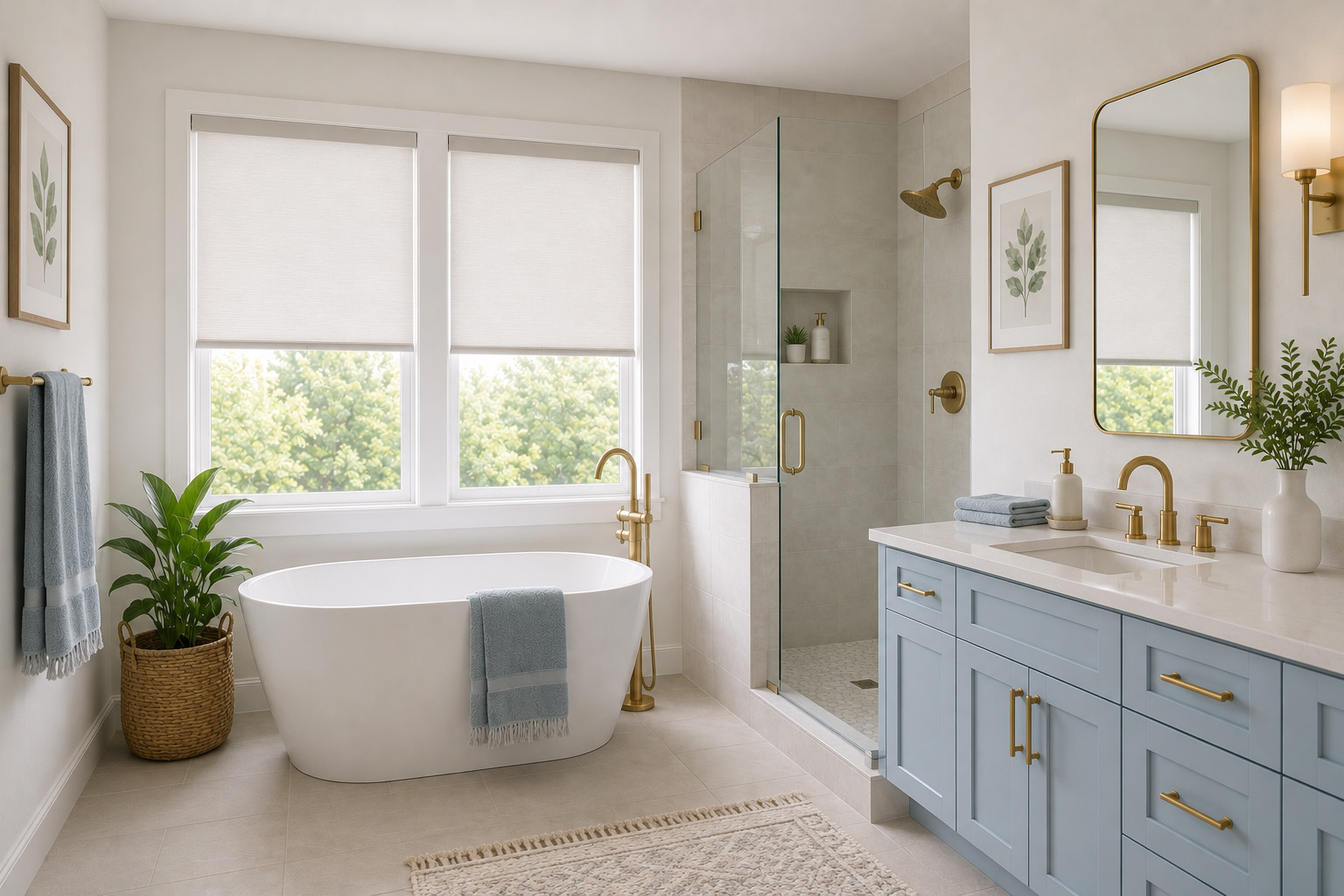
When shopping for window shades for bathrooms, kitchens, laundry rooms or other humidity-prone spaces, you may see terms such as mold resistant, mildew resistant, fungal resistant or antimicrobial. These descriptions sound similar, but they do not always mean exactly the same thing.
In everyday use, mold and mildew are closely related terms. Mildew generally refers to certain kinds of mold or fungus and is often used to describe flatter surface growth. For window treatment shoppers, the more important question is not which word appears in the marketing description, but whether the specific fabric has documented testing or treatment supporting its resistance claim.
A mold-resistant or mildew-resistant window shade should also not be confused with a mold-proof product. Resistance means the material is designed or tested to better resist fungal growth under certain conditions; it does not mean mold can never grow if moisture, condensation or other favorable conditions are present.
This guide explains the difference between common terminology, how testing such as ASTM G21 fungal resistance testing fits into the picture, and how to evaluate qualifying window shade fabrics.
For more information about healthy-home materials and certifications, visit our Healthy Home Window Treatments resource center.
What Is the Difference Between Mold-Resistant and Mildew-Resistant Window Shades?
For most homeowners, the distinction is smaller than the terminology may suggest. Mold is a broad term for microscopic fungi, while mildew is commonly used to describe certain types or forms of mold or fungal growth.
A window shade marketed as mold resistant or mildew resistant is therefore generally describing resistance to fungal growth on the material. The exact performance depends on the fabric, coating, antimicrobial treatment and supporting test documentation.
| Term | What It Generally Means | What to Verify |
|---|---|---|
| Mold Resistant | Material is designed or tested to resist certain fungal growth | Test method, treatment and exact fabric covered by the claim |
| Mildew Resistant | Material is designed or tested to resist fungal growth often described as mildew | Supporting manufacturer documentation and test results |
| Fungal Resistant | Broader technical description of resistance to fungi | Whether testing such as ASTM G21 supports the claim |
| Mold Proof | Implies mold can never grow | Avoid treating fungal-resistance testing as proof of an absolute claim |
Learn more: Are Antimicrobial Window Shades Worth It?
Are Mold and Mildew the Same Thing?
They are closely related. Mold is a broad term covering many microscopic fungi. Mildew is commonly used for certain kinds of mold or fungus, often describing growth that appears flatter or more surface-oriented.
For window shade fabrics, that means you should not assume that a product labeled "mildew resistant" necessarily has a fundamentally different capability from one labeled "mold resistant." The important evidence is the material documentation behind the claim.
Focus on the Tested Material, Not Just the Marketing Term
Two manufacturers may use slightly different language to describe similar material performance. One may say "mildew resistant," another may say "fungal resistant," and another may reference a specific test standard.
Whenever possible, look for the actual test method, reported result or manufacturer specification rather than relying only on the front-facing marketing phrase.
Mold Resistant Does Not Mean Mold Proof
This distinction is one of the most important things to understand when shopping for window treatments.
A mold-resistant fabric may be formulated, treated or tested to resist fungal growth better than an untreated material. That does not mean the shade can never develop mold or mildew under real-world conditions.
Persistent condensation, water leaks, high humidity, poor ventilation and surface contamination can still create conditions favorable to fungal growth.
Think of Resistance as a Material-Performance Feature
The best way to interpret mold or mildew resistance is as an additional layer of product performance. It may make a fabric better suited to challenging environments, but it does not replace good moisture management.
Moisture Control Still Matters
Even the best fungal-resistant window treatment should be used as part of a larger moisture-control strategy.
Bathrooms, kitchens and laundry rooms naturally generate more humidity than many other rooms. Condensation can also form on cool window glass and surrounding surfaces when warm humid air contacts them.
Helpful Moisture-Control Practices
- Use exhaust fans in bathrooms and kitchens.
- Address plumbing or window leaks promptly.
- Dry persistent condensation around windows.
- Improve ventilation in rooms that regularly remain humid.
- Follow the manufacturer's cleaning and care instructions for the shade.
- Avoid allowing wet fabric to remain damp for extended periods.
Material resistance can help, but moisture management remains the most important factor in reducing conditions favorable to mold growth.
How Does ASTM G21 Relate to Mold- and Mildew-Resistant Shades?
ASTM G21 is a standardized laboratory practice used to evaluate the resistance of synthetic polymeric materials to fungi. It is one of the more useful pieces of supporting information you may see when comparing fungal-resistant window treatment fabrics.
If a specific shade fabric has documented ASTM G21 testing, that tells you the material was evaluated under controlled conditions favorable to fungal growth.
However, ASTM G21 is a test practice, not a treatment and not a certification. It does not make a material fungal resistant by itself.
For a detailed explanation, see What Does ASTM G21 Mean for Window Shade Fabrics?.
| Claim or Test | What It Tells You |
|---|---|
| Mold Resistant | A performance description that should be supported by appropriate material documentation |
| Mildew Resistant | A performance description generally relating to resistance to fungal growth |
| ASTM G21 Tested | Identifies a standardized laboratory practice used to evaluate fungal resistance |
| ASTM G21 Test Result | Provides additional information about how the specific tested material performed |
How Does Bacteria & Fungal Resistance Fit In?
Some performance fabrics are described more broadly as bacteria- and fungal-resistant. This can involve multiple material properties, test methods or antimicrobial technologies.
It is important not to assume that a fungal-resistance test also proves bacterial resistance. Bacteria and fungi are different types of microorganisms, and claims relating to each should have their own supporting documentation.
For qualifying products and a broader explanation of these features, visit our Bacteria & Fungal Resistant Window Shades guide.
How Is Microban® Different From Mold-Resistance Testing?
Microban® is antimicrobial product-protection technology that may be incorporated into or applied to qualifying materials. Depending on the specific technology used, it may provide protection against certain bacteria, mold, mildew or fungi on the treated material.
This is different from ASTM G21. Microban is a product-protection technology, while ASTM G21 is a laboratory practice used to evaluate fungal resistance.
| Feature | ASTM G21 | Microban® |
|---|---|---|
| What Is It? | Standardized fungal-resistance test practice | Branded antimicrobial product-protection technology |
| Added to Material? | No | May be incorporated into or applied to qualifying materials |
| Fungal Performance | Evaluates resistance to fungi under test conditions | Depends on the specific Microban technology used |
| Bacterial Performance | Not evaluated by ASTM G21 | Certain Microban technologies may provide antibacterial product protection |
Learn more in our guide to Microban® Antimicrobial Window Shades.
Where Are Mold- and Mildew-Resistant Window Shades Most Useful?
Fungal-resistant material characteristics can be especially useful where window coverings experience higher humidity, condensation or frequent moisture exposure.
Bathrooms
Steam and moisture make bathrooms one of the most common spaces where customers consider mold- or mildew-resistant fabrics.
Kitchens
Cooking, sinks and changing temperatures can increase humidity around kitchen windows.
Laundry Rooms
Washers, dryers and limited ventilation can create warmer, more humid conditions that place more demands on window treatment materials. Explore the Best Window Treatments for Laundry Rooms
Sunrooms and Utility Spaces
Temperature swings and condensation can make performance fabrics worth considering in other moisture-prone areas as well.
Material Choice Matters Too
A fungal-resistance claim is only one part of choosing a window treatment for a humid environment.
Some materials naturally handle moisture exposure better than others. Synthetic performance fabrics may be easier to clean and less absorbent than certain natural textiles, while specific coatings or treatments may add additional resistance.
Also Consider
- Whether the fabric absorbs moisture easily.
- How easy the material is to clean.
- Whether the headrail and hardware are suitable for the environment.
- Whether the shade remains close to condensation-prone glass.
- The manufacturer's recommended room applications.
- Whether fungal-resistance testing applies to the exact fabric being ordered.
Does Blackout or Light-Filtering Fabric Affect Mold Resistance?
Blackout and light-filtering describe how a shade manages light; they do not automatically tell you anything about fungal resistance.
A blackout fabric may have a coating or multilayer construction, while a light-filtering fabric may use a different weave or backing. Either one could potentially have fungal-resistance testing if the manufacturer documents it.
Do not assume a blackout fabric is mold resistant simply because it has a coated surface, and do not assume a light-filtering fabric is more susceptible. Review the material specifications for the exact fabric.
How to Shop for Mold- or Mildew-Resistant Window Shades
When fungal resistance matters, focus on documentation rather than broad terminology.
Look for Product-Specific Claims
Confirm whether the mold-, mildew- or fungal-resistance claim applies to the exact fabric or material you are selecting.
Look for Supporting Testing
If ASTM G21 or another fungal-resistance test is referenced, review the available result or manufacturer documentation when possible.
Check the Entire Treatment
The fabric may be fungal resistant while other components have different performance characteristics. Consider headrails, bottom rails and hardware when selecting a treatment for a humid room.
Match the Product to the Environment
Fungal resistance is useful, but so are moisture resistance, cleanability and proper ventilation.
Mold Resistant vs. Mildew Resistant vs. Antimicrobial
| Term | Primary Meaning | What It Does Not Automatically Mean |
|---|---|---|
| Mold Resistant | Designed or tested to resist certain fungal growth | Mold proof or immune to moisture problems |
| Mildew Resistant | Designed or tested to resist fungal growth often described as mildew | Guaranteed resistance to every fungus |
| Fungal Resistant | Broader technical description of resistance to fungi | Automatic bacterial resistance |
| Antimicrobial | Broader term that may include activity against certain bacteria, fungi or other microorganisms depending on the technology | That every antimicrobial technology protects against every microbe |
| Mold Proof | Absolute claim | Should not be inferred from routine fungal-resistance testing |
How Mold-Resistant Shades Fit Into a Healthy Home
Fungal-resistant window treatment fabrics can be one useful feature in a healthier-home strategy, particularly in areas where humidity and condensation are concerns.
They should be considered alongside other material characteristics such as chemical emissions, harmful-substance testing, cleanability and moisture resistance.
Our Healthy Home Window Treatments section brings these topics together so you can compare features based on what matters most in each room.
Expert Guidance from Blinds Chalet
Blinds Chalet has helped homeowners shop for custom window treatments since 2006. Terms such as mold resistant, mildew resistant, fungal resistant and antimicrobial can sound interchangeable, but the supporting documentation behind those terms is what matters most.
When we evaluate these claims, we look at the specific fabric or material being offered and the manufacturer's supporting information. If ASTM G21 testing is listed, we treat that as evidence that the specific material was evaluated for fungal resistance under laboratory conditions rather than as proof that the entire finished shade is mold-proof.
We also distinguish between testing and treatment. ASTM G21 is a test practice, while technologies such as Microban® may be incorporated into a material to provide antimicrobial product protection.
If fungal resistance is an important part of your window treatment decision, contact us before ordering. We can help identify qualifying fabrics and explain which claims apply to the exact product and fabric you are considering.
Related Healthy Home Guides
- Healthy Home Window Treatments
- Bacteria & Fungal Resistant Window Shades
- What Does ASTM G21 Mean for Window Shade Fabrics?
- Microban® Antimicrobial Window Shades
- GreenGuard Certified Window Treatments
- OEKO-TEX Certified Window Treatments
- GreenGuard vs OEKO-TEX Certifications for Window Shades
- Best Window Shades for People with Allergies
- Window Treatments that are Non-Toxic
Mold- and Mildew-Resistant Window Shade FAQs
What is the difference between mold-resistant and mildew-resistant window shades?
The terms overlap because mildew generally refers to certain types or forms of mold or fungal growth. For window shades, both terms usually describe a material designed or tested to resist fungal growth. The supporting product documentation is more important than the specific marketing term used.
Is mildew a type of mold?
Mildew is commonly used to describe certain kinds of mold or fungus, often with flatter surface growth. The terms are closely related rather than completely separate categories.
Does mold resistant mean mold proof?
No. Mold resistant means a material is designed or tested to better resist certain fungal growth. It does not mean mold can never grow under real-world conditions, especially when persistent moisture, condensation or high humidity is present.
What does mildew resistant mean on a window shade?
Mildew resistant generally means the fabric or material has characteristics designed to resist fungal growth commonly described as mildew. Look for supporting test or manufacturer documentation to understand exactly what the claim covers.
Does ASTM G21 test for mold resistance?
ASTM G21 is a standardized laboratory practice for evaluating resistance of synthetic polymeric materials to fungi. It provides useful evidence about fungal resistance but should not be interpreted as proving that a finished window shade is mold proof.
Does ASTM G21 also test bacteria?
No. ASTM G21 focuses on fungi. A claim of bacterial resistance requires separate supporting documentation and should not be inferred from ASTM G21 fungal-resistance testing.
Is Microban the same as mold-resistant testing?
No. Microban is branded antimicrobial product-protection technology that may be incorporated into qualifying materials. ASTM G21 is a laboratory test practice used to evaluate fungal resistance. A material may potentially have both, but one does not automatically prove the other.
Are mold-resistant shades good for bathrooms?
Fungal-resistant fabrics can be useful in bathrooms because of the higher humidity and moisture exposure common in these rooms. The complete treatment should also be moisture appropriate, easy to clean and used with proper ventilation.
Can mold grow on a mold-resistant shade?
Yes, it can still be possible under severe or persistent moisture conditions. Resistance reduces susceptibility but does not create an absolute barrier against fungal growth in every environment.
How can I reduce mold around my window shades?
Control moisture around the window by addressing leaks, reducing persistent condensation, improving ventilation and keeping the shade and surrounding surfaces clean and dry. Follow the manufacturer's cleaning instructions for the specific window treatment.
Do blackout shades resist mold better than light-filtering shades?
Not necessarily. Blackout and light-filtering describe light-control performance rather than fungal resistance. Either type may use a fungal-resistant fabric if the manufacturer provides supporting documentation for the specific material.
How do I find mold- or mildew-resistant window shades?
Look for product-specific fabric documentation describing fungal, mold or mildew resistance and check for supporting testing such as ASTM G21 where applicable. Blinds Chalet can help identify qualifying fabrics and explain the available test information before you order.