









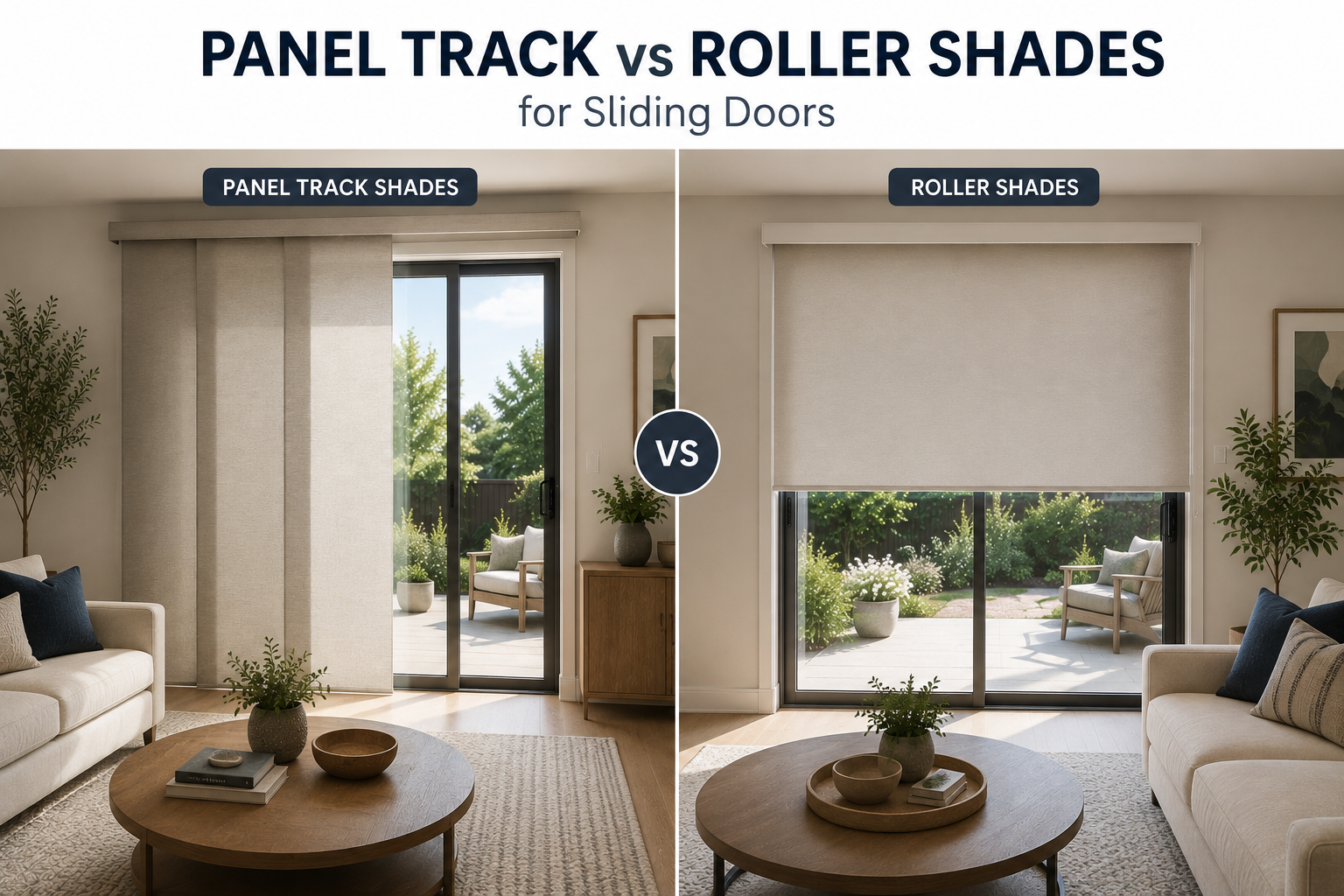
Compare panel track blinds and roller shades for sliding glass doors based on door access, privacy, light control, room darkening, stacking, appearance and everyday operation.
Panel track blinds and roller shades are two modern alternatives to traditional vertical blinds, but they operate in very different ways. Panel track blinds move horizontally across a track, while roller shades raise and lower vertically. That difference affects how easily you can use the sliding door, how the treatment looks when open and how much control you have over individual sections of glass.
For a frequently used sliding glass door, panel track blinds are often the more convenient choice because the panels slide in the same direction as the door. Roller shades may be better when you want a minimalist appearance, independent control over different sections of glass or a wider selection of solar, light-filtering, room-darkening and blackout fabrics.
This guide compares the two options specifically for sliding doors. If you are still deciding among several product types, start with our Vertical Blind Alternatives: Comparing Your Best Options guide or our How to Choose Vertical Blind Alternatives buying guide.
Panel Track Blinds vs. Roller Shades: Which Is Better for a Sliding Door?
Panel track blinds are generally better when frequent door access and side-to-side operation are the top priorities. Roller shades are generally better when you want a cleaner open view, independent control of different sections of glass and greater flexibility in fabric selection.
Neither option is automatically better for every sliding door. The right choice depends on how often the door is used, where the fabric will stack or roll, whether privacy or blackout is important and whether you want one treatment to operate as a complete system or several shades to operate independently.
| Feature | Panel Track Blinds | Roller Shades |
|---|---|---|
| Operating Direction | Side to side | Up and down |
| Frequent Door Access | Excellent | Good to Moderate |
| Modern Appearance | Excellent | Excellent |
| Open View | Panels stack along one or both sides | Fabric rolls above the opening |
| Independent Section Control | Limited | Excellent with multiple shades |
| Fabric Selection | Good to Very Good | Excellent |
| Privacy | Very Good with opaque fabric | Very Good with opaque fabric |
| Room Darkening | Good to Very Good | Very Good with blackout fabric |
| Potential Light Gaps | Between overlapping panels and outer edges | Between multiple shades and around the sides |
| Stacking Space | Requires side stacking space | No side stack; fabric rolls above |
| Motorization | Varies by product | Widely available on many products |
The Biggest Difference: How They Operate
The most important difference between panel track blinds and roller shades is their direction of movement.
Panel Track Blinds Move With the Door
Panel track blinds use wide fabric panels suspended from a multi-channel track. The panels slide horizontally to one side or split toward both sides of the opening.
Because a sliding glass door also moves horizontally, the treatment and door operate in the same general direction. This makes it relatively easy to move the panels away from the active door section without opening the entire window treatment.
Roller Shades Move Vertically
Roller shades raise from the bottom and roll around a tube above the opening. On a sliding door, the shade covering the active panel generally needs to be raised before someone walks through the doorway.
This does not make roller shades unsuitable for sliding doors, but it does make everyday usage an important consideration. Learn more in our guide Can Roller Shades Work on Sliding Glass Doors?.
Which Is Better for Frequent Door Access?
Panel track blinds usually have the advantage when a sliding door is used frequently throughout the day.
You can slide the panels away from the active door area and leave them there while people enter and exit. With the right configuration, the remaining glass can stay covered while the doorway remains accessible.
Panel Tracks Are Better When
- The door is opened many times throughout the day.
- You want the treatment to move in the same direction as the door.
- You want to uncover the doorway without raising fabric above the opening.
- You prefer one integrated track system across the entire opening.
Roller Shades Are Better When
- The sliding door is used only occasionally.
- The opening can be divided into separate shades.
- The shade over the active panel can remain raised during periods of frequent use.
- You want independent control over the stationary and active glass sections.
If convenient door access is your primary concern, also review our guide to the best window treatments for sliding glass doors.
Which Has the More Modern Appearance?
Both panel tracks and roller shades can create a contemporary look, but they produce very different visual effects.
Panel Track Appearance
Panel tracks create broad vertical sections of fabric across the opening. Their large panels make the treatment visually noticeable even when closed, which can make a large sliding door feel like an intentional architectural feature.
They work especially well in contemporary, transitional and minimalist interiors where clean lines and large areas of fabric complement the scale of the door.
Roller Shade Appearance
Roller shades generally create a more understated appearance. When lowered, they provide simple flat expanses of fabric. When fully raised, the fabric rolls above the opening and leaves the glass largely unobstructed.
If your priority is making the window treatment disappear when open, roller shades have a clear advantage because there is no large side stack.
Which Provides the Better Open View?
Roller shades generally provide the better unobstructed view when fully open because the fabric rolls above the door rather than stacking beside it.
Panel Track Stack
Panel track blinds gather into an overlapping stack on one or both sides. Depending on the number and width of the panels, part of that stack may remain in front of the glass.
If there is adequate wall space beside the door, an outside-mounted system may allow some of the stack to extend beyond the glass. The exact result depends on the track and installation.
Roller Shade Roll
Roller shade fabric rolls around a tube above the opening, preserving the width of the view when fully raised. The roll, cassette or fascia remains visible above the glass but does not create a side stack.
For rooms where preserving an expansive outdoor view is a high priority, this can be a significant advantage.
Which Is Better for Controlling Different Sections of Glass?
Roller shades have the advantage when you want independent control over individual sections of a sliding glass door.
A two-panel or multi-panel door can often be divided into separate roller shades. One shade can remain lowered over the stationary glass while another is raised over the active door.
Advantages of Separate Roller Shades
- Each section can be adjusted independently.
- You can block sunlight on one part of the opening while leaving another uncovered.
- The stationary glass can remain private while the doorway is open.
- Individual shades can be raised to different heights.
Panel Track Operation
Panel track blinds typically operate as one interconnected system. Moving one panel causes other panels to follow along the track as they overlap and stack.
This makes panel tracks very convenient for opening a large portion of the doorway, but they provide less precise control over individual sections of glass than separate roller shades.
Panel Track Blinds vs. Roller Shades for Privacy
Both treatments can provide strong privacy when opaque fabrics are selected. The larger difference is where privacy gaps may occur.
Panel Track Privacy
Panel tracks rely on overlapping fabric panels. An opaque material can block direct views through the fabric, but narrow sightlines may occur where panels overlap or around the outer edges.
Roller Shade Privacy
An opaque roller shade also blocks direct views through the material. However, multiple shades can leave gaps between adjacent units, and inside-mounted shades usually have small spaces along the sides.
For a multi-shade installation, positioning the gaps over the door's vertical frames or mullions can reduce direct sightlines.
If privacy is one of your highest priorities, read our Best Alternatives to Vertical Blinds for Privacy guide.
Which Is Better for Blackout and Room Darkening?
Roller shades generally have the advantage when strong room darkening is the primary goal because blackout roller fabrics can prevent light from passing directly through the material.
However, a blackout fabric does not automatically create a completely dark room. Multiple roller shades can leave gaps between units, and light can enter around the outer edges.
Panel Track Room Darkening
Opaque and room-darkening panel fabrics can substantially reduce incoming light, but overlapping panels can create narrow light gaps. The treatment also requires clearance around the outer edges for operation.
Roller Shade Room Darkening
Blackout roller fabrics provide excellent light blockage through the material itself. An outside mount can improve coverage around the sides, while careful alignment of multiple shades can reduce center gaps.
For a more detailed comparison, visit our Best Vertical Blind Alternatives for Blackout & Room Darkening guide.
Which Is Better for Sun, Heat and Glare?
Both panel tracks and roller shades can help control direct sunlight, but roller shades generally provide more specialized fabric options for solar control.
Solar Roller Shades
Solar screen roller fabrics are designed to reduce glare and solar heat while preserving varying levels of outside view. This makes them especially useful on sliding doors that receive strong morning or afternoon sun.
Panel Track Fabrics
Panel track blinds may also be available in solar, screen, light-filtering or opaque materials depending on the product. Wide panels can provide effective coverage across large expanses of glass.
Neither treatment provides the same insulating construction as vertical cellular shades. If energy efficiency is a major concern, read our Best Energy-Efficient Alternatives to Vertical Blinds guide.
Side Stack vs. Overhead Roll
How the treatment looks when open is one of the most important differences between these two products.
Panel Track Side Stack
Panel track blinds gather to one side or split toward both sides. This stack may cover some of the glass unless there is enough wall space to extend the track beyond the opening.
The amount of stacking space depends on the number of panels, panel width and track configuration.
Roller Shade Overhead Roll
Roller shades eliminate the side stack because the material rolls above the opening. This makes them particularly attractive when you want to preserve the full width of the view.
The tradeoff is that the shade must be raised vertically before the active door section can be used.
Inside Mount vs. Outside Mount
Mounting style affects both appearance and performance for panel track blinds and roller shades.
Inside Mount
An inside mount keeps the treatment within the opening and preserves surrounding trim. It requires adequate mounting depth and sufficient clearance from handles and other door hardware.
Inside mounting can also create larger edge gaps, particularly with roller shades.
Outside Mount
An outside mount places the track or roller above the opening. This can provide additional flexibility around door handles and trim and may allow the treatment to extend beyond the glass.
For panel tracks, extending the track beyond the opening may allow more of the panel stack to sit away from the glass. For roller shades, additional width can improve privacy and room-darkening coverage along the outer edges.
Which Offers More Fabric Choices?
Roller shades generally offer the broader range of specialized fabrics because the product category includes decorative, light-filtering, solar, room-darkening and blackout materials.
Choose Solar Fabric When
You want to reduce glare and direct solar heat while preserving some outward visibility.
Choose Light-Filtering Fabric When
You want diffused daylight with increased privacy.
Choose Room-Darkening Fabric When
You want stronger privacy and significant reduction in incoming light.
Choose Blackout Fabric When
You want to prevent light from passing through the fabric itself.
Panel tracks may offer many of these same fabric types, but available selections depend more heavily on the specific product and manufacturer.
Which Is Better for Motorization?
Motorized roller shades are widely available and can be especially useful on large sliding doors with several independently operated shades.
Motorization allows shades to be raised and lowered without manually operating each section and can make it easier to adjust the treatment as sunlight changes throughout the day.
Motorized panel track options may also be available depending on the specific product, but operating choices vary more widely. If automation is important, confirm the available controls, power options and size limitations before selecting either treatment.
Which Is Easier to Clean and Maintain?
Both treatments are relatively simple compared with window coverings that contain many narrow slats or vanes, but fabric choice has a significant effect on cleaning requirements.
Panel Track Maintenance
Panel track blinds contain multiple large panels that can collect dust. Their broad flat surfaces are generally straightforward to vacuum gently or clean according to the fabric manufacturer's instructions.
Roller Shade Maintenance
Roller shades also have broad flat fabric surfaces and roll most of the material away when open. Routine dusting or gentle vacuuming is typically sufficient for many fabrics.
Always follow the cleaning recommendations for the specific material because some fabrics should not be washed or spot cleaned with moisture.
Choose Panel Track Blinds When
- The sliding door is used frequently throughout the day.
- You want a treatment that opens in the same direction as the door.
- You prefer large contemporary fabric panels.
- You are comfortable with the panels stacking along one or both sides.
- You want one coordinated treatment across the complete opening.
- You want easier doorway access without raising the treatment overhead.
Browse our custom panel track blinds to compare available fabrics and configurations.
Choose Roller Shades When
- You want the cleanest possible view when the treatment is fully open.
- You want several sections of the glass to operate independently.
- The door is not opened constantly throughout the day.
- You want a very broad selection of solar, light-filtering, room-darkening or blackout fabrics.
- You want the sliding-door treatment to coordinate with roller shades on nearby windows.
- You are interested in motorized operation.
Browse our custom roller shades or read Can Roller Shades Work on Sliding Glass Doors? for more detailed installation considerations.
Panel Track Blinds or Roller Shades: Which Should You Choose?
If the sliding glass door is one of the primary entrances to your patio or backyard and is opened many times each day, panel track blinds are usually the more practical choice. Their horizontal operation matches the movement of the door and makes it easier to keep the doorway accessible.
If the door is used less frequently and you value a minimal appearance, independent section control and an unobstructed view when the treatment is open, roller shades may be the better choice.
For many homeowners, the decision comes down to one question: do you value easier door access or a cleaner open view more? Panel tracks generally favor access, while roller shades generally favor visual simplicity and independent light control.
Panel Track vs. Roller Shade Buying Checklist
- Identify the active door panel: Determine which part of the opening must remain easiest to access.
- Consider frequency of use: A heavily used door generally favors horizontal operation.
- Measure the complete opening: Record width, height, depth and available wall space.
- Decide where the treatment should go when open: Compare a side stack with an overhead roll.
- Evaluate privacy needs: Consider fabric opacity and potential gaps.
- Evaluate light control: Decide whether solar control, room darkening or blackout is most important.
- Consider independent control: Determine whether separate sections need to operate independently.
- Check door hardware: Measure handles, locks, trim and any other projections.
- Consider motorization: Decide whether automated operation would improve everyday convenience.
- Order fabric samples: Compare color, texture, opacity and view-through in the actual room.
Expert Guidance from Blinds Chalet
Blinds Chalet has helped homeowners shop for custom window treatments since 2006. When comparing panel tracks and roller shades for a sliding door, we recommend starting with how the door is actually used rather than choosing solely by appearance.
For a heavily used door, operating direction often becomes the deciding factor. Panel tracks move horizontally and generally provide easier access. Roller shades can work extremely well when the opening is divided into logical sections and the active shade can be raised independently.
We also recommend considering the finished position of the treatment when it is open. Panel tracks require side stacking space, while roller shades preserve the width of the view by rolling above the opening. Neither approach is inherently better; the right configuration depends on the opening and your priorities.
Because size limits, fabrics and operating options vary by product, always review the measuring instructions and specifications for the exact treatment you are considering.
Content developed by: Blinds Chalet's window treatment team
Last updated: August 2026
Continue Researching Vertical Blind Alternatives
- Vertical Blind Alternatives Expert Advice Center
- Vertical Blind Alternatives: Comparing Your Best Options
- How to Choose Vertical Blind Alternatives
- Can Roller Shades Work on Sliding Glass Doors?
- Best Alternatives to Vertical Blinds for Privacy
- Best Vertical Blind Alternatives for Blackout & Room Darkening
- Best Energy-Efficient Alternatives to Vertical Blinds
- Panel Track Blinds vs. Vertical Blinds
- Panel Track Blinds vs. Drapery Panels
- Pros and Cons of Panel Track Blinds
When you are ready to compare products, browse our panel track blinds, roller shades and vertical blind alternatives.
Panel Track Blinds vs. Roller Shades FAQs
Are panel track blinds or roller shades better for sliding glass doors?
Panel track blinds are generally better for frequently used sliding doors because they move horizontally and can slide away from the active doorway. Roller shades may be better when you want independent section control, a broad selection of fabrics and a more unobstructed view when the shades are fully raised.
Which is more modern, panel track blinds or roller shades?
Both can create a modern appearance. Panel tracks use wide vertical fabric panels and create a more architectural look, while roller shades have a simpler profile and largely disappear above the opening when raised.
Which provides better privacy, panel track blinds or roller shades?
Both treatments can provide strong privacy with opaque fabrics. Panel tracks may have small sightlines where panels overlap, while multiple roller shades can have gaps between adjacent shades and around the outer edges.
Which is better for blackout, panel tracks or roller shades?
Roller shades generally have the advantage for strong room darkening because blackout fabrics can block light through the material itself. However, side gaps and spaces between multiple roller shades can still allow light into the room. Panel tracks can also provide strong room darkening with opaque fabrics but may allow light through panel overlaps.
Which provides a better view when open?
Roller shades generally provide the more unobstructed view because the fabric rolls above the opening. Panel track blinds stack along one or both sides and may cover part of the glass when fully open.
Are roller shades easier to use than panel track blinds?
The answer depends on how the sliding door is used. Roller shades provide excellent independent control over separate sections of glass, while panel tracks are generally easier for frequent doorway access because they open horizontally in the same direction as the door.
Which option is better for a frequently used patio door?
Panel track blinds are generally more practical for a frequently used patio door because the panels can slide away from the active doorway without being raised above the opening.
Which is better for solar heat and glare control?
Both treatments can use fabrics designed to reduce sunlight, but roller shades often provide a wider selection of specialized solar screen materials. Panel track blinds may also be available with solar fabrics depending on the product.
Can panel track blinds and roller shades be motorized?
Motorized options may be available for both product types depending on the specific treatment. Motorization is common on many roller shade products and can be especially useful when several shades cover a large sliding door. Available power and control options vary by product.
Shop our selection of roller shades to discover a wide range of styles to find the best option for your home.
Still researching your options? Check out our rollup shades buying guides for in-depth articles to help you choose with confidence.