









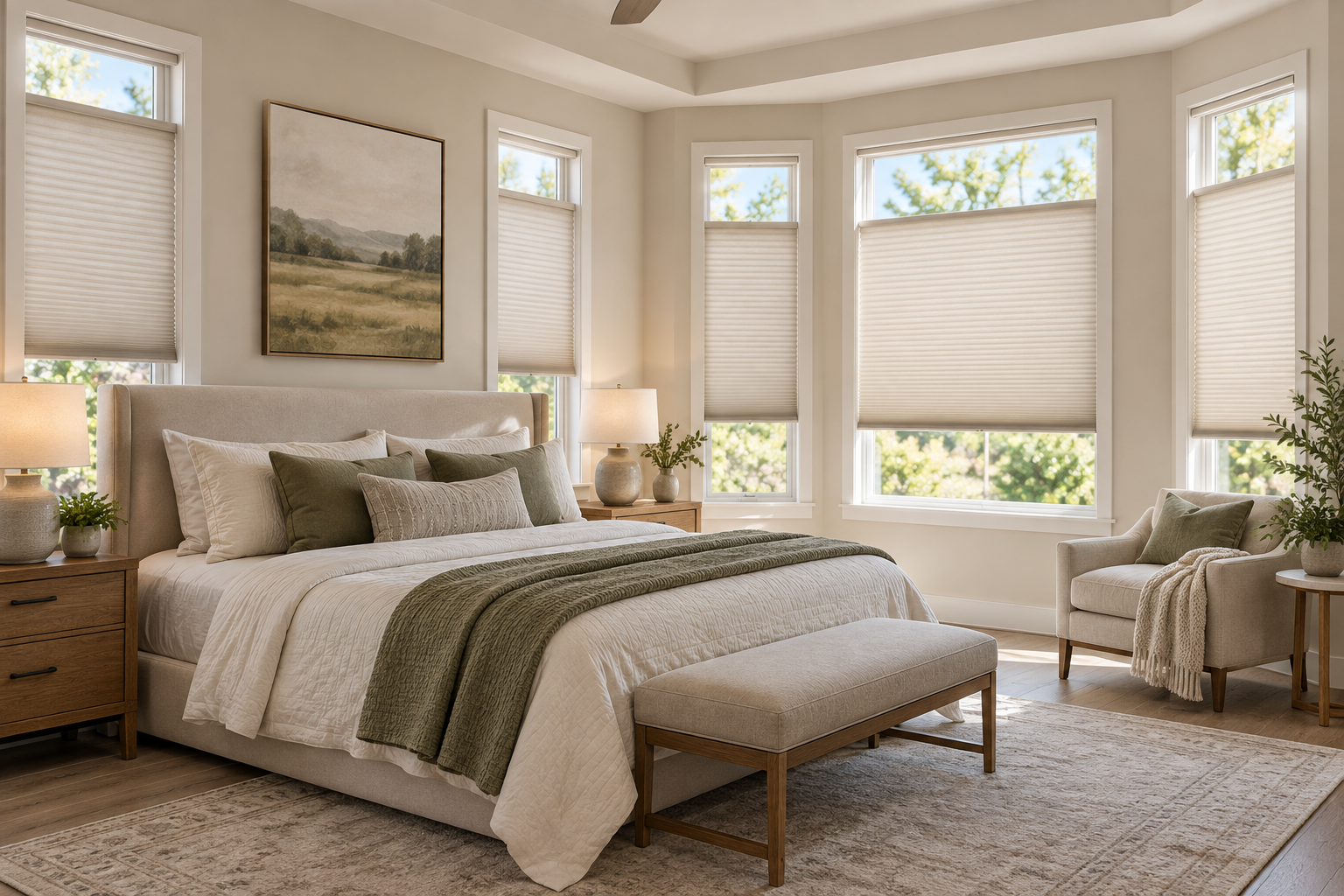
This guide walks through the most useful privacy and light-blocking upgrades, what problem each one solves, and which products offer them. If you're still deciding between light filtering, room darkening, and blackout, start with our privacy and light control guide. When you're ready to shop, browse our privacy shades and blinds.
Which Upgrade Solves Your Problem?
| The Problem | Upgrade That Fixes It | Available On |
|---|---|---|
| Pinpoints of light through the holes in blind slats | Decorative tapes or routeless slats | Wood, faux wood, and aluminum blinds |
| Light and visibility around the edges of a shade | Side channels or an outside mount | Select cellular shades; most products for outside mount |
| Fabric lets through too much light or shows silhouettes | Privacy liner or blackout liner | Woven wood and select Roman shades |
| Want daylight without giving up street-level privacy | Top down bottom up | Cellular, woven wood, and Roman shades |
| Need filtered light by day and darkness at night | Day/night (dual fabric) shades | Select cellular shades |
Upgrades for Horizontal Blinds
Horizontal blinds give you precise control by tilting the slats, but even fully closed blinds let light through small openings. These upgrades close those gaps.
Decorative Tapes
Standard blinds use thin cord ladders, with the lift cords running through a small hole (called a route hole) punched in each slat. Decorative tapes replace the cord ladders with wide fabric strips that cover those holes. They block the pinpoints of light that come through the slats and add a tailored, decorative look.
- Best for: Bedrooms and living rooms where you want a finished look and extra light blocking.
- Trade-off: Fabric tapes are harder to clean than standard cord ladders.
- Available on: wood blinds, faux wood blinds, and aluminum blinds.
Routeless Slats
Routeless blinds remove the route hole entirely. Instead of passing through the slat, the lift cord runs along the outside edge in a small notch. With no hole in the slat, more light is blocked when the blind is closed.
- Best for: Bedrooms and media rooms where you want the most light blocking from a blind.
- Bonus: Individual slats can be removed, which makes cleaning easier.
- Trade-off: Because the slats are removable and the cords run on the outside, routeless blinds are not recommended for homes with small children or pets, or for door-mounted blinds. For child-safe options, see our guide to safety upgrades for blinds and shades.
- Available on: Wood and faux wood blinds.
Upgrades for Window Shades
With fabric shades, privacy and light blocking depend on two things: the fabric itself and how well the shade covers the window opening. These upgrades improve both.
Privacy Liner and Blackout Liner
A liner is an extra layer of fabric attached to the back (street side) of a shade. It's most useful on natural and decorative fabrics that don't provide full privacy on their own, like woven wood and some Roman shade fabrics. Liners come in two grades:
- Privacy liner: Blocks most light and provides complete privacy, while still letting a soft glow through.
- Blackout liner: Blocks light through the fabric and provides complete privacy. Best for bedrooms, nurseries, and media rooms.
Liners add some weight to the shade. They're available on bamboo and woven wood shades, and a blackout liner is available on select Roman shades.
Side Channels
An inside-mounted shade needs a small clearance on each side to operate, and that's where light and outside views sneak in. Side channels are narrow tracks mounted along the window frame that cover those edges. Paired with a blackout fabric, they create the darkest result you can get from a shade. See our shades with side channels.
Top Down Bottom Up
Top down bottom up shades can be lowered from the top or raised from the bottom. Lowering the shade from the top lets daylight in through the upper part of the window while the lower part stays covered from street-level views. That makes it a strong choice for bathrooms, bedrooms, and street-facing rooms.
- Trade-off: There's an extra rail between the headrail and the top of the shade, and some cords are visible when the shade is lowered from the top.
- Available on: cellular shades, woven wood shades, and Roman shades.
Learn more in our top down bottom up guides.
Day/Night Shades
Day/night shades combine a light filtering fabric and a blackout fabric in one shade. Use the light filtering side during the day for softened light and privacy, and the blackout side at night or for sleeping. They're a good fit for bedrooms and nurseries where needs change through the day.
Mounting: The Free Upgrade
How you mount a blind or shade affects privacy as much as any add-on. An inside mount looks clean but leaves small gaps at the edges. An outside mount overlaps the window frame, covering those gaps and blocking more light. If light gaps are your main concern and you don't want side channels, measure for an outside mount that extends past the frame on each side. Our guide to inside mount vs outside mount blackout shades explains the difference, and our measuring instructions cover both mount types.
Combining Upgrades for the Best Result
The biggest improvements usually come from combining a fabric or slat upgrade with a coverage upgrade:
- Darkest bedroom: Blackout shades with side channels, or blackout fabric with an outside mount.
- Private bathroom with daylight: Top down bottom up cellular shade in a light filtering fabric.
- Light-blocking blinds: Faux wood or wood blinds with routeless slats or decorative tapes, outside mounted.
- Natural look with full privacy: Woven wood shade with a privacy or blackout liner.
Not sure which combination fits your windows? Order free samples to test fabrics in your space, or contact our design team for free help.
Related Privacy & Light Control Guides
- Light Filtering vs Room Darkening vs Blackout
- Do Light Filtering Shades Provide Privacy?
- Do Blinds Provide Privacy at Night?
- Privacy & Light Control Resource Center
Privacy & Light-Blocking Upgrade FAQs
How do I stop light from coming through the holes in my blinds?
Choose decorative tapes, which cover the route holes with fabric strips, or routeless slats, which remove the holes entirely. Both are available on wood and faux wood blinds, and decorative tapes are also available on aluminum blinds.
How do I block light coming in around the edges of my shades?
Add side channels, which cover the gaps along each side of an inside-mounted shade, or choose an outside mount that overlaps the window frame. For the darkest result, combine either option with a blackout fabric.
What is the difference between a privacy liner and a blackout liner?
Both provide complete privacy. A privacy liner blocks most light but still lets a soft glow through, while a blackout liner blocks light through the fabric for a darker room. Choose a privacy liner for living spaces and a blackout liner for bedrooms and media rooms.
Are routeless blinds worth it?
Routeless blinds block more light than standard blinds and are easier to clean because the slats can be removed. They're worth it for bedrooms and media rooms, but they are not recommended for homes with small children or pets, or for door-mounted blinds.
Can I add a liner to shades I already own?
Liners are built into the shade when it's made, so it's best to choose one when you order. If you already have shades that let in too much light, contact our design team to talk through your options.
Can one shade give me both filtered light and blackout?
Yes. Day/night shades combine a light filtering fabric and a blackout fabric in a single shade, so you can switch between softened daylight and full darkness without a second window treatment.
Which upgrade gives the most privacy while still letting in daylight?
Top down bottom up. Lowering the shade from the top lets light in through the upper part of the window while keeping the lower part covered from street-level views.