









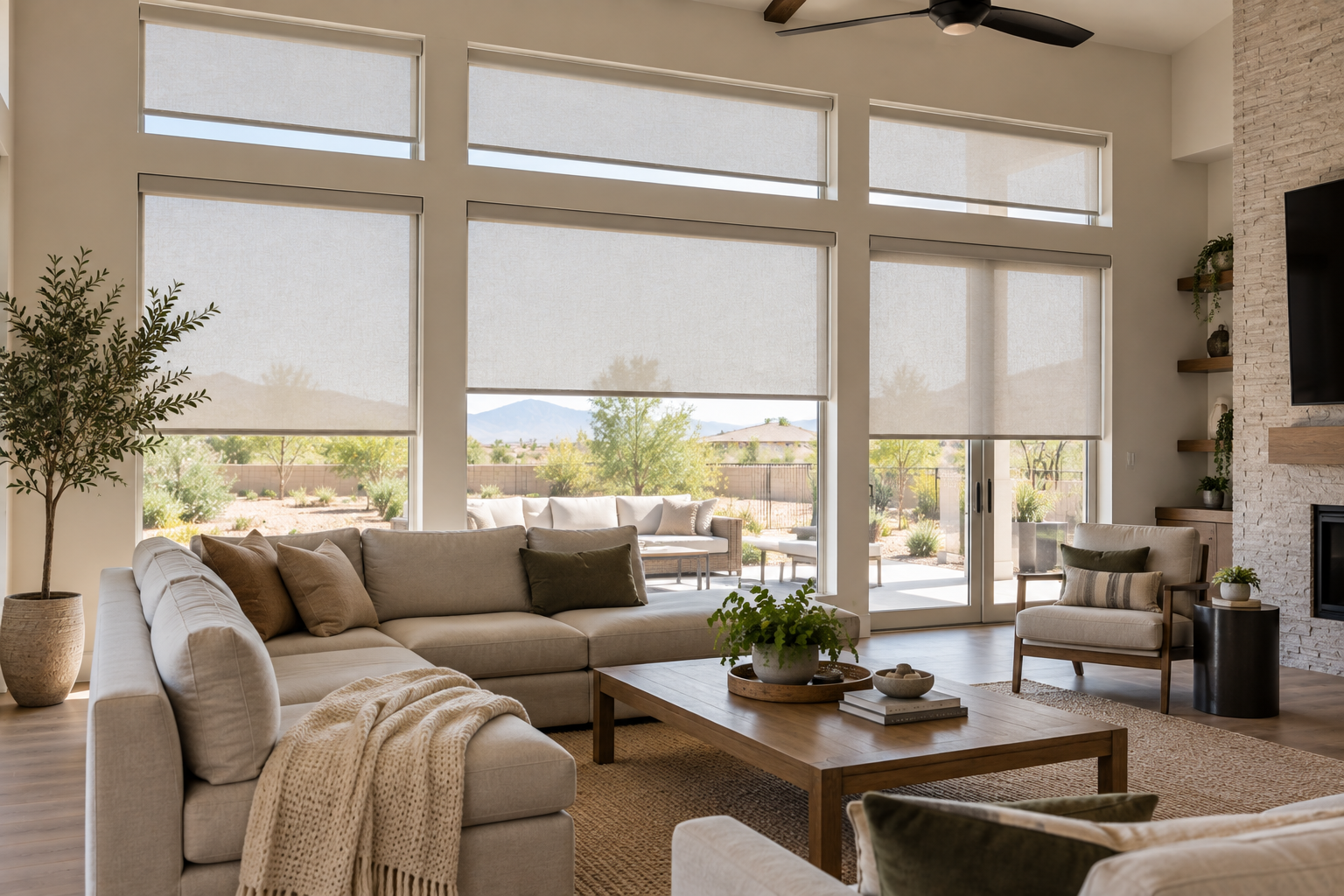
What Is a Transom Window?
A transom window is a smaller window positioned above a door or another window, traditionally used to bring in extra light and, in older homes, additional ventilation. Transoms come in several shapes, rectangular being the most common, with arched, fan-shaped, and other decorative profiles appearing in older or more architecturally detailed homes. Transoms are easy to confuse with sidelights, the narrow windows positioned beside a door rather than above it; if that's what you're covering instead, our sidelight blinds and shades collection is built specifically for that shape.
Should You Cover a Transom Window at All?
Plenty of transoms are left uncovered, and that's a reasonable choice when privacy isn't a concern and the window doesn't create a glare or heat problem in the room. Covering becomes worth considering when an uncovered transom lets in more heat or cold than you'd like, creates glare in a media room or home office, or when the room below needs more complete privacy than the main window treatment alone provides, such as a bedroom or bathroom with a transom above the door.
Best Options for Transom Windows
Cellular or Pleated Shades
Custom-shaped cellular and pleated shades are one of the most popular treatments for transoms because they can be manufactured to fit rectangular, arched, or other shaped openings while adding a small amount of insulation. Most fixed transom shades in this category are light-filtering or room-darkening rather than fully operable, since the shape and height often make daily adjustment impractical.
Wood or Faux Wood Blinds
For rectangular transoms mounted above a window that already uses wood or faux wood blinds, matching blinds on the transom create a cohesive, coordinated look. This works best on straightforward rectangular shapes; arched or irregular transoms generally aren't a fit for standard slat blinds.
Shutters
Shutters offer the most built-in, architectural appearance of any transom option, and they're often able to cover an arched or shaped transom as a single custom unit rather than a series of smaller pieces. This tends to be the higher-cost option, but it's a strong choice when the transom is a visible architectural feature you want the treatment to complement rather than hide.
Motorized Shades
Transoms are frequently mounted higher than a person can comfortably reach, especially above tall doors or in rooms with high ceilings. Motorization solves the reachability problem directly and is worth considering any time a transom shade needs to be operable but isn't within easy arm's reach.
Fixed vs. Operable Transom Treatments
Many transom shades, particularly custom arched or shaped versions, are built as fixed treatments that don't raise or lower, only providing a constant level of light filtering or room darkening. This keeps costs down and works well when the transom's job is simply to soften or block light consistently. If you want the ability to fully open the transom at times and cover it at others, you'll need an operable option, typically a rectangular shade or blind, or a motorized shade if reach is a concern.
Matching Your Transom to the Window or Door Below
A transom is almost always seen alongside the door or window beneath it, so coordinating color, material, and finish between the two makes a noticeably more finished impression than treating the transom as a separate decision. This doesn't necessarily mean using the identical product on both — our guide on whether window treatments should match throughout your home covers how to coordinate without needing an exact match everywhere in the house, and the same logic applies at the scale of a single doorway.
Measuring and Mounting Considerations
Rectangular transoms generally follow standard measuring practices, similar to any other window in the room. Arched, angled, or otherwise irregularly shaped transoms typically require a template to measure accurately, since standard tape-measure dimensions can't fully capture an irregular curve. If your transom isn't a simple rectangle, it's worth having one of our design consultants walk through the measuring process with you rather than guessing at the shape on your own. Our general measuring guide covers standard rectangular openings if that applies to your transom.
Comparing Transom Window Treatment Options
| Option | Works on arched shapes | Typically fixed or operable | Best for |
|---|---|---|---|
| Cellular or pleated shades | Yes | Usually fixed | Most transom shapes, added light control with some insulation |
| Wood or faux wood blinds | No, rectangular only | Operable | Matching a rectangular transom to blinds used below |
| Shutters | Yes | Often fixed for the arched portion | A built-in, architectural look for a visible transom |
| Motorized shades | Depends on the base product | Operable | Transoms mounted out of comfortable reach |
Availability of fixed versus operable options and exact shape compatibility varies by product line, so check the individual product specifications for the shape and configuration you need.
Common Mistakes
Choosing Full Blackout for a Purely Decorative Transom
If the transom's main job is adding architectural light and character, a heavy blackout treatment can defeat the purpose of having the window at all. Light-filtering options usually make more sense unless there's a specific glare or privacy reason to go darker.
Ignoring Reach When Choosing an Operable Product
Ordering an operable shade for a transom you can't comfortably reach means it likely won't get used as intended. If reach is a concern, plan for a fixed shade or motorization from the start rather than after installation.
Mismatching Finish From the Window or Door Below
A transom in a noticeably different color or material from the treatment below it tends to look like an afterthought rather than a coordinated design choice.
Guessing at Irregular Shapes Instead of Templating
Estimating an arched or curved transom's dimensions without a proper template is one of the most common causes of a poor fit on non-rectangular transoms.
When Not to Cover a Transom
- If the transom is a protected or notable architectural detail in a historic home, and privacy or light isn't actually a problem, leaving it uncovered may be the better choice.
- If the transom is high enough that neither a fixed nor motorized option is practical for your budget, and it isn't causing a glare or privacy issue, it's reasonable to leave it as is for now.
- If light control is already handled by the window or door below, a transom that isn't independently causing a problem may not need its own separate treatment.
Our Take on Transom Window Treatments
Blinds Chalet has been helping homeowners find treatments for standard and specialty-shaped windows since 2006, and transoms are one of the situations where we most often recommend a fixed shade over an operable one, simply because the window's height and shape usually make daily adjustment more trouble than it's worth. Our advice is to start with whether the transom is actually causing a light, heat, or privacy problem, and let that answer, along with the window's shape, guide the product choice rather than defaulting to whatever's already on the window below it.
Related Guides
- Specialty Window Treatments Guides
- Best Window Treatments for Arch Windows
- Best Window Treatments for Bay Windows
- Best Blinds for Tall Windows
- Should Window Treatments Match Throughout Your Home?
- Blinds for Hard to Reach Windows
- Shop Sidelight Blinds and Shades
- Best Window Coverings for Garage Windows
Frequently Asked Questions
What's the best window treatment for a transom window?
A custom-shaped cellular or pleated shade is generally the most popular option, since it fits both rectangular and arched transoms while adding some insulation. Shutters are a good alternative for a more built-in, architectural look.
Can transom shades be opened and closed?
Many transom shades, especially arched or irregularly shaped ones, are built as fixed treatments that provide a constant level of light filtering rather than raising and lowering. Rectangular transoms have more operable options available.
Do I need a template to measure an arched transom window?
Yes, arched or irregularly shaped transoms typically require a template rather than standard tape-measure dimensions to get an accurate fit. Rectangular transoms can usually be measured the same way as a standard window.
Should my transom shade match the window or door below it?
Coordinating color, material, and finish between the transom and the treatment below it generally looks more intentional than treating them as separate decisions, though they don't need to be the exact same product.
Do all transom windows need to be covered?
No. If a transom isn't causing a privacy, glare, or heat problem, and it's a feature you want to keep visible, it's reasonable to leave it uncovered.