










See How No-Drill Blinds and Shades Work
Before deciding whether no-drill installation is right for your windows, it helps to understand how the different systems work. This video explains what no-drill blinds and shades are, how they stay in place, and the different mounting systems available.
How Can Blinds Stay Up Without Screws?
No-drill blinds stay in place by replacing the holding force normally provided by screws and brackets with another mounting method.
| Mounting System | What Holds It in Place | Where the Force Is Applied |
|---|---|---|
| Integrated Tension | Adjustable mechanical pressure | Between opposite sides of the window opening |
| Lever-Lock Tension Rail | Expandable mounting rail locked under pressure | Between opposite sides of the window opening |
| Twist-to-Fit Tension | Threaded or rotating expansion mechanism | Between opposite sides of the window opening |
| Adhesive | Bond between adhesive and mounting surface | On the mounting surface itself |
| Magnetic | Magnetic attraction | Against a compatible steel surface |
How Do Tension-Fit No-Drill Blinds Work?
Tension-fit blinds work on a similar basic principle to other pressure-fit products: the mounting assembly becomes slightly wider than its relaxed position and presses against two opposing surfaces.
For blinds and shades, those opposing surfaces are normally the left and right sides of an inside-mount window opening.
As the mechanism is tightened, padded or protective end pieces press against the jamb. Friction between those contact points and the mounting surface helps hold the headrail in position.
The Fit Matters
The system must be designed for the measured opening. If a product is outside its allowable width range or the window does not provide an appropriate surface for the end pieces to contact, the mounting mechanism may not function as intended.
This is why measuring a no-drill blind correctly is just as important as measuring a traditionally installed blind. Learn more how to measure for no-drill window treatments
How Does an Integrated Tension Headrail Work?
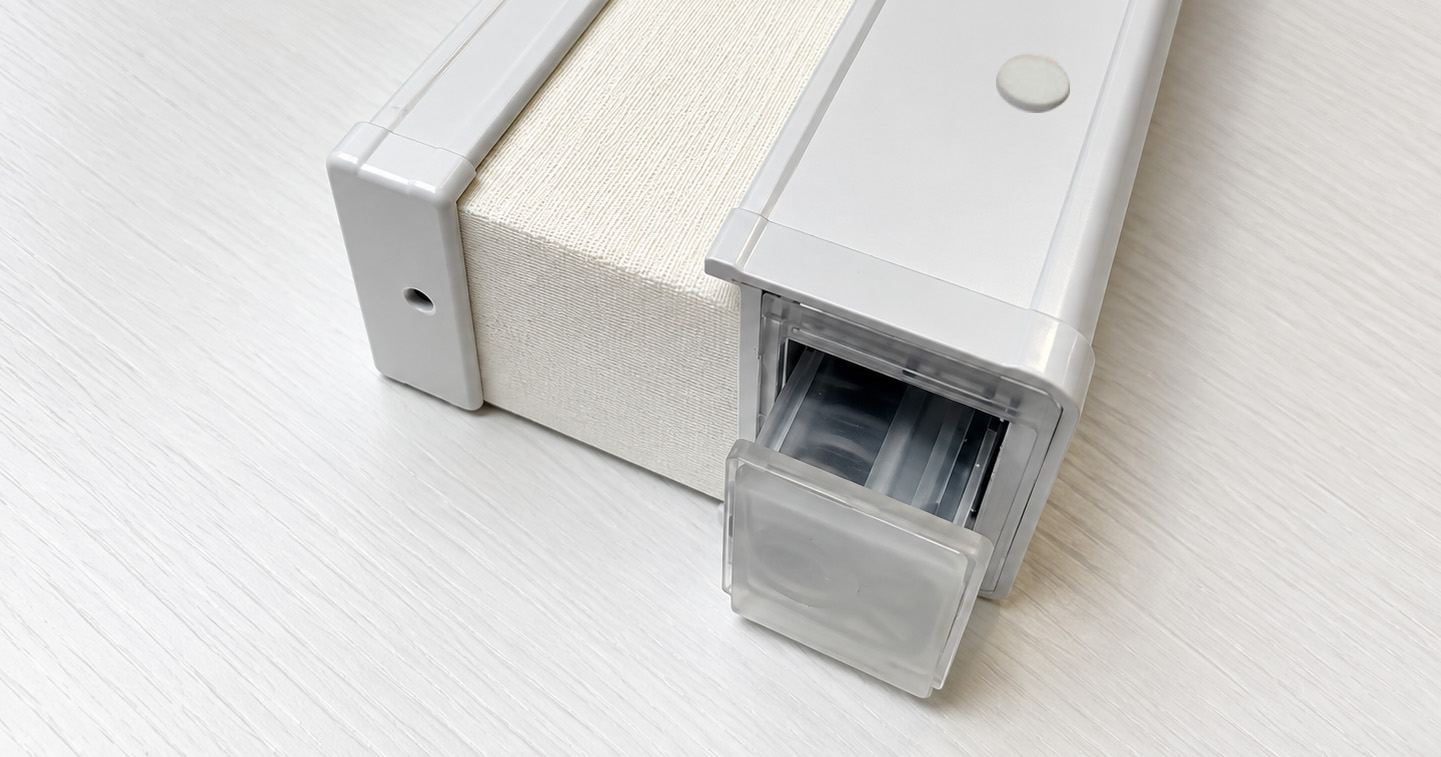
With an integrated tension system, the expanding mechanism is built directly into the blind or shade headrail.
After the treatment is positioned in the window opening, the tension device is adjusted outward until the ends of the headrail press firmly against the jamb.
On systems offered through Blinds Chalet, the tension can be adjusted using an Allen wrench. This allows the installer to gradually increase the holding pressure while keeping the main adjustment mechanism inside the headrail.
Why Integrating the Mechanism Matters
Traditional no-drill tension systems sometimes add a mounting rail and then attach the actual shade to that rail. An integrated design combines those functions.
The result is fewer visible layers of hardware.
Sliding Covers on Select Horizontal Blinds
Some horizontal blind designs go one step further by providing a cover that slides over the tension-adjustment area after installation.
Once the Allen-wrench adjustment is complete, the opening can be concealed, giving the headrail a cleaner finished appearance.
How Does a Lever-Lock No-Drill Headrail Work?
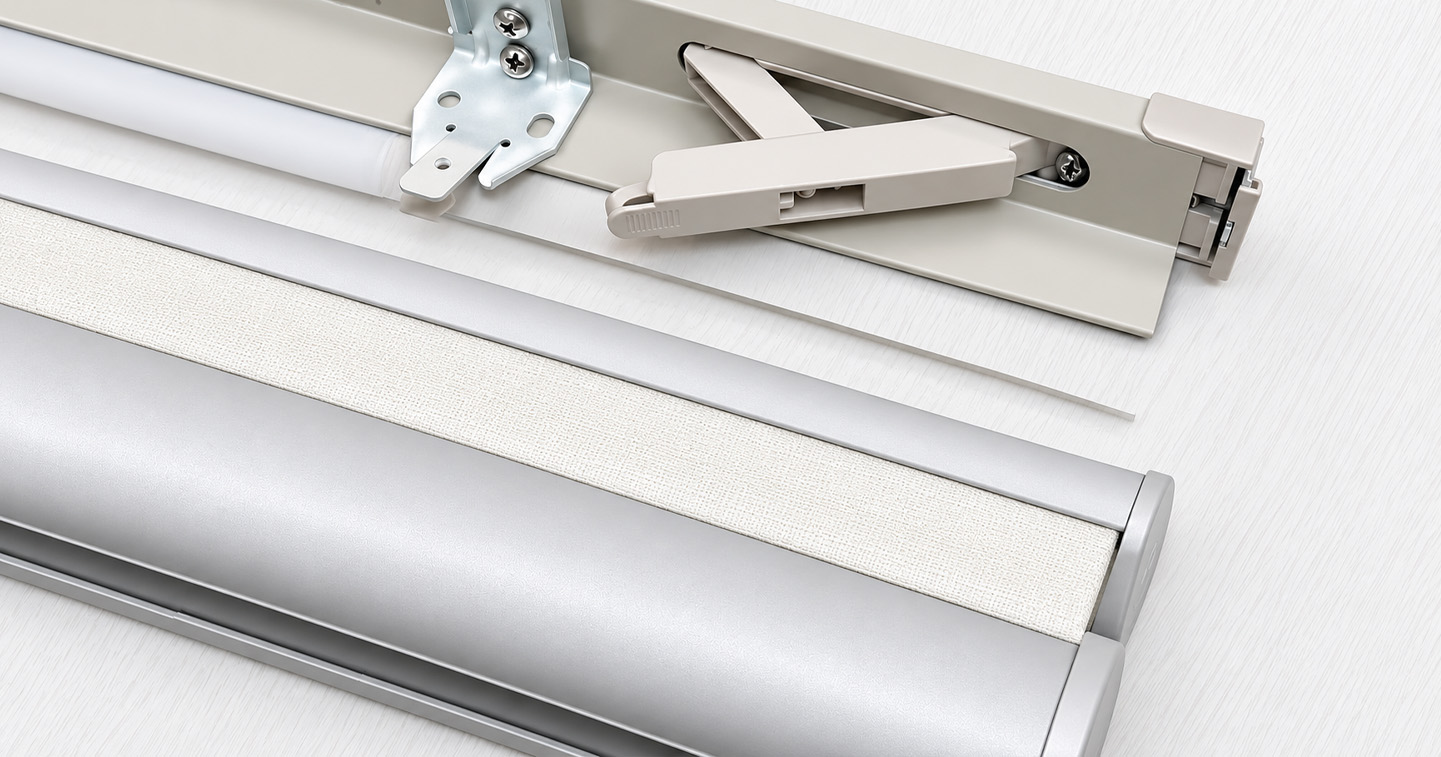
A lever-based system separates the no-drill mounting assembly from the blind or shade itself.
First, the tension headrail is positioned within the window opening. The mounting rail is expanded so its ends contact the left and right jambs.
A lever is then compressed or locked, maintaining pressure against the opening.
After the no-drill rail is secure, the blind or shade is attached to the brackets or hardware on that mounting rail.
Why Is the Extra Headrail Visible?
Because the pressure rail and window treatment are separate components, the finished installation effectively has two layers: the no-drill mounting rail and the blind or shade attached to it.
This approach can work well mechanically, but the additional rail may be visible above or behind the treatment and may increase the amount of projection into the room.
Integrated Tension vs. Separate Tension Headrail
| Feature | Integrated Tension Headrail | Separate Lever-Lock Headrail |
|---|---|---|
| Number of Main Rail Components | One integrated treatment/headrail assembly | Separate mounting rail plus the treatment |
| How Pressure Is Adjusted | Allen wrench or integrated adjustment mechanism | Expandable rail and locking lever |
| Visible Additional Hardware | Minimal | Separate mounting headrail may remain visible |
| Finished Profile | Generally cleaner and more compact | Can be somewhat bulkier |
| Requires Drilling | No | No |
| Typical Mount | Inside mount | Inside mount |
For our recommendations on which approach we prefer and why, see Best No-Drill Blinds and Shades.
How Do Twist-to-Fit No-Drill Blinds Work?
Twist-fit designs are another form of mechanical tension mounting.
Instead of tightening with an Allen wrench or locking a lever, the installer rotates an adjustment component. The threaded mechanism gradually extends the rail or end pieces outward until sufficient pressure is created against the window opening.
The basic principle is therefore similar to other tension systems even though the adjustment method is different.
How Do Peel-and-Stick No-Drill Shades Work?
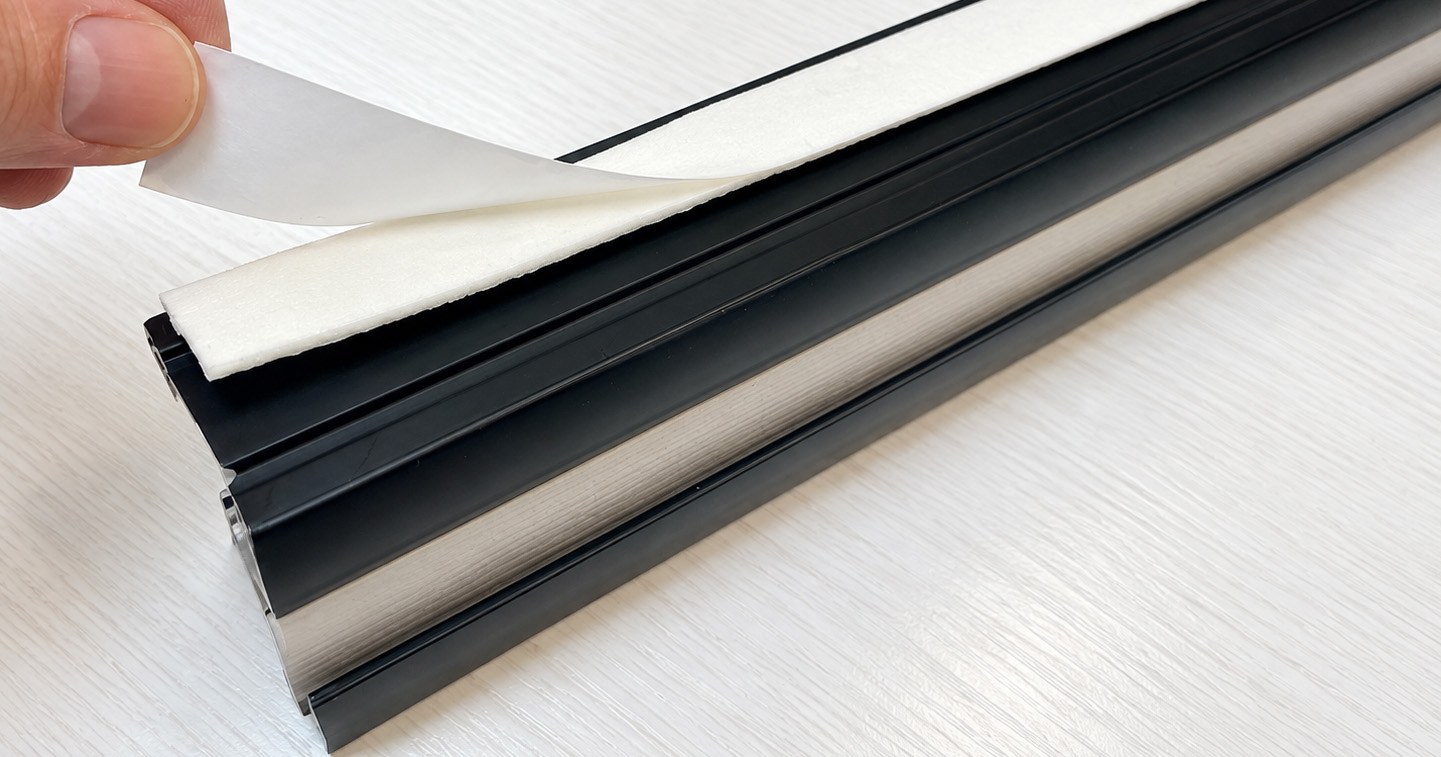
Adhesive no-drill products do not create pressure between the sides of the window opening.
Instead, an adhesive strip or adhesive-backed bracket is attached directly to a compatible mounting surface. The weight and operation of the treatment are then supported by the bond between the adhesive and that surface.
Surface Preparation Is Important
Dust, grease, loose paint, texture or an incompatible finish can reduce adhesion. Installation instructions may require the mounting area to be cleaned and allowed to dry before the adhesive is applied.
Why We Consider Adhesive More Temporary
Adhesive systems can be inexpensive and extremely convenient, but the mounting bond is more dependent on environmental and surface conditions than a mechanical tension system.
Heat, humidity, treatment weight, surface condition and the adhesive itself can influence long-term performance.
For that reason, we tend to view peel-and-stick products as especially useful for temporary, lightweight or budget-oriented applications rather than automatically treating them as equivalent to a mechanical custom tension system.
How Do Magnetic No-Drill Blinds Work?
Magnetic mounting systems rely on magnetic attraction between the mounting hardware and a compatible metal surface.
No tension between the window jambs is required and no adhesive bond has to support the treatment.
The limitation is compatibility. A magnet must be able to attach securely to the door or frame. Steel may work, while materials such as wood, vinyl and aluminum generally do not provide the necessary magnetic surface.
How to Check
Place a household magnet against the intended mounting area. If it attaches firmly, the surface may be suitable for a compatible magnetic product. Always confirm the exact product requirements before ordering.
Does Tension Damage the Window Frame?
A properly designed tension system distributes its mounting force through the designated end-contact areas instead of through drilled screws.
That does not mean every surface is appropriate. The jamb needs to be solid enough to accept the pressure and should meet the manufacturer's requirements.
Fragile finishes, damaged trim, loose surfaces or unusual window construction should be evaluated before installation.
The goal is enough tension to secure the blind or shade—not excessive force beyond the installation instructions.
Why Accurate Measuring Matters More With Tension-Fit Blinds
Traditional mounting brackets give installers some ability to position hardware within the opening. A tension-fit system depends more directly on the relationship between the headrail and the exact opening width.
If the window is narrower at one point than another, that difference can matter.
Measure the Width in Multiple Places
Follow the measuring instructions for the exact product. Inside-mount windows are commonly checked near the top, middle and bottom because window openings are not always perfectly square.
Measure Where the Tension System Will Actually Sit
The most important width is the opening where the no-drill headrail will contact the jamb. Decorative trim or changes in the opening farther down may not represent the available width at the headrail.
See our How to Measure for Blinds and Shades guide, and always follow the product-specific no-drill measuring instructions before ordering.
How Much Window Depth Do No-Drill Blinds Need?
No-drill does not mean no mounting space.
The headrail, tension assembly, end caps and treatment all occupy physical space inside the window opening.
Every product has its own minimum depth requirement. A fully recessed appearance may require even more depth than the minimum necessary to install the product.
Check for Obstructions
Window cranks, locks, handles, screens and projecting trim can interfere with the blind even when there is enough nominal depth for the headrail.
Do Window Openings Have to Be Perfectly Square?
They do not necessarily need to be mathematically perfect, but tension-fit systems work best when the mounting area provides suitable opposing surfaces.
Substantial taper, irregular trim or uneven mounting surfaces can make a pressure-fit installation more difficult.
Measure carefully and verify the requirements of the exact no-drill product if your opening is noticeably out of square.
How Do You Remove No-Drill Blinds?
Removal depends on the mounting system.
Integrated Tension Systems
Release or loosen the tension mechanism according to the manufacturer's instructions until the pressure against the jamb is reduced enough to remove the treatment.
Lever-Lock Systems
Remove the shade from the mounting rail as required, release the locking lever and then reduce the pressure so the mounting headrail can be removed.
Twist-Fit Systems
Rotate the adjustment in the opposite direction to retract the expanding mechanism.
Adhesive Systems
Follow the adhesive manufacturer's removal method carefully. Pulling an adhesive mount away incorrectly may damage paint or leave residue.
Magnetic Systems
The treatment or magnetic brackets can generally be pulled away from the compatible metal surface.
Can No-Drill Blinds Be Repositioned?
Mechanical tension systems are generally more suitable for removal and repositioning than adhesive systems because their mounting force can be released and reapplied.
Whether an adhesive mount can be reused depends on the product and adhesive system. A replacement adhesive strip may be required.
Magnetic products are particularly easy to reposition when used on a compatible surface.
How Does the Weight of the Shade Affect No-Drill Installation?
Every mounting system has limits.
A larger blind or shade puts more load on the mounting system, particularly during operation. Raising, lowering or tilting a treatment can create forces beyond the product's static weight.
This is why no-drill compatibility may be available for a smaller size of a product but unavailable once the window exceeds certain dimensions.
Never assume that a no-drill mounting system can support an oversized treatment simply by increasing the tension or adding more adhesive.
Can Motorized Shades Use No-Drill Mounting?
Select products may combine no-drill installation with motorization, but availability depends on the treatment and mounting system.
Motorized treatments can weigh more because of the motor, battery and related hardware, so product-specific size and weight limits become particularly important.
Verify that both the selected shade and motorized configuration qualify for the no-drill option before ordering.
How Does No-Drill Installation Affect Blackout Performance?
The mounting mechanism itself does not determine whether a fabric is blackout. A blackout shade can still use a compatible no-drill system.
However, most mechanical tension systems are inside mounted, and inside-mounted shades normally require some clearance between the fabric and window opening.
That clearance can allow light around the sides even when the fabric itself is blackout.
If maximum room darkness is more important than avoiding screw holes, compare the no-drill option with outside-mount or specialty light-blocking systems before ordering.
Why Are No-Drill Blinds Popular With Renters?
Traditional blind installation normally requires mounting screws. No-drill systems can avoid those holes, which can be attractive in rental properties.
Tension systems also make it possible to install a more substantial custom shade without depending entirely on a disposable temporary treatment.
Renters should still check lease requirements and consider whether the mounting method could affect paint, trim or other finishes.
How the No-Drill Systems Compare
| System | Requires Opposing Jambs | Uses Adhesive | Requires Magnetic Surface | Easily Removable |
|---|---|---|---|---|
| Integrated Tension | Yes | No | No | Generally yes |
| Lever-Lock Tension | Yes | Usually primarily mechanical; follow product instructions | No | Generally yes |
| Twist-Fit Tension | Yes | No in a typical mechanical system | No | Generally yes |
| Peel-and-Stick | No | Yes | No | Depends on adhesive and surface |
| Magnetic | No | No | Yes | Yes |
Which No-Drill System Should You Choose?
The answer depends on whether your priorities are appearance, ease of installation, price, removability or compatibility with a particular window.
For a long-term custom installation, we generally prefer a mechanical tension-based system when the window and product support it. Within that category, an integrated tension headrail provides an especially clean appearance because the mounting system is incorporated into the treatment itself.
For our complete ranking and buying recommendations, read Best No-Drill Blinds and Shades.
Related Article: How to Know if No-Drill Blinds or Shades are the Right Option?
Shop No-Drill Blinds and Shades
Blinds Chalet offers select custom window treatments with no-drill installation options. The exact mounting system and availability depend on the product, dimensions and configuration selected.
Browse our no-drill blinds and shades to see current product options.
You can also compare our complete selections of custom blinds and custom shades.
Expert Guidance from Blinds Chalet
Blinds Chalet has helped homeowners measure and install custom window treatments since 2006. No-drill mounting has improved significantly from the inexpensive temporary shades many homeowners first associate with the term.
Modern mechanical tension systems can support custom window treatments without drilling by applying controlled pressure between the sides of a suitable window opening.
We have experience with both integrated tension systems and designs that use a separate lever-lock mounting rail. Both eliminate traditional mounting screws, but they are noticeably different after installation.
Our preference is generally the integrated design when available because the tension mechanism is built into the treatment itself. The system can be tightened with an Allen wrench, and on some horizontal blinds a sliding cover conceals the adjustment area once installation is complete.
The most important factor is still compatibility. A no-drill system needs the correct window dimensions, mounting depth and product configuration to work properly.
Related Guides
- Best No-Drill Blinds and Shades
- Shop No-Drill Blinds and Shades
- Best Applications for Toolless Blinds or Shades
- Do N-Drill Blinds and Shades Really Stay Up?
- How to Measure for Blinds and Shades
- Custom Window Blinds
- Custom Window Shades
- Cellular Shades
- Roller Shades
- Solar Shades
How No-Drill Blinds Work FAQs
How do no-drill blinds stay up?
Mechanical no-drill blinds typically use adjustable tension against opposite sides of an inside-mount window opening. Other systems may use adhesive or magnets. The exact method depends on the product.
How does a tension-fit blind work?
A tension-fit blind uses an expanding mechanism to press padded or protective ends of the headrail or mounting rail against opposite sides of the window opening. That pressure and friction hold the treatment in position without traditional mounting screws.
How does an integrated no-drill headrail work?
The tension mechanism is built into the blind or shade headrail. On systems offered by Blinds Chalet, an Allen wrench is used to adjust the tension outward against the window jamb until the treatment is securely held in position.
How does a lever-lock no-drill headrail work?
A separate mounting rail is expanded against the sides of the window opening and a lever is locked to maintain pressure. The blind or shade is then attached to that mounting rail.
Do no-drill blinds need an inside mount?
Most mechanical tension-fit no-drill systems require an inside-mount style opening because they need opposing surfaces to press against. Adhesive and magnetic systems can have different mounting requirements.
Do no-drill blinds damage window frames?
Properly installed tension systems avoid screw holes, but the mounting surface must still be suitable for the applied pressure. Fragile finishes, damaged trim and unusual window materials should be evaluated before installation.
How do adhesive no-drill shades work?
Adhesive shades use peel-and-stick strips or brackets that bond directly to a compatible mounting surface. Their performance depends on the surface condition, adhesive, treatment weight, installation and environmental conditions.
How do magnetic no-drill blinds work?
Magnetic blinds use magnets to attach the mounting hardware or treatment to a compatible steel surface. They are easy to install and remove but only work where the mounting surface is suitably magnetic.
Can no-drill blinds be removed and reinstalled?
Many mechanical tension and magnetic systems can be removed and repositioned. Adhesive systems may require replacement adhesive and should be removed according to the manufacturer's instructions.
Why does window depth matter for no-drill blinds?
The headrail and no-drill mounting mechanism still need enough physical room inside the window opening. Each product has minimum depth requirements, and additional depth may be needed for a fully recessed appearance.
Can motorized shades be installed without drilling?
Select products may support both motorization and no-drill installation. Availability depends on the product, dimensions, motor configuration and mounting-system weight limits.
Are no-drill blinds as secure as traditional blinds?
A correctly measured and installed no-drill system is designed to support the treatment within its stated limits. Traditional screw-mounted brackets may still be preferable for very large or heavy treatments or windows that are not compatible with tension mounting.
Which type of no-drill mounting system is best?
For a long-term custom installation, Blinds Chalet generally prefers a mechanical tension system when the window is compatible. An integrated tension headrail provides an especially clean appearance because the mounting mechanism is incorporated into the treatment itself.