







Learn how standard roll and reverse roll roller shades differ in fabric position, appearance, window clearance, light gaps and overall fit so you can choose the right configuration for your window.
When ordering roller shades, one small option can make a noticeable difference in how the finished shade looks and operates: standard roll versus reverse roll. Both styles use the same basic roller shade design, but the fabric comes off the roller in a different direction.
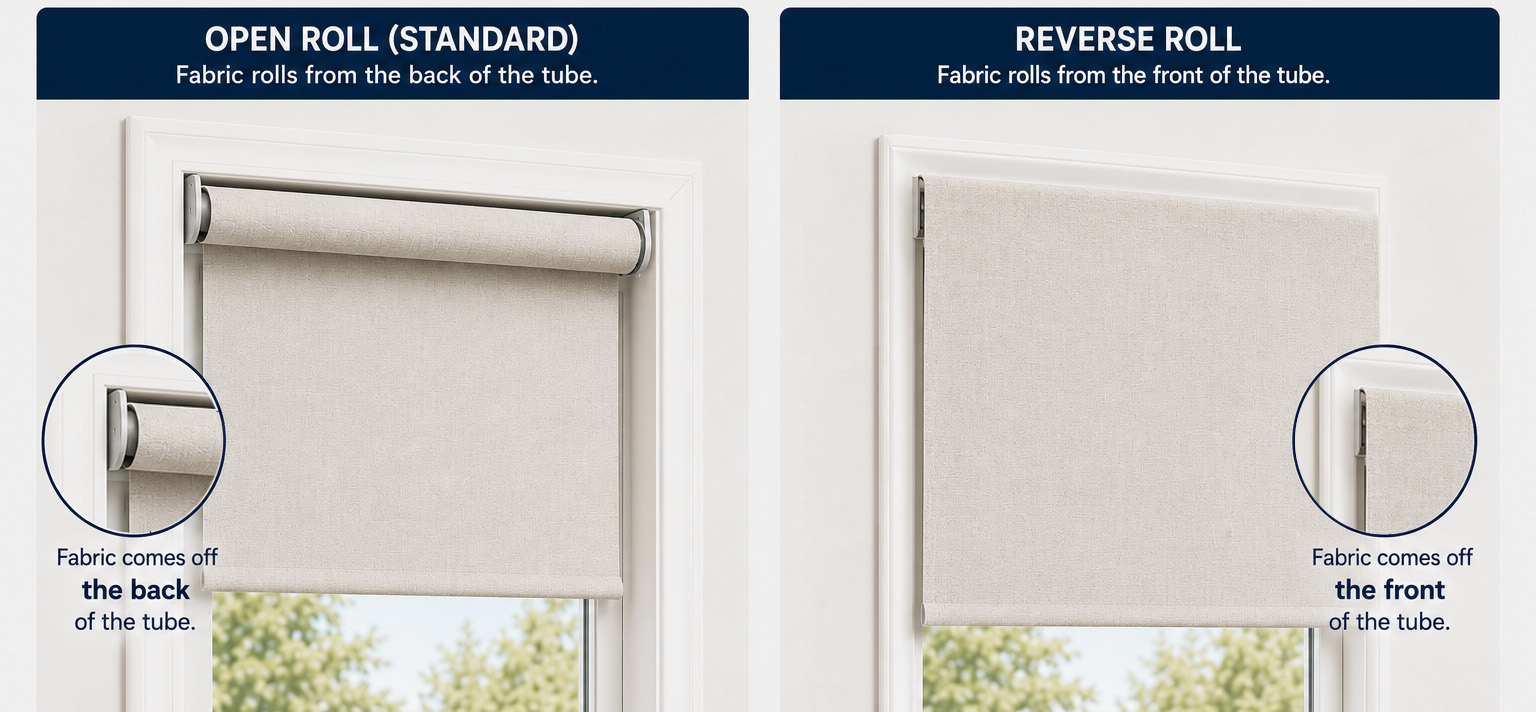
With a standard roll, the fabric typically drops from the back of the roller, closer to the window glass. With a reverse roll, the fabric comes off the front of the roller, placing it farther away from the glass and window frame.
Neither style is automatically better for every window. Standard roll is often preferred for a more traditional appearance and closer fit to the glass, while reverse roll can provide extra clearance around window handles, cranks or other obstructions.
If you are still comparing roller shade options, browse our custom roller shades, read our guide to choosing the right roller shades, or explore roller shade styles, custom options and fabrics.
What Is the Difference Between Standard Roll and Reverse Roll Roller Shades?
The difference is the direction the fabric rolls off the tube. On a standard roll shade, the fabric typically drops from the back of the roller, keeping it closer to the window. On a reverse roll shade, the fabric comes off the front of the roller, which moves the fabric farther into the room.
| Feature | Standard Roll | Reverse Roll |
|---|---|---|
| Fabric Position | Falls from the back of the roller | Falls from the front of the roller |
| Distance From Glass | Usually closer to the window | Usually farther from the window |
| Appearance | Traditional and streamlined | Cleaner front-facing roll appearance |
| Light Gaps | May help reduce light entering behind the fabric | Can create more space between the fabric and glass |
| Handle or Crank Clearance | More likely to encounter obstructions | Can provide additional clearance |
| Inside Mount | Often preferred when depth and clearance allow | Useful when hardware projects into the shade path |
| Outside Mount | Works well in many applications | Can create a distinctive forward-roll appearance |
What Is a Standard Roll Roller Shade?
A standard roll roller shade is configured so the fabric comes off the back of the roller tube and hangs closer to the window glass.
This is the configuration many homeowners picture when they think of a traditional roller shade. Because the fabric sits closer to the window, it can create a streamlined appearance and may help reduce the visible space between the shade and the glass.
Advantages of Standard Roll
- Keeps the fabric closer to the window.
- Creates a traditional roller shade appearance.
- Can help reduce the appearance of light entering behind the fabric.
- Works well when there are no major obstructions in the shade path.
- Often provides a clean fit for inside-mounted applications.
Potential Limitations of Standard Roll
- Window handles or cranks can interfere with the fabric.
- Deep trim or projecting hardware may push against the shade.
- The fabric may not clear certain architectural features.
What Is a Reverse Roll Roller Shade?
A reverse roll roller shade is configured so the fabric comes off the front of the roller tube rather than the back. This moves the shade farther away from the glass and projects the fabric slightly farther into the room.
The additional clearance can make reverse roll especially useful when the window has handles, cranks, trim or other obstructions that would interfere with a standard roll shade.
Advantages of Reverse Roll
- Provides additional clearance around window hardware.
- Can help the fabric clear handles, locks and projecting trim.
- Creates a clean front-facing roll appearance.
- Can be useful for certain outside-mount applications.
- May allow the shade to operate more freely when the window area is crowded.
Potential Limitations of Reverse Roll
- The fabric sits farther from the glass.
- The additional space can increase visible light around or behind the shade.
- It may not be the best choice when maximum room darkening is the priority.
Which Looks Better: Standard Roll or Reverse Roll?
Appearance is subjective, but the two configurations create noticeably different looks.
Standard Roll Appearance
Standard roll creates a more traditional roller shade profile because the fabric drops from the rear of the tube. The roll itself is often less visually prominent from inside the room, especially when the shade is mounted high in the opening.
Reverse Roll Appearance
Reverse roll exposes the front side of the fabric roll more directly. Some homeowners prefer this because the shade appears to roll cleanly forward without the fabric wrapping behind the tube.
If aesthetics are a major factor, you may also want to review our roller shade styles, fabrics and custom design options.
Which Is Better for Window Handles and Cranks?
Reverse roll is often the better option when window hardware projects into the path of the shade.
Because the fabric sits farther away from the glass, reverse roll can provide extra clearance around casement window handles, crank mechanisms, locks, trim or other obstructions.
Choose Reverse Roll When
- A handle projects several inches from the window.
- A crank would rub against standard roll fabric.
- The shade needs to clear deep or decorative trim.
- You want additional distance between the fabric and glass.
Choose Standard Roll When
- The window has no projecting hardware.
- You want the shade to sit closer to the glass.
- You prefer a more traditional roller configuration.
- Reducing light around the window is more important than extra clearance.
Does Roll Direction Affect Light Gaps?
Yes. Roll direction can affect how close the fabric sits to the glass, which can influence how much light is visible around or behind the treatment.
Standard roll usually places the fabric closer to the window, which can help reduce the amount of light visible behind the shade.
Reverse roll places the fabric farther into the room. That extra space can make light entering around the edges or behind the fabric more noticeable, especially in a room-darkening or blackout application.
Blackout Considerations
If maximum room darkening is your priority, standard roll is often the better starting point when window hardware does not interfere with the shade.
However, roll direction is only one part of blackout performance. Mounting style, side gaps, shade width and the surrounding window construction also affect the finished result.
Standard Roll vs Reverse Roll for Inside Mount
Both roll types can be used for inside-mounted roller shades, but the available window depth and hardware clearance should be checked carefully.
Standard Roll Inside Mount
Standard roll is often preferred when the opening has adequate depth and no hardware interferes with the fabric. The shade remains closer to the glass and typically creates a recessed, streamlined appearance.
Reverse Roll Inside Mount
Reverse roll can be useful when handles or cranks extend toward the room. By moving the fabric forward, the shade may clear those obstructions more easily.
The tradeoff is that the fabric sits farther away from the glass, which can increase visible light gaps.
Standard Roll vs Reverse Roll for Outside Mount
Outside-mounted roller shades provide more flexibility because the roller can be positioned above or beyond the window opening.
Standard Roll Outside Mount
Standard roll allows the fabric to fall closer to the wall or window surface, which can help improve coverage around the opening.
Reverse Roll Outside Mount
Reverse roll brings the fabric farther into the room and can create a more visible front-facing roll. It may also help the fabric clear trim, molding or projecting window hardware.
For outside mounts where room darkening is important, consider how far the fabric will project from the wall and whether that creates additional light pathways.
Does Standard or Reverse Roll Provide Better Privacy?
Privacy depends more on the fabric opacity and overall fit than on the roll direction itself, but standard roll can have a slight advantage because the material typically sits closer to the window.
With reverse roll, the additional distance from the glass can create wider viewing angles along the sides, particularly on an inside mount.
If nighttime privacy is important, choose an opaque fabric and evaluate the complete installation rather than relying on roll direction alone.
Does Fabric Type Affect Which Roll Direction You Should Choose?
Most roller shade fabrics can work with either standard or reverse roll when the product offers both configurations, but the purpose of the fabric may influence the better choice.
Solar Fabrics
For solar shades, reducing glare and heat may matter more than minimizing every light gap. Either roll direction can work depending on clearance and appearance.
Light-Filtering Fabrics
Light-filtering fabrics can work well with either configuration. Choose based on window hardware, appearance and mounting depth.
Room-Darkening and Blackout Fabrics
Standard roll is often preferred when maximum light coverage is important because the fabric typically sits closer to the window.
You can compare the broader range of available materials on our roller shades page.
Does a Cassette or Valance Change the Difference?
A cassette, fascia or valance can cover the roller and hardware, making the visual difference between standard and reverse roll less noticeable from the front.
However, the direction the fabric leaves the roller still affects how close the shade sits to the glass and how much clearance it has around window hardware.
If you are selecting decorative upgrades, review our guide to the top features of roller shades to see other options that can affect appearance and operation.
Should You Choose Standard Roll or Reverse Roll?
Choose standard roll when you want the fabric closer to the window, prefer a traditional roller shade appearance and do not have handles, cranks or trim interfering with the fabric.
Choose reverse roll when you need additional clearance around window hardware or prefer the look of the fabric rolling forward from the front of the tube.
| Your Priority | Better Choice to Consider |
|---|---|
| Fabric close to the glass | Standard Roll |
| Maximum room-darkening potential | Standard Roll |
| Window handle clearance | Reverse Roll |
| Casement window crank clearance | Reverse Roll |
| Traditional roller shade appearance | Standard Roll |
| Front-facing roll appearance | Reverse Roll |
| Deep trim or projecting hardware | Reverse Roll |
Common Mistakes When Choosing Roll Direction
Choosing by Appearance Alone
Reverse roll may look better to you, but it can create clearance or light-gap differences that matter more than appearance once the shade is installed.
Forgetting Window Hardware
Handles, cranks and locks should be measured before ordering. A standard roll shade that constantly rubs against hardware will not operate properly.
Ignoring Room-Darkening Goals
If blackout performance is a priority, placing the fabric farther from the glass may increase visible light around the edges.
Assuming Every Roller Shade Offers Both Options
Available roll directions vary by product, fabric and hardware configuration. Always check the options available for the exact roller shade you are ordering.
Standard vs Reverse Roll Buying Checklist
- Check the window hardware: Look for cranks, handles, locks and other obstructions.
- Measure projection: Determine how far those obstructions extend into the room.
- Decide how close you want the fabric to the glass: Standard roll generally sits closer.
- Consider room darkening: Standard roll may provide better coverage when light control is important.
- Choose your mounting style: Compare inside- and outside-mount requirements.
- Review available fabrics: Make sure your preferred fabric is offered with the roll direction you want.
- Consider decorative hardware: A cassette or valance can change how much of the roller is visible.
- Review product specifications: Confirm that the exact roller shade supports the configuration before ordering.
Expert Guidance from Blinds Chalet
Blinds Chalet has helped homeowners shop for custom window treatments since 2006. When choosing between standard and reverse roll, we recommend starting with the physical window rather than the appearance of the roller.
Window handles, cranks, trim and mounting depth are usually the most important factors. If the fabric can hang freely without touching anything, standard roll is often the simplest choice and keeps the shade closer to the glass. If hardware interferes with that path, reverse roll can provide the extra clearance needed for smooth operation.
We also recommend considering your light-control goals. For room-darkening and blackout applications, keeping the fabric closer to the window can help reduce the amount of light visible behind the shade, although mounting style and side gaps remain equally important.
Because available fabrics, hardware and roll configurations vary by product, always review the specifications for the exact shade before placing your order.
Continue Researching Roller Shades
- Shop Custom Roller Shades
- What Are Roller Shades?
- How to Choose the Right Roller Shades
- Top Features of Roller Shades
- Roller Shade Styles, Custom Options & Fabrics
- Instructions for Roller Shade Measuring
When you are ready to compare fabrics, colors, control types and available options, browse our custom roller shades and solar screen roller shades.
Standard Roll vs Reverse Roll Roller Shades FAQs
What is the difference between standard roll and reverse roll roller shades?
With a standard roll, the shade fabric typically comes off the back of the roller and hangs closer to the window. With a reverse roll, the fabric comes off the front of the roller and sits farther away from the glass.
Which is better, standard roll or reverse roll?
Neither is better for every window. Standard roll is often preferred when you want the fabric closer to the glass, while reverse roll is useful when the shade needs additional clearance around handles, cranks or other window hardware.
Does reverse roll help clear window handles?
Yes. Reverse roll positions the fabric farther from the window, which can provide additional clearance around handles, locks, cranks and projecting trim.
Is standard roll better for blackout roller shades?
Standard roll can be a better choice for room-darkening applications because the fabric generally sits closer to the window. However, side gaps, mounting style and overall coverage also have a major effect on blackout performance.
Does reverse roll create larger light gaps?
Reverse roll can make light around or behind the shade more noticeable because the fabric sits farther from the glass. The exact amount depends on the mounting style, shade width and window construction.
Can both standard roll and reverse roll be inside mounted?
Both may be available for inside-mounted roller shades depending on the product. Standard roll works well when there is adequate clearance, while reverse roll can help the fabric clear window hardware that projects into the opening.
Can reverse roll roller shades be outside mounted?
Yes, reverse roll can be used with many outside-mounted roller shade configurations. It may be selected for appearance or to provide extra clearance around trim and window hardware.
Does a valance or cassette hide the difference between standard and reverse roll?
A cassette, fascia or valance can hide much of the roller hardware, making the visual difference less noticeable. The roll direction still affects how far the fabric sits from the glass and whether it clears window hardware.
How do I know which roll direction my window needs?
Check the mounting depth and look for handles, cranks, locks or trim that could interfere with the shade. Choose standard roll when the fabric can hang freely close to the glass, and consider reverse roll when additional clearance is needed.
Shop our selection of roller shades to discover a wide range of styles to find the best option for your home.
Still researching your options? Check out our rollup shades buying guides for in-depth articles to help you choose with confidence.