








The right window covering for a rental has to survive tenant turnover, pass basic safety requirements, and still look good in listing photos, and that's a different set of priorities than shopping for your own home.
If you manage a long-term rental, run an Airbnb, or furnish a vacation home, the best blinds are the ones that hold up with minimal maintenance, meet current cordless safety expectations, and don't need to be babied by every new occupant. For most rental situations, that points to cordless faux wood blinds or cordless aluminum mini blinds for everyday rooms, and cordless cellular shades for bedrooms where guests or tenants want better light control and quiet. Below, we break down why those categories lead the list, where a corded or premium option still makes sense, and the mistakes we see landlords and hosts make most often when they order in bulk.
What Actually Matters When You're Buying for a Rental
Buying blinds for a property you don't live in changes the priority order. A homeowner might optimize for a specific fabric texture or a designer color story. A landlord or host is usually optimizing for these things instead:
Durability Under Turnover
Every new tenant or guest operates blinds differently, and some will be rougher on them than others. Slats get bent, cords get yanked, and control wands go missing. Materials that resist everyday abuse, like faux wood PVC and aluminum, hold up far better between turnovers than delicate natural materials.
Cordless Safety and Liability
Corded blinds are one of the more common hidden hazards called out by federal safety regulators, particularly for households with young children. Industry safety standards from the Window Covering Manufacturers Association have pushed the market toward cordless and inaccessible-cord designs for exactly this reason, and most stock and custom products sold today are built to meet that standard. For a rental, cordless or wand-tilt window coverings reduce a real strangulation risk for any child who lives in or visits the unit, and they reduce your exposure if a covering-related injury is ever traced back to what was installed. We are not attorneys and this is not legal advice, so if you have specific liability questions for your properties, talk to your insurer or legal counsel.
Cost Per Unit at Scale
If you're outfitting one window, price differences barely register. If you're outfitting a whole building or several vacation properties, a few dollars per blind adds up fast. Aluminum mini blinds and standard faux wood blinds tend to offer the lowest reasonable cost per opening while still meeting the durability and safety priorities above.
Ease of Replacement
When something does break, you want a straightforward fix, not a specialty part. Standard slat sizes and widely available control types make repairs and one-off replacements faster between tenants.
Neutral, Broadly Appealing Style
Rentals and vacation homes are shown to a wide range of people. White, light neutral, or classic wood-tone finishes photograph well, match almost any furniture a tenant or guest brings, and don't date the space the way a trend color can.
Best Blind Types for Rental Properties
Cordless Faux Wood Blinds
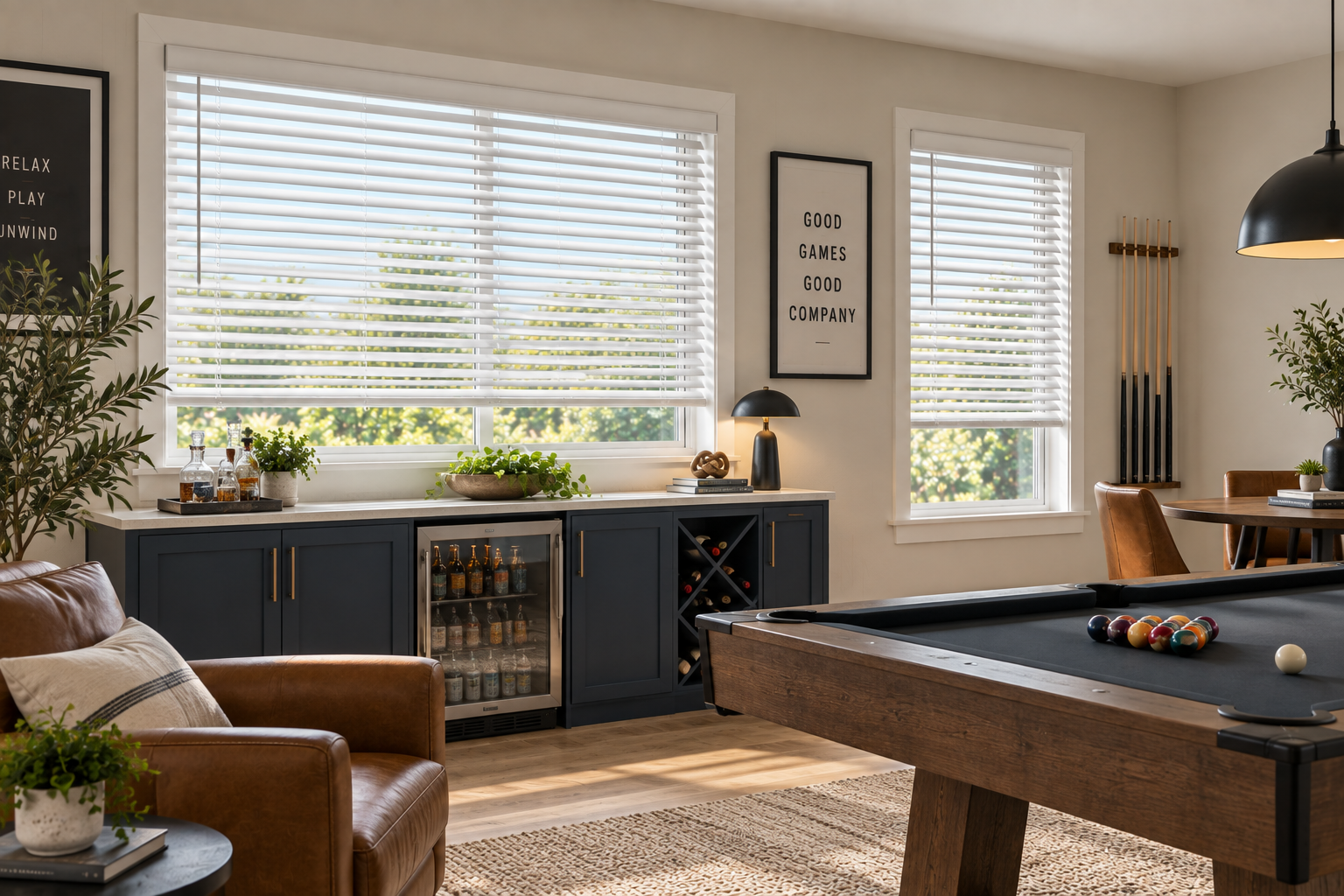
Faux wood blinds made from PVC or composite material are one of the most common recommendations we make for rental units. They resist warping and moisture far better than real wood, which matters in bathrooms and kitchens, and a cordless lift removes the safety concern for family tenants. They work in nearly every room type and hold up to normal wear without much maintenance. Browse the faux wood blinds category to compare current styles and slat sizes.
Cordless Aluminum Mini Blinds
Aluminum mini blinds are usually the lowest-cost option that still performs well, which makes them a practical pick for large multi-unit properties or secondary rooms where budget matters more than a premium look. They're lightweight, resist moisture, and are simple to install and replace. See the full range on the aluminum and vinyl mini blinds category page.
Cordless Cellular (Honeycomb) Shades
For bedrooms in a long-term rental or a vacation home, cellular shades add a meaningful upgrade: better light control, a quieter operation than slat blinds, and some insulating benefit from the honeycomb air pockets. They cost more per window than faux wood or aluminum, so many owners reserve them for bedrooms or a primary living area rather than every window in the unit. Explore options on the cellular shades category page.
When Motorized Blinds Make Sense
Motorized lift isn't a default recommendation for standard rentals, since it adds cost and one more thing that can need service. For a short-term vacation rental where you manage light and privacy remotely between guest turnovers, or a unit with keyless smart-lock check-in, motorized cellular or roller shades can be worth the added investment. If you're considering it, ask about battery life, recharging cadence, and whether a hub is required before you commit to a whole property. Explore motorized blinds and shades.
Comparing Your Main Options
| Type | Relative cost | Durability for turnover | Cordless available | Best use in a rental |
|---|---|---|---|---|
| Aluminum mini blinds | Lowest | Good | Yes | Secondary rooms, multi-unit buildings, tight budgets |
| Faux wood blinds | Low to moderate | Very good | Yes | Living rooms, kitchens, bathrooms, whole-unit standardization |
| Cellular shades | Moderate | Good | Yes | Bedrooms, vacation-home primary rooms, listing photos |
| Real wood blinds | Higher | Fair (dents, moisture-sensitive) | Yes | Higher-end long-term rentals, owner-occupied units |
Exact pricing and slat or fabric specifications vary by product and size, so check the individual product specifications before ordering at volume.
Common Mistakes Landlords and Hosts Make
Choosing the Cheapest Corded Stock Blind
The lowest-priced corded option at a big-box store often isn't compliant with current cordless safety expectations and tends to fail quickly under repeated use by different occupants. The small savings rarely offset the safety exposure and the replacement cost down the line.
Measuring One Window and Assuming the Rest Match
In older buildings especially, window openings can vary by a surprising amount unit to unit or even room to room. Ordering identical sizes across a property without measuring each opening is one of the most common causes of return requests we see from property owners. Our measuring guide walks through inside- and outside-mount measuring for exactly this reason.
Skipping Fit Protection on Bulk Orders
When you're ordering many windows at once, a measuring mistake on even one or two openings is common. Fit-guarantee programs exist specifically to make that kind of mistake inexpensive to fix rather than a full re-order.
Over-Investing in a Single Property
Premium wood blinds or fully motorized shades can be the right call for a high-end vacation rental competing on presentation, but they're often overkill for a standard long-term rental where a tenant may not notice or value the upgrade. Match the spend to what the property and rent level can actually support.
When Standard Rental Blinds Are Not the Right Fit
There are situations where the typical rental recommendation doesn't apply:
- A luxury short-term rental competing on high-end photography and guest reviews may justify real wood blinds, designer Roman shades, or motorized cellular shades despite the added cost and upkeep.
- Historic properties or units under an HOA or property-management style guide may have material or appearance restrictions that rule out certain product types.
- Units with very large or unusually shaped windows, such as bay windows or oversized sliders, may need a different product category or custom configuration rather than a standard stock choice.
- If a property has frequent long-stay tenants who treat the unit like a permanent home, some owners choose to let tenants select and pay for their own upgrade within approved guidelines rather than standardizing everything.
When any of these apply, it's worth a conversation with a design consultant before ordering in bulk.
Our Take as a Retailer That Works With Property Owners
Blinds Chalet has been selling and helping customers measure and install custom window blinds and shades since 2006, and property owners and hosts ordering for multiple units or listings are a regular part of that business. The pattern we see consistently: owners who standardize on one or two dependable product lines across a property save time on reordering, keep replacement parts simple, and spend less over several turnover cycles than owners who mix and match based on whatever is cheapest at the moment. We're not going to tell you every rental needs the most expensive option on the site, and we'll say so directly if a simpler product is the better fit for what you're outfitting.
Related Guides
- Are Aluminum Mini Blinds Worth It? Cost, Durability & Value Guide
- Pros and Cons of Faux Wood Blinds
- Made to Measure Blinds Guide
- Cordless and Motorized Vertical Blinds
- Window Treatments for Rental Units
Frequently Asked Questions
Are cordless blinds required for rental properties?
There isn't a single nationwide law requiring cordless blinds in every rental, but voluntary industry safety standards have pushed most stock and custom window coverings toward cordless or inaccessible-cord designs, and many landlords choose cordless options specifically to reduce child-safety risk and liability exposure. Check your local and state landlord-tenant regulations, since requirements can vary by jurisdiction.
What are the most durable blinds for a rental property?
Faux wood blinds and aluminum mini blinds tend to hold up best to repeated tenant or guest use because they resist moisture, don't warp, and use simple, widely available parts if something needs to be repaired or replaced.
Should I use the same blinds in every unit of a rental property?
Standardizing on one or two product lines across a property usually saves time and money over several turnover cycles, since it simplifies reordering and repairs. Just make sure to measure each window individually rather than assuming openings match, since sizes can vary even within the same building.
Are motorized blinds worth it for an Airbnb or vacation rental?
Motorized blinds can be worth the added cost for a short-term rental where you want to manage light and privacy remotely between guest stays, but they add expense and another component that can need service, so they aren't a default recommendation for every rental.
What blinds should I avoid in a rental property?
Be cautious with low-cost corded stock blinds, since many don't meet current cordless safety expectations and tend to fail quickly under repeated use by different occupants. Delicate natural materials that are sensitive to moisture or heavy handling can also be a poor fit for high-turnover units.