









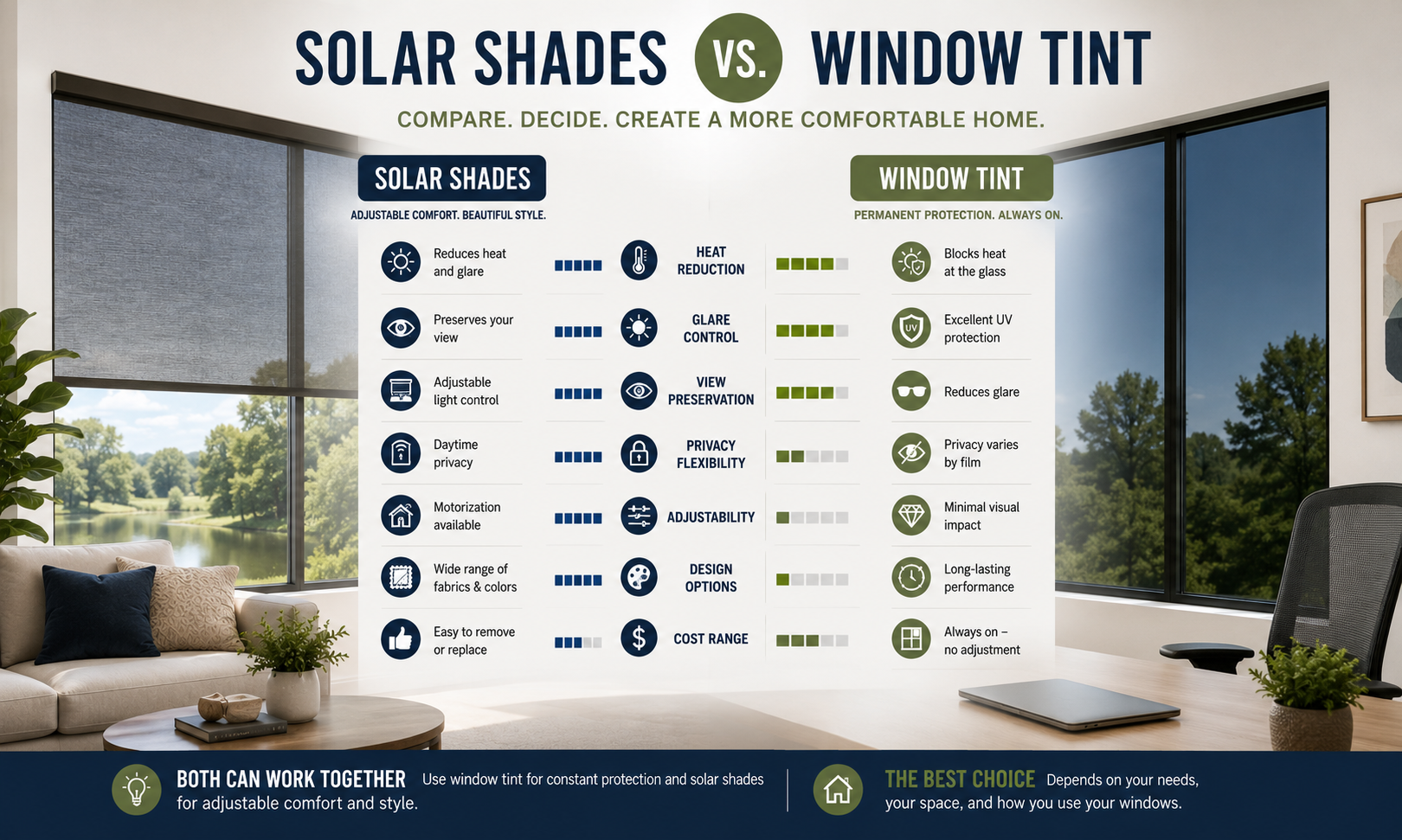
Solar Shades vs Window Tint: Which Is Better for Heat, Glare and UV Protection?
Solar shades and window tint are both popular solutions for reducing heat, glare, and UV exposure through windows. Both can help make a room more comfortable, protect furniture from fading, and reduce harsh sunlight. However, they work in very different ways.
Window tint is a film applied directly to the glass, while solar shades are fabric window coverings that roll up and down over the window. The best choice depends on whether you want a permanent glass treatment or an adjustable window covering that gives you more flexibility throughout the day.
What Are Solar Shades?
Solar shades are roller-style window shades made with screen fabrics designed to reduce glare, block UV rays, and help control heat while preserving your daytime view. The fabric openness factor determines how much light and visibility the shade allows.
Solar shades are especially popular for living rooms, offices, sunrooms, west-facing windows, and large windows where homeowners want sunlight control without completely blocking the view.
Shop our full collection of solar screen shades.
What Is Window Tint?
Window tint is a thin film applied directly to the glass. Residential window films are commonly used to reduce glare, block UV rays, and lower solar heat gain. Unlike solar shades, window tint remains in place all the time and does not raise, lower, or adjust throughout the day.
Window tint can be a good option when you want an always-on solution that does not add fabric or hardware to the window. However, because it is fixed to the glass, it does not provide the same flexibility as adjustable solar screen shades.
Solar Shades vs Window Tint Comparison
| Feature | Solar Shades | Window Tint |
|---|---|---|
| Heat Reduction | Excellent, especially with lower openness fabrics | Good to excellent, depending on film type |
| Glare Control | Excellent and adjustable | Good, but fixed |
| UV Protection | Excellent with many solar screen fabrics | Excellent with many residential films |
| Daytime View | Preserved, depending on openness factor | Preserved, depending on film darkness |
| Adjustability | Raises, lowers, and can be motorized | Fixed in place |
| Privacy | Good daytime privacy, limited nighttime privacy | Varies by film; limited nighttime privacy |
| Appearance | Adds a finished window treatment | Minimal visual change to the window |
| Blackout Option | Available by choosing blackout roller shade fabrics instead | Not typically a blackout solution |
| Smart Home Options | Available with motorized solar shades | Not applicable |
Which Reduces Heat Better?
Both solar shades and window tint can help reduce heat from the sun. Window tint works directly on the glass by filtering solar energy before it fully enters the room. Solar shades work by covering the window with a technical screen fabric that reduces solar heat gain while still allowing some view-through.
Solar shades offer the advantage of adjustability. You can lower them during the hottest part of the day and raise them when you want more natural light or a clearer view. Lower openness fabrics, such as 1% or 3%, generally provide stronger heat and glare reduction than more open fabrics.
Related guides: Best Window Treatments for Arizona Heat | Energy Efficient Window Treatments
Which Is Better for Glare Reduction?
Solar shades are often the better choice for glare reduction because they are adjustable. In rooms with televisions, computer monitors, or reflective surfaces, you can lower the shade when glare is a problem and raise it when glare is not an issue.
Window tint can also reduce glare, but the level of glare reduction is fixed. If the tint is too light, it may not provide enough glare control during intense sunlight. If it is too dark, it may make the room feel dim even when glare is not a problem.
For more help choosing glare-control window treatments, read our guide to the best window treatments for glare reduction.
Privacy Differences Between Solar Shades and Window Tint
Privacy is one of the most important differences between solar shades and window tint. Both products can provide some daytime privacy, but neither should be considered a full nighttime privacy solution by itself.
Solar Shade Privacy
Solar shades provide the best privacy during the day when it is brighter outside than inside. Lower openness fabrics, such as 1% or 3%, usually provide more daytime privacy than 5% or 10% fabrics.
At night, when lights are on inside the home, people outside may be able to see through solar screen fabrics. For nighttime privacy, consider layering solar shades with drapery or choosing a blackout or room-darkening roller shade.
Window Tint Privacy
Some window films can improve daytime privacy, especially reflective or darker films. However, window tint also becomes less private at night when interior lights are on. Because tint is fixed to the glass, it cannot be adjusted for different lighting conditions.
For more privacy options, visit our Privacy and Light Control Guides.
Which Provides Better UV Protection?
Both solar shades and window tint can help reduce UV exposure that contributes to fading of furniture, flooring, rugs, and artwork. The level of protection depends on the specific fabric or film selected.
Solar shades have the advantage of combining UV protection with a finished window treatment. Window tint has the advantage of staying in place even when no shade is lowered. If UV protection is a major concern, many homeowners use both window tint and solar shades together.
Appearance and Design Differences
Solar shades and window tint create very different looks. Solar shades add a visible window treatment to the room and are available in different fabric colors, textures, openness factors, cassette headrails, and motorized options.
Window tint has a more minimal appearance because it is applied directly to the glass. It does not add fabric, texture, or a decorative finishing element to the room. This can be a benefit if you want the window to look mostly unchanged, but it may not provide the same finished interior design appearance as custom solar shades.
Which Is Better for Different Rooms?
| Room or Area | Recommended Option | Why |
|---|---|---|
| Living Rooms | Solar Shades | Adjustable glare control, UV protection, and view preservation |
| Home Offices | Solar Shades | Better control of screen glare throughout the day |
| Sunrooms | Solar Shades or Both | Strong sunlight control with the option to raise or lower shades |
| Bedrooms | Room-Darkening or Blackout Shades | Solar shades and tint are not ideal for complete nighttime privacy or darkness |
| Media Rooms | Blackout Shades | Better light blocking for TV and movie viewing |
| West-Facing Windows | Solar Shades | Excellent for afternoon glare and heat control |
Can You Use Solar Shades and Window Tint Together?
Yes. Solar shades and window tint can be used together for additional heat reduction, UV protection, and glare control. Window tint provides a constant layer of protection at the glass, while solar shades give you adjustable control throughout the day.
This combination can be especially helpful for west-facing windows, sunrooms, Arizona homes, and rooms with strong sunlight exposure. However, even when used together, you may still need room-darkening or blackout shades if nighttime privacy or full darkness is the goal.
Solar Shades vs Window Tint: Which Should You Choose?
Choose solar shades if you want adjustable light control, glare reduction, UV protection, view preservation, motorization options, and a finished window treatment. Solar shades are usually the better choice for living rooms, offices, sunrooms, patio doors, and west-facing windows.
Choose window tint if you want an always-on glass treatment with minimal visual impact and no fabric or shade hardware. Window tint may be a good option when you do not want a visible window covering, but it offers less flexibility than solar shades.
For many homeowners, solar shades provide the better all-around solution because they can be raised, lowered, customized, and paired with other window treatments when additional privacy or room darkening is needed. Read more about the Pros and Cons of Solar Screen Shades
Related Guides
- Solar Screen Shades
- Roller Shades
- Solar Shade Buying Guides
- Guide to Solar Screen Shade Fabrics Openness
- Best Window Treatments to Reduce Glare
- Do Screen Roller Shades Provide Privacy?
- Privacy and Light Control Guides
- Blackout Window Treatments
Solar Shades vs Window Tint FAQs
Are solar shades better than window tint?
Solar shades are usually better if you want adjustable glare control, view preservation, fabric options, and motorization. Window tint may be better if you want an always-on glass treatment with minimal visual impact.
Which reduces more heat, solar shades or window tint?
Both can help reduce heat. Window tint filters solar energy at the glass, while solar shades reduce heat by covering the window with screen fabric. Lower openness solar shades generally provide stronger heat and glare reduction than more open fabrics.
Do solar shades block UV rays?
Yes. Solar shade fabrics are designed to reduce UV exposure, helping protect furniture, floors, rugs, and artwork from fading. The amount of UV protection depends on the fabric and openness factor selected.
Can you use solar shades and window tint together?
Yes. Solar shades and window tint can be used together for additional heat reduction, glare control, and UV protection. This combination is especially useful for sunny rooms, west-facing windows, and homes in hot climates.
Which provides better privacy, solar shades or window tint?
Solar shades and window tint can both provide daytime privacy, depending on lighting conditions. Neither is ideal for full nighttime privacy when interior lights are on. For nighttime privacy, choose room-darkening or blackout shades.
Does window tint eliminate glare?
Window tint can reduce glare, but it may not eliminate it completely. Solar shades provide adjustable glare control because they can be raised or lowered depending on the time of day and sun exposure.
Are solar shades worth it if my windows are already tinted?
Yes. Solar shades can still be useful on tinted windows because they provide adjustable glare control, added comfort, a finished appearance, and the option to raise or lower the shade as lighting conditions change.
Which is easier to replace, solar shades or window tint?
Solar shades are generally easier to replace or update because they are mounted over the window. Window tint must be removed from the glass and replaced with new film if you want a different look or performance level.
Manage heat and UV exposure with our range of solar screen shades ideal for rooms with direct sunlight and large windows.
Learn how different fabrics and openness factors work in our solar shades buying guides and expert advice where you’ll find in-depth guides and comparisons.