









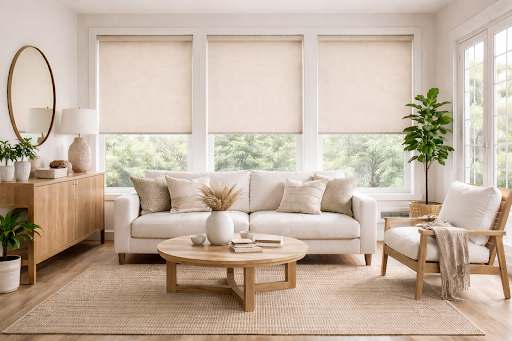
When comparing roller vs cellular shades, you’re choosing between two popular window treatments with very different strengths. Roller shades offer a sleek, modern profile with smooth operation and a wide range of fabric options and filtration, such as blackout materials. Cellular shades, also known as honeycomb shades, are designed with insulating air pockets that improve energy efficiency and help regulate indoor temperatures year-round. Understanding how each option performs in terms of light control, privacy, style, and cost will help you select the right shade for your space and lifestyle.
What Are Roller Shades?
Roller shades are sleek window coverings made from a single piece of fabric that rolls onto a tube at the top of the window. When lowered, the fabric forms a smooth, clean panel that complements modern and minimalist interiors.
Roller shades are available in light-filtering, blackout, and screen fabrics that help reduce glare and block harmful UV rays. They can be customized with cordless or motorized lift systems, making them ideal for living rooms, offices, and large windows.
What Are Cellular Shades?
Cellular shades, also known as honeycomb shades, feature pleated fabric that forms insulating air pockets. These cells trap air and create a thermal barrier between your window and your room.
Available in single-cell and double-cell designs, cellular shades offer exceptional insulation and energy efficiency. They also come in light-filtering and blackout options, with upgrades like top-down bottom-up operation for enhanced privacy and light control.
Roller Shades vs Cellular Shades: Quick Comparison
| Feature | Roller Shades | Cellular Shades |
|---|---|---|
| Appearance | Sleek, smooth and modern | Soft, pleated honeycomb appearance |
| Energy Efficiency | Moderate; helps control sunlight and glare | Excellent; honeycomb cells help slow heat transfer |
| Blackout | Excellent with blackout fabric | Excellent with blackout fabric plus added insulation |
| Privacy | Depends heavily on fabric type | Very good, with light-filtering and blackout options |
| Outside View | Available with solar/screen fabrics that preserve daytime views | No direct outward view when the shade is lowered |
| Large Windows | Excellent; compact roll and clean appearance | Very good, subject to product size limits |
| Cleaning | Generally easier because of the smooth surface | Requires more careful dusting or vacuuming around the cells |
| Top-Down Bottom-Up | Generally not available | Commonly available |
| Motorization | Widely available | Widely available |
| Typical Cost | Basic styles are often more economical | Often higher due to cellular construction and available upgrades |
| Best For | Modern style, large windows, easy maintenance and view-through fabrics | Insulation, privacy, bedrooms and top-down bottom-up operation |
Key Comparison Factors
Energy Efficiency and Insulation
Cellular shades provide superior insulation thanks to their honeycomb construction. The trapped air reduces heat transfer, helping maintain indoor comfort and potentially lowering heating and cooling costs.
Roller shades reduce glare and UV heat gain but do not offer the same insulation benefits as cellular designs.
Light Control and Privacy
Roller shades offer flexible light control through various fabric choices, especially blackout materials. However, some screen fabrics may allow visibility into the home at night when lights are on.
Cellular shades provide stronger privacy options, particularly with blackout fabrics. With top-down bottom-up functionality, you can allow natural light from above while maintaining privacy below.
Cost Considerations
Basic roller shades are typically more budget-friendly than cellular shades. Their simple construction often makes them a cost-effective solution for covering multiple windows.
Cellular shades generally cost more due to their multi-layer design and energy-saving benefits. However, long-term insulation performance may help offset the higher upfront investment.
Durability and Maintenance
Roller shades are easy to maintain due to their smooth surface. Light dusting or gentle wiping usually keeps them looking clean.
Cellular shades require more delicate care, as dust can collect within the pleats. Gentle vacuuming with a brush attachment is recommended for maintenance.
Pros and Cons Analysis
Roller Shades: Advantages and Disadvantages
Advantages:
- Sleek, modern appearance
- Wide variety of fabrics and colors
- Ideal for large windows
- Easy to clean
- Lower upfront cost
- Compact stack when raised
Disadvantages:
- Minimal insulation compared to cellular shades
- Screen fabrics may provide limited nighttime privacy
- Less sound absorption
Cellular Shades: Advantages and Disadvantages
Advantages:
- Superior energy efficiency
- Excellent privacy options
- Top-down bottom-up flexibility
- Sound dampening properties
- Strong blackout performance
Disadvantages:
- Higher initial cost
- Taller stack height when raised
- More delicate cleaning process
- No outward visibility when closed
Quick recommendation: Choose roller shades when you want a clean modern look, large-window coverage or the option to preserve an outside view. Choose cellular shades when insulation, privacy and energy efficiency are higher priorities.
Which Is More Energy Efficient: Roller or Cellular Shades?
Cellular shades are generally the better choice for insulation. Their honeycomb-shaped cells create pockets of air between the window and the room, helping slow heat transfer through the glass.
Roller shades can still help reduce solar heat gain by blocking or filtering direct sunlight, especially when solar or blackout fabrics are used. However, a standard roller shade does not create the same insulating air pockets as a cellular shade.
If your main goal is improving comfort around hot or cold windows, cellular shades usually have the advantage. If glare and direct sunlight are the bigger problem, roller shades may provide the right balance of solar control, appearance and view.
Which Is Better for Privacy?
Both roller and cellular shades can provide excellent privacy, but the result depends on the fabric and how you want to use the window.
Cellular shades generally provide strong privacy when lowered because the fabric blocks a direct view through the window. Top-down bottom-up cellular shades offer an additional advantage by allowing daylight through the upper portion of the window while keeping the lower portion covered.
Roller shades offer more variation. Light-filtering and blackout fabrics can provide strong privacy, while solar or screen fabrics are designed to preserve some outward visibility. Those open-weave fabrics usually do not provide reliable nighttime privacy when interior lights are on.
If privacy is the main priority, cellular shades are often the simpler choice. If preserving a daytime view is important, roller solar shades offer an option cellular shades cannot.
Which Is Better for Large Windows?
Roller shades are often an excellent choice for large windows because the fabric rolls compactly onto a tube rather than creating a large folded stack at the top of the window.
Cellular shades can also work well on large windows, but the maximum available size varies by product, fabric and operating system. Larger cellular shades can also create a taller stack when fully raised.
For especially large or wide windows, check the maximum dimensions of the specific product before ordering. Motorization can also make either shade type easier to operate on oversized or hard-to-reach windows.
If maintaining a minimal profile and maximizing the exposed glass when the shade is raised are priorities, roller shades usually have the advantage.
Which Is Easier to Clean?
Roller shades are generally easier to maintain because they have a relatively smooth fabric surface. Regular dusting or gentle vacuuming is usually enough for routine care, depending on the fabric.
Cellular shades require a little more attention because dust can collect along the pleats or inside the honeycomb cells. A vacuum with a soft brush attachment or light dusting is usually recommended.
If easy maintenance is one of your highest priorities, roller shades typically have the advantage.
Which Shade Type Should You Choose?
Choose roller shades if you want a streamlined look with flexible fabric choices that preserve daytime views. They’re perfect for contemporary interiors and large window areas.
Choose cellular shades if insulation, energy efficiency, and privacy are your top priorities. They are especially effective in bedrooms, nurseries, and climates with extreme temperatures.
Still unsure? Browse our full collection of window shades to compare styles and find the perfect fit for your home.
Should You Choose Roller Shades or Cellular Shades?
Choose Roller Shades If...
- You prefer a clean, contemporary appearance.
- You have large or wide windows.
- You want solar fabric that preserves some daytime view.
- Easy cleaning and maintenance are important.
- You want a compact shade when fully raised.
- You are looking for a potentially lower-cost basic option.
Choose Cellular Shades If...
- Energy efficiency and insulation are important.
- You want strong privacy without adjustable slats.
- You want top-down bottom-up operation.
- You need blackout for a bedroom or nursery.
- You want a softer, more textured fabric appearance.
- You have windows that feel especially hot or cold.
There is no single winner for every room. Roller shades tend to perform best when style, view and simple operation are the priorities, while cellular shades are stronger when insulation and privacy matter most.
Which Shade Has the Better Look for Your Home?
Roller shades have a smooth, streamlined appearance that works especially well in modern, contemporary and minimalist interiors. Their simple construction also allows for a wide variety of colors, textures, patterns and decorative fabrics.
Cellular shades have a softer, pleated appearance created by their honeycomb construction. They work well in both traditional and contemporary spaces and are a good choice when you want the window treatment to provide texture without becoming a major decorative focal point.
Choose roller shades if you prefer a cleaner, flatter profile and more decorative fabric choices. Choose cellular shades if you prefer a softer appearance and place greater value on insulation and privacy.
Which Is Better for Bedrooms?
Both roller and cellular shades can work well in bedrooms, especially when paired with blackout fabrics.
Blackout roller shades are a strong choice when you want a clean, modern appearance and excellent light control. They are available in a wide variety of fabrics and can work especially well on large bedroom windows.
Blackout cellular shades combine room darkening with the added insulation of a honeycomb design, making them especially useful for bedrooms with windows that feel hot in summer or cold in winter.
If appearance and fabric variety are the priority, roller shades may be the better fit. If insulation and energy efficiency are more important, cellular shades usually have the advantage.
Blackout Roller vs Blackout Cellular Shades
Both blackout roller shades and blackout cellular shades are designed to reduce incoming light and improve privacy, but they achieve these benefits in different ways.
Blackout roller shades use opaque fabrics that help block sunlight when the shade is lowered. Their simple, low-profile design creates a sleek appearance that works especially well in modern homes and bedrooms. Many blackout roller shades are also available with side channels or cassette systems to further minimize light gaps.
Blackout cellular shades combine light-blocking fabrics with an insulating honeycomb structure that traps air inside the shade. This design helps improve energy efficiency while also reducing outside noise and enhancing room comfort.
Homeowners often choose blackout roller shades when they prioritize:
- Modern aesthetics
- Simplified operation
- Decorative fabric choices
- Minimal window profile
Blackout cellular shades are often preferred for:
- Maximum insulation
- Improved energy efficiency
- Noise reduction
- Enhanced room comfort
The best option ultimately depends on whether style and simplicity or insulation and efficiency are the higher priority for the room. Explore our collection of blackout window shades
Roller Shades vs Cellular Shades: Price Comparison
Roller shades and cellular shades are available at a wide range of price points, so the final cost depends on the specific fabric, window size, operating system and optional upgrades you choose.
Roller shades are often the more economical starting option. Their relatively simple construction can make basic light-filtering or room-darkening roller shades a good choice when you need to cover several windows while keeping costs under control.
Cellular shades often cost more because of their honeycomb construction and the additional features commonly available, such as blackout fabrics, double-cell designs and top-down bottom-up operation. However, the added insulation may provide additional value for customers concerned about energy efficiency and comfort.
| Cost Factor | Roller Shades | Cellular Shades |
|---|---|---|
| Basic Starting Price | Often lower | Often somewhat higher |
| Premium Fabrics | Can increase cost significantly | Can increase cost significantly |
| Blackout Upgrade | Available on many products | Available on many products |
| Motorization | Available and adds to the overall price | Available and adds to the overall price |
| Top-Down Bottom-Up | Generally not available | Available on many products and may increase cost |
| Insulating Value | Moderate depending on fabric | Higher due to honeycomb construction |
| Best Value For | Budget-conscious shoppers, large windows and simple light control | Shoppers prioritizing insulation, privacy and additional operating options |
Which Is the Better Value?
If your main priority is keeping the initial purchase price lower, roller shades often provide the better value, particularly with standard fabrics and operating systems.
If insulation, energy efficiency or top-down bottom-up operation are important, cellular shades may justify the higher initial cost because those features provide benefits that a standard roller shade does not.
For both shade types, premium fabrics, larger window sizes, motorization and other upgrades can have a greater impact on the final price than the shade style alone. Compare similarly configured products rather than assuming every roller shade will cost less than every cellular shade.
Can Roller and Cellular Shades Be Motorized?
Yes. Both roller shades and cellular shades are available with motorized operating systems on many products. Motorization is especially useful for large windows, hard-to-reach windows and rooms with multiple shades. Roller shades pair particularly well with motorization because of their simple rolling mechanism, while motorized cellular shades combine convenient operation with the insulating benefits of the honeycomb design. Shop our collection of motorized window shades
Explore More
Ready to explore your options? Browse our Cellular Shades collection and Roller Shades collection.
You can also explore:
- Compare Solar Screen Shades to Cellular Shades
- Guides to Cellular Shades
- Top Selling Cellular Shades
- Highest Rated Cellular Shades
- Guides to Roller Shades
- Top Selling Roller Shades
- Highest Rated Roller Shades
Roller vs Cellular Shades - Frequently Asked Questions
What is the main difference between roller shades and cellular shades?
Roller shades use a single piece of fabric that rolls onto a tube, creating a sleek, modern look. Cellular shades (also called honeycomb shades) feature pleated fabric that forms air pockets, providing superior insulation and energy efficiency.
Which is more energy efficient: roller shades or cellular shades?
Cellular shades are more energy efficient because their honeycomb structure traps air and reduces heat transfer. Roller shades offer light and glare control but provide minimal insulation compared to cellular designs.
Are roller shades or cellular shades better for privacy?
Both options offer privacy, but cellular shades provide more flexibility with light-filtering and blackout fabrics. Roller shades can provide privacy depending on the fabric selected, sheer rollers may allow visibility at night when lights are on inside.
Which shade type is better for bedrooms?
Cellular shades are often preferred for bedrooms due to their superior insulation and blackout options. Blackout roller shades are also a strong choice if you prefer a clean, minimalist look.
Do roller shades block heat?
Roller shades can reduce heat gain and block UV rays, helping control glare and protect furnishings. However, they do not insulate as effectively as cellular shades.
Are cellular shades bulky compared to roller shades?
Cellular shades have a pleated structure that creates visible folds when raised, while roller shades roll up into a compact tube. Roller shades typically have a slimmer profile at the top of the window.
Which option offers more design variety?
Roller shades offer extensive fabric choices, including screens, light filtering, blackout materials, and decorative prints. Cellular shades focus more on solid colors and subtle textures designed for energy efficiency.
Can both roller and cellular shades be motorized?
Yes. Both roller shades and cellular shades are available with cordless and motorized lift systems, including smart home integration options for convenient operation.
Which shade type is easier to clean?
Roller shades are typically easier to clean because they have a smooth fabric surface. Cellular shades require gentle dusting or vacuuming to clean between pleats.
Are roller shades more affordable than cellular shades?
Basic roller shades are often more affordable than cellular shades. However, premium fabrics, motorization, and specialty features can increase pricing for either option.
Which shade is better for large windows?
Roller shades are often ideal for large windows because of their smooth operation and minimal stack. Cellular shades also work well but may have a taller stack height when raised.
How do I choose between roller and cellular shades?
Choose roller shades if you prefer a modern aesthetic and view-through solar fabrics. Choose cellular shades if energy efficiency, insulation, and temperature control are your top priorities.
Shop Roller and Cellular Shades
Ready to compare your options?
Shop our selection of cellular shades to discover a wide range of styles designed for insulation, privacy, and light control.
You can also learn more by visiting our cellular shades guide hub for additional insights and recommendations.